Most Coffee Carts Don’t Fail on the Coffee — They Fail on the Maths
Nobody starts a coffee cart because they love spreadsheets. But the carts that survive figured out their coffee cart startup costs and break-even before they ever pulled a shot. Here’s how.
Almost nobody opens a coffee cart because they love numbers. They do it because they love coffee, and the dream of being their own boss at a sunny market on a Saturday morning. That’s a wonderful reason to start — and a terrible reason to skip the financial planning. Because here’s the hard truth the successful cart owners learn early: most carts that fail don’t fail on the coffee. The coffee is usually fine. They fail on the maths — a price that never quite covered the milk, a pitch fee that quietly ate the day’s profit, a startup bill that ran thousands over budget because nobody added it up first. Getting your coffee cart startup costs and break-even right, before you launch, is what separates the dream from the expensive lesson. Here’s how to do it.
The costs that ambush new owners
The first place coffee carts get into trouble is the startup itself. It’s very easy to think of the big obvious cost — the cart or the espresso machine — and mentally file that as “the startup cost.” But the real total is a long list of smaller items that add up frighteningly fast:
The cart or trailer and the espresso machine and grinder are just the start. Then there’s your initial stock of beans, milk, cups, lids, syrups. Licensing and permits. Food-safety registration. Insurance. Any equipment for power and water. Branding, signage, a menu board. A float of change and card-payment hardware. Each feels minor; together they can easily run to a number far higher than the “obvious” costs alone.
The owners who get ambushed are the ones who budgeted for the machine and the cart, spent up to what they could afford on those, and then discovered a long tail of necessary expenses with no money left for them. The fix is unglamorous but powerful: list every startup cost, down to the small stuff, and total it honestly before committing. A realistic startup number is far less scary when you know it in advance than when it arrives as a series of unwelcome surprises.
The number that actually matters: break-even
Once you know your startup cost, the single most important question in your whole business plan is: how many cups do you need to sell to make it back? This is your break-even, and it’s the number that turns a vague dream into a concrete plan.
Break-even reframes everything. “I want to start a coffee cart” is a wish. “I need to sell around X cups to repay my investment, and then Y cups a day to cover my running costs and make a living” is a plan — something you can actually assess. Suddenly you can ask the real questions: Is that many cups a day realistic at the markets I can get? How long until I’ve paid back my startup cost? At what point does this become genuinely profitable?
Knowing your break-even before you launch is what lets you decide, with clear eyes, whether the numbers work. Sometimes the honest answer is that they don’t — the pitch fees are too high, or the realistic cup volume is too low, and the business won’t clear its costs. That’s a hard thing to discover, but discovering it on a spreadsheet before you’ve spent your savings is a gift. Far better than discovering it three stressful months in.
Running costs are where the quiet leaks live
Break-even isn’t only about repaying startup costs — it’s about covering your ongoing running costs too, and these hide some nasty surprises for coffee carts specifically. The biggest is pitch fees: what you pay to trade at a market or event. A high pitch fee can quietly consume most of a day’s profit, turning a busy, satisfying day into one that barely broke even. Then there’s fuel to get there, licence renewals, repairs, and the cost of the coffee itself.
If you don’t have these mapped, you can be busy — pouring cups all day, feeling successful — and still not making money, because the running costs are eating everything. Plenty of cart owners have had the demoralizing realisation that a packed market day left them with almost nothing once the pitch fee and costs came out. Understanding your true running costs is what stops “busy” and “profitable” from drifting apart.
Plan first, but keep tracking after
The planning doesn’t stop at launch. The same numbers you estimated beforehand — costs, prices, cup volumes — need tracking once you’re trading, so you can see whether reality matches your plan and adjust. Your estimated break-even becomes something you check against actual sales. Your assumed costs get replaced by real ones. A plan is a starting hypothesis; tracking is how you find out if it’s true and steer accordingly. The best cart owners plan carefully and keep their numbers straight once they’re pouring.
An important note
To be clear, because this involves real money and a regulated activity: this is about organising and understanding your own numbers — it is not financial, tax, accounting, legal, or business advice, and it guarantees no result. Any figures in a template are examples only; replace them with your own real numbers. Crucially, food and drink businesses are regulated: you must check the licensing, food-safety, and insurance requirements that apply in your area, and those are your responsibility. Consult a qualified professional for tax and accounting decisions. A planning tool helps you understand the money; it can’t make the business succeed or tell you what’s legally required where you trade.
If you want the planning done for you
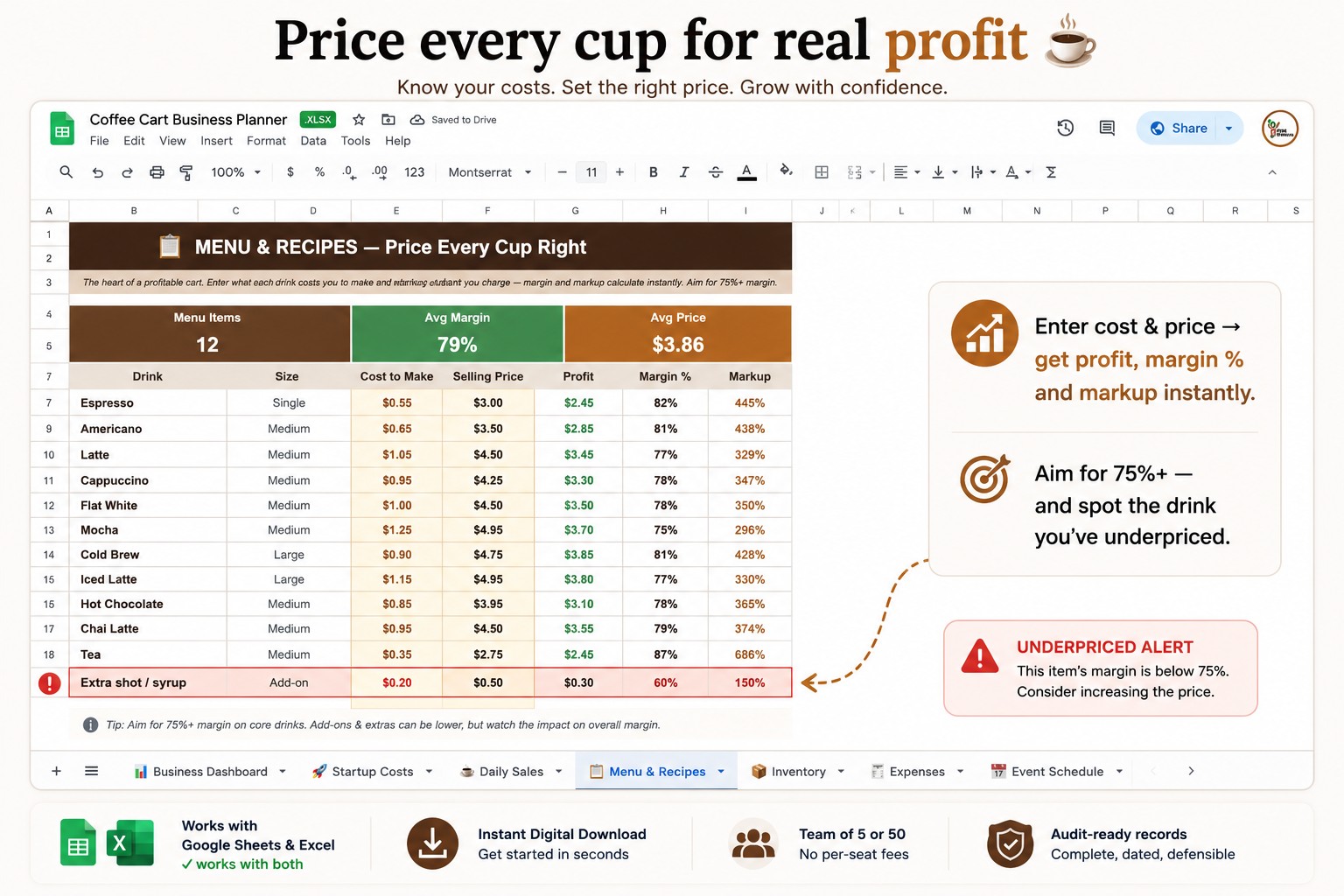
I built a coffee cart business planner in Google Sheets that handles exactly this — a startup cost planner with a break-even calculator that tells you how many cups you need to sell to repay your investment, plus daily sales, menu pricing, inventory, and a monthly P&L for once you’re trading:
👉 Coffee Cart Business Planner for Google Sheets & Excel
Whether you use mine or a notebook, do the maths before you spend the money. Total up every startup cost, work out your break-even, and map your running costs honestly. The coffee is the fun part, and if you love it, it’ll probably be great. But it’s the numbers that keep the cart open long enough for people to enjoy it. Great coffee gets them back; knowing your numbers keeps you in business.
This reflects my own perspective and is a planning tool — not financial, tax, accounting, legal or business advice, and it guarantees no result; figures are examples, and licensing/food-safety/insurance requirements are your responsibility to check. Are you planning a coffee cart or already running one? Tell me where you’re at in the comments.