The Second Job Nobody Warned You About
You signed up to teach your children — and you do, and it’s wonderful. Nobody mentioned you’d also be the registrar. Here’s how to make homeschool record keeping something you build as you go, not something you reconstruct in a panic.
Somewhere behind the reading lessons and the kitchen-table science, there’s a job nobody puts in the brochure. How many days have we actually done? How many hours? Which book did she read in October? Where did I put that handwriting sample? And then the question that arrives with a cold jolt sometime in spring: if someone asked me for records tomorrow, could I actually produce them? Multiply that by three children and eleven subjects and a whole school year, and it’s no wonder most homeschool records live in three notebooks, a phone camera roll, and a great deal of hope. Homeschool record keeping doesn’t have to be like that — but the fix isn’t working harder in April. It’s a small habit in September. Here’s what actually helps.
Why reconstruction never works
The default approach — teach all year, then assemble records when you need them — fails for a reason that has nothing to do with effort. Records are made of details that decay: exact dates, hours, which child did what, which book was finished when. Those details are perfectly available on the day and almost entirely gone three months later.
So reconstruction becomes guesswork dressed up as documentation. You count backwards through a calendar trying to remember which days you actually did school. You estimate hours. You go through your camera roll looking for evidence of that science project. It takes hours, it’s stressful, and the result is less accurate than a rough note made on the day would have been.
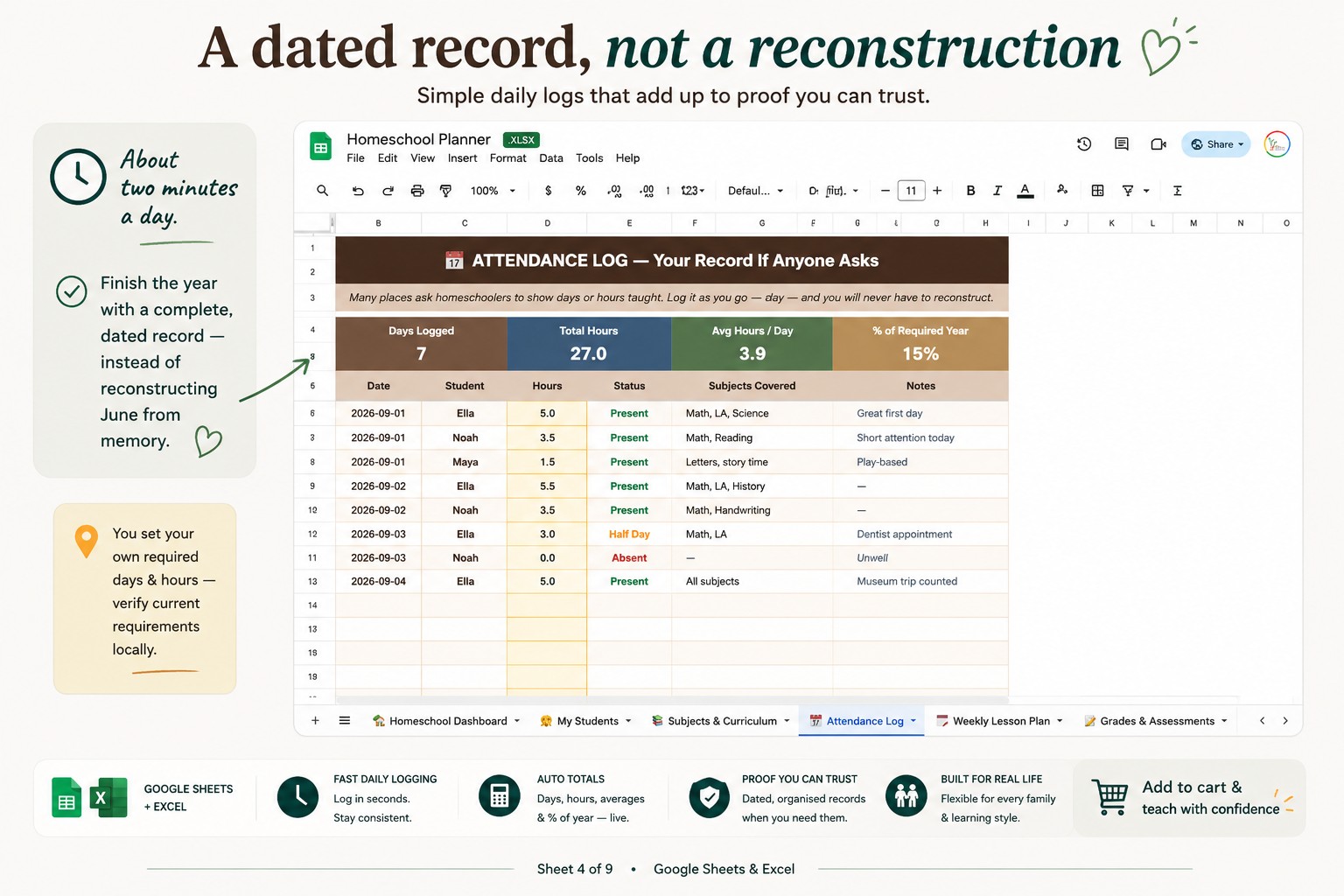
The alternative isn’t more work overall — it’s the same work, moved to when it costs almost nothing. Logging the day takes about two minutes while it’s fresh. Reconstructing the same day in April takes far longer and produces something worse.
Log the boring things daily; they’re what you’ll actually need
The unglamorous items are the ones that matter most when records are requested: days and hours. Wherever you are, some measure of “did school happen, and how much” is usually what’s counted — and it’s the single hardest thing to reconstruct, because one Tuesday in November is indistinguishable from another in hindsight.
A daily line — date, child, hours, and whether it was a full day, half day, or a day off — accumulates into something genuinely valuable: a complete, dated record you didn’t have to think about. Half days especially deserve to be recorded honestly rather than guessed at later, because they’re common in homeschooling and they add up.
The bonus is that once it’s logged, the derived numbers come free: total days, days remaining against whatever target applies to you, total hours, average hours per day. Those are exactly the figures you’d otherwise be frantically calculating, and they’re also genuinely useful during the year for knowing where you stand.
Portfolios are built, not assembled
The second thing that’s much easier continuously than retrospectively is the portfolio — work samples, projects, co-op classes, field trips. Two problems make retrospective assembly painful.
First, you forget what you did. A field trip in October is a lovely memory by March and an undocumented one by June. The small, ordinary-seeming projects that would actually demonstrate a year of learning are exactly the ones that vanish from memory.
Second — and this one catches everyone — you can’t find the physical items. You kept the writing sample. You know you kept it. It’s somewhere. This is why a “where it’s stored” note next to each entry is one of those small ideas that saves a disproportionate amount of grief. Logging that the sample is in the blue folder in the study, on the day you file it, is the difference between producing it in two minutes and searching the house for an afternoon.
Reading logs work the same way. Books read across a year are impossible to recall completely, and a running list requires seconds per entry. And it’s worth logging read-alouds and audiobooks alongside independent reading — they’re all part of the learning that happened, and a record that only counts one kind understates your year.
Multiple children: one system, not several
If you’re teaching more than one child, the organisational challenge multiplies faster than the number of children — different subjects, different levels, different paces, all needing separate records.
The instinct is a separate notebook or file per child. It’s understandable and it creates a specific problem: you now maintain several parallel systems, nothing gives you a family-wide view, and the duplicated effort makes the whole thing more likely to be abandoned by November.
One system with children as a dimension — rather than several systems — is far more sustainable. You record each child once, and everything after that organises by child automatically. You get both views: how each child is doing, and how the family’s year is going overall. Same information, a fraction of the maintenance.
An honest note about requirements
I want to be very clear here, because this is where a lot of homeschool products overpromise. No planner, template, or system — mine or anyone’s — can guarantee that your records will satisfy any authority. Homeschooling requirements differ enormously by country, state, and province, and they change over time. Anyone promising compliance is promising something they can’t deliver.
What organised records do give you is a complete, dated, honest account of what you did — which puts you in a far better position than reconstruction and hope. But knowing and meeting the rules that apply where you live is your responsibility, and the authoritative sources are your local education authority and reputable homeschool organisations in your area. Please check with them, and check again occasionally, because requirements move.
This is an organisation tool, not legal, educational, curriculum, or compliance advice.
Two minutes a day beats a week in April
The whole argument comes down to that trade. Two minutes at the end of the day, logging what happened while you still remember it, versus a stressful week trying to rebuild the year from a camera roll — and ending up with something less accurate anyway.
The small daily habit also has a quieter benefit: it removes the low-grade dread. That spring “could I produce records tomorrow?” jolt only happens to people who don’t know the answer. When you’ve been logging along, the answer is simply yes, and you stop carrying the worry.
If you want it set up for you
I built a homeschool planner in Google Sheets to hold all of this in one place — attendance and hours with your own required days and hours, a reading log, a portfolio and field-trip log with a “where it’s stored” column, grades, and curriculum progress, all organised by child so one file covers your whole family:
👉 Homeschool Planner for Google Sheets & Excel
Whether you use mine or a notebook by the kitchen table, start logging in September rather than assembling in April. You signed up to teach your children, not to be an archivist — so make the archive build itself, two minutes at a time. Teach more, chase paperwork less. 🏡
This reflects my own perspective and is an organisation tool — NOT legal, educational, curriculum or compliance advice, and it does not guarantee your records will satisfy any authority. Requirements vary widely and change; always verify current rules with your local education authority. What’s the record you were most glad you’d kept? Tell me in the comments — a first-year family will thank you.