The 15-Minute Reset for the Days It All Feels Impossible
Some days the tiny-step trick isn’t enough and the whole house feels like a wall. Here’s the timer-based rescue that breaks cleaning paralysis — and why being allowed to stop is the important part.
There are days when even the good strategies don’t reach you. You know the task should be broken down. You know a five-minute win would help. And you still can’t move, because the mess has crossed some threshold where looking at it produces a kind of static — too much, everywhere, no idea where to begin, and a growing certainty that whatever you do won’t make a dent. That’s cleaning paralysis, and it’s one of the most demoralising ADHD experiences precisely because you can see exactly what needs doing while being unable to do any of it. What works on those days isn’t a better to-do list. It’s a small, finite, timed rescue mission — and permission to stop when it’s done. Here’s how that works.
Why “everything” is the problem
The reason paralysis hits hardest when things are worst is that the task has become effectively infinite. When one room is untidy, the job has edges: you can imagine finishing it. When the whole house has drifted, there are no edges — every room needs something, everything connects to everything else, and there’s no visible end point.
An infinite task is unstartable. Your brain does a quick, unconscious cost estimate, gets back “this will never end,” and refuses to begin. That’s not irrational; it’s a reasonable response to an unbounded demand from a brain that’s already running low.
Which points straight at the fix: put edges back on. Not by making the task smaller in importance, but by making it finite — a specific action, for a specific short time, after which you are genuinely, explicitly done.
The mission format: small, specific, timed, finite
A reset mission is a pre-written, fifteen-minute rescue plan. The pre-written part matters as much as the fifteen minutes, because on a paralysed day, deciding what to do is itself one of the things you can’t do. Choosing from a short list of ready-made missions removes that decision entirely.
The classic ones are effective precisely because they’re narrow and mechanical:
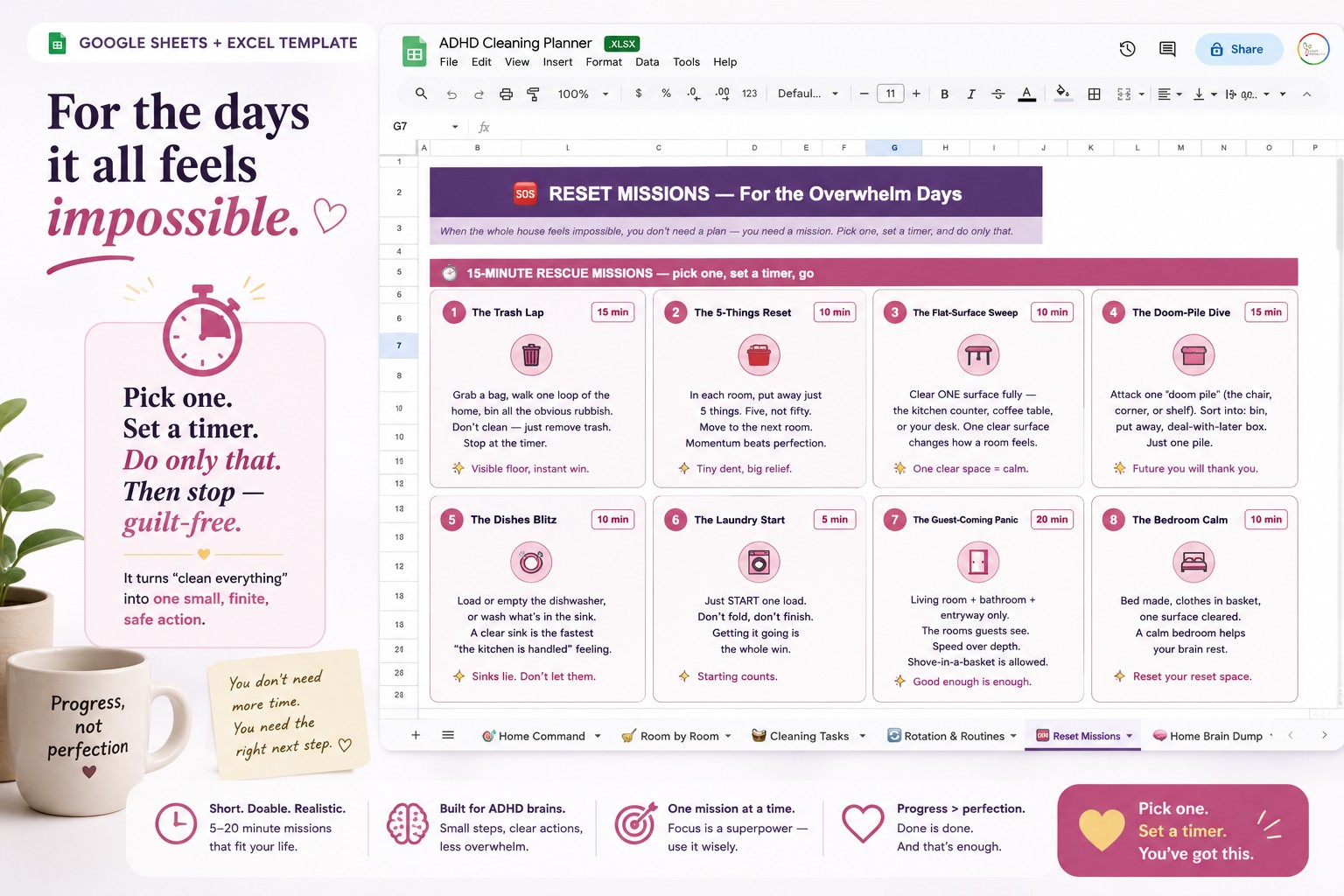
The Trash Lap. One loop around the house with a bin bag, collecting only the obvious rubbish. Nothing else. It’s mindless, requires zero decisions, and makes a visible difference fast — which is exactly what a paralysed brain needs to believe the effort is worth it.
The 5-Things Reset. Put away just five things in each room. Not tidy the room — five things. Then move on. It spreads a small, achievable improvement across the whole house, so nowhere feels untouched.
The Doom-Pile Dive. Fifteen minutes on the one pile that’s been silently accumulating on the chair. Not finishing it necessarily — just fifteen minutes at it.
What all of these share: no planning, no decisions, a clear rule, a visible result, and a hard stop.
The timer is doing real work
Setting an actual timer isn’t a gimmick. It changes the psychology of the task in three ways.
It caps the commitment. You’re not agreeing to clean the house; you’re agreeing to fifteen minutes. That’s a much smaller thing to say yes to, and your brain evaluates it accordingly.
It creates a little urgency. ADHD brains respond to urgency, and a visible countdown supplies some artificially — which is often exactly the ingredient that was missing.
It removes the ambiguity about “done.” Without a timer, cleaning ends when it’s “finished,” which is undefined and therefore never. With one, done is a moment that arrives whether or not the house is perfect. That certainty is what makes starting feel safe.
Being allowed to stop is the whole point
Here’s the part people skip, and it’s the most important: when the timer goes, you stop, and you don’t feel bad about it.
This matters for a practical reason. If reset missions secretly become “a trick to get me started so I clean for two hours,” your brain will learn that, and next time it will refuse to begin — because the fifteen-minute promise wasn’t true. The commitment has to be real for it to keep working.
If you happen to feel like continuing, that’s fine and lovely. But it must be genuinely optional. The mission was fifteen minutes; fifteen minutes were done; that is a complete success. Guilt about not doing more is exactly the thing that turns a workable strategy into another source of shame.
And a fifteen-minute improvement is real. Not a transformed house — but a bagged pile of rubbish, or five things away in each room, and crucially a break in the paralysis. Tomorrow’s version of you is starting from a slightly better place, and from the knowledge that starting was possible.
When it falls apart again — and it will
One last thing, because this is where people quit for good. At some point the system will lapse. A hard week happens, nothing gets done, and things drift back. That is normal and expected, not evidence that you failed or that the approach doesn’t work for you.
The healthy response is simply to forgive the lapse and do one tiny thing — one mission, one five-minute win. No audit of how long it’s been, no penance, no “I have to catch up on everything first.” The shame spiral after a lapse does far more damage than the lapse itself; it’s what turns a two-week gap into a six-month one. You’re not starting over. You’re just starting again, which you’re allowed to do as many times as you need.
An important, caring note
Please note: this is about organisation and self-compassion — it is not medical, psychological, or therapeutic advice, is not a treatment for ADHD or any condition, and guarantees no result. It doesn’t replace support from a doctor or therapist. If your home, clutter, or overwhelm feels genuinely unmanageable or distressing, or if it’s affecting your wellbeing or safety, please reach out to a qualified professional or someone you trust. You deserve support with that, and asking for it is a strength.
If you want the missions ready to go
I built eight fifteen-minute Reset Missions into my ADHD cleaning planner in Google Sheets — the Trash Lap, the 5-Things Reset, the Doom-Pile Dive and more, ready to pick on a bad day, alongside tasks broken into tiny next steps and filtered by your energy:
👉 ADHD Cleaning Planner for Google Sheets & Excel
Whether you use mine or invent your own, keep a couple of missions written down for the bad days — because writing them requires decisions you won’t have available when you need them. Pick one, set a timer, do only that, then stop. Done beats perfect, fifteen minutes beats nothing, and you’re allowed to start again as many times as it takes. 🧡
This reflects ADHD-friendly organising principles — not medical, psychological or therapeutic advice, not a treatment for any condition, and it guarantees no result. If overwhelm feels unmanageable, please reach out to a qualified professional or someone you trust. What’s your 15-minute rescue when everything feels impossible? Share it in the comments.