Makers Don’t Undercharge on Materials. They Undercharge on Themselves.
You know what the fabric cost. You know what the thread cost. What you don’t know is what you’re actually earning per hour — and that’s the number that decides whether this is a business.
Almost every maker prices the same way. You know what the materials cost, because you bought them. You add a bit on top. You look at what similar shops are charging, take a breath, and set a price that feels about right. It’s not unreasonable — it’s what everyone does. But there’s a whole category of cost sitting outside that calculation, and it’s the biggest one: your time. Working out how to price handmade items properly means counting all of it, not just the making — and for most makers, doing that for the first time is genuinely startling. Here’s what’s missing.
The hours nobody counts
Ask a maker how long a product takes and they’ll tell you the making time. The cutting and sewing. The pouring and curing. The hours at the bench. That’s the part that feels like work, so that’s the part that gets counted.
Now list everything else that happened for that product to reach a customer:
- Photographing it, editing the photos, and re-shooting the one that didn’t work
- Writing the listing description and the tags
- Answering the message asking about shipping
- The trip to buy more thread, and the time spent choosing it
- Packing it, printing the label, taking it to the post office
- Bookkeeping, admin, updating stock, chasing a supplier
- The Saturday at the craft fair — setup, the day itself, the packing down
None of that is optional and none of it is free. It’s all time you spent so that item could sell, and if it isn’t in your price, you’re doing it for nothing. For many handmade businesses, the non-making time is comparable to the making time — sometimes more.
This is why so many makers describe being busy but broke. They’re working constantly and the money doesn’t reflect it, because a large share of the work was never priced.
Overhead: the costs that aren’t materials either
There’s a second invisible category. Your business has costs that don’t attach to any single product: subscriptions, insurance, a website, ads, equipment that wears out and needs replacing, the tools you bought once.
These are real money, and they have to come out of your sales — but because they don’t belong to any particular item, they usually get paid out of “whatever’s left” rather than being priced in. That means every sale is quietly under-covering them.
The standard way to handle this is to work out your overhead per working hour: total your monthly business costs, divide by the hours you actually work in the business (honestly — including the admin), and you get a small per-hour figure that can be added to every product alongside your labour. It’s not glamorous arithmetic, but it means each product carries its fair share of keeping the business alive, and the overhead stops eating the profit you thought you’d made.
And a small one that gets forgotten constantly: packaging and branding are materials. The box, the tissue, the sticker, the thank-you card, the ribbon. They’re per-item costs and they belong in the item’s cost, not in a vague sense of “business expenses.”
Choosing an hourly rate (the uncomfortable bit)
Once you accept your time belongs in the price, you have to put a number on it — and this is where makers get stuck, because it feels presumptuous.
The useful framing: pick the rate you’d need to earn for this to be worth doing instead of a job somewhere else. Not what you think customers will tolerate. Those are different questions, and mixing them up is exactly how makers end up working for less than minimum wage while feeling guilty about their prices.
Many people start at around their local minimum wage, purely as a floor, and discover that even that produces prices meaningfully higher than they’ve been charging. That discovery is uncomfortable and it’s the entire point of the exercise. You’re not being greedy; you were previously being unpaid.
One more thing worth saying, because pricing carries a lot of emotion for makers: charging properly for your time isn’t arrogance, and low prices aren’t humility. They’re just an inaccurate calculation — one you can correct without becoming a different person.
Buy in packs, use in pieces
A practical costing point that trips everyone up: you buy materials in packs, rolls, sheets and bottles, but you use them in pieces, metres, grams and millilitres.
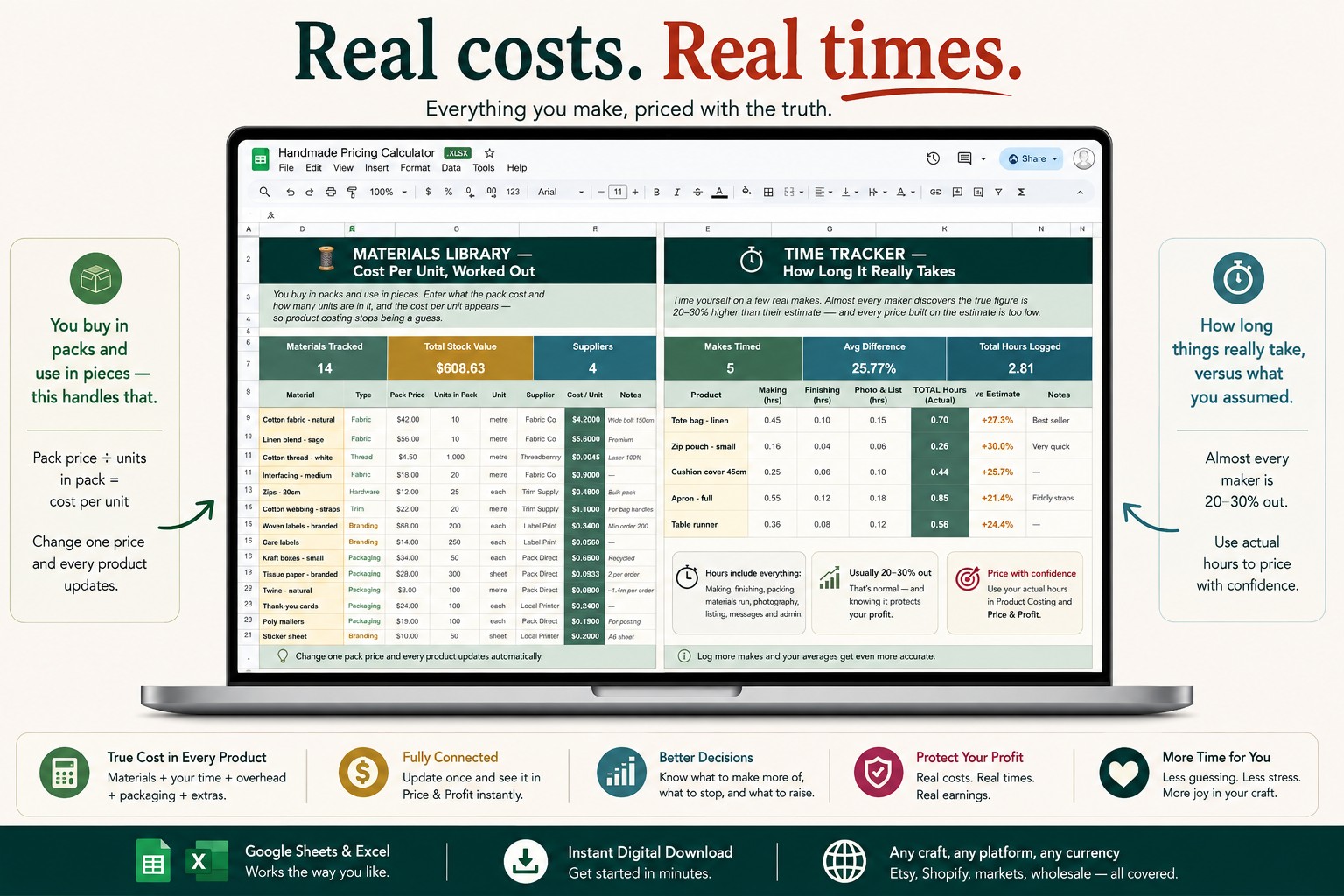
If you cost a product by guessing “a bit of fabric, some thread,” you’ll be wrong, and usually wrong low. Working out the cost per unit for each material once — pack price divided by how many units are in the pack — means every product’s material cost is accurate and, importantly, updatable. When a supplier’s price goes up, you change one number and every product that uses it recalculates. That’s the difference between pricing you can maintain and pricing that quietly goes stale as costs rise around you.
And then the fees come off
The last bite is the platform’s. Whatever marketplace you sell through takes something from every sale — a listing fee, a percentage of the transaction, a payment processing cut. It comes off after the customer pays, which makes it psychologically easy to overlook when setting a price.
Two things matter here. Include it in the calculation, and use your own current rates — fee structures change, and they vary by country, category and seller. Never rely on a figure someone quoted in an article (including this one, which is why I haven’t quoted any). Check what your platform actually charges you today and put that number in.
Once fees are in, you finally have the honest chain: materials + your time + overhead + packaging → true cost → your price → minus fees → what you actually keep. Divided by the hours it took, that’s your real hourly earnings — the number this whole exercise exists to reveal.
An important note
To be clear: this is a general explanation and a way of organising your own figures. It is not financial, accounting, tax, legal, or business advice, and it guarantees no result. Any figures mentioned are illustrative; yours will differ. Platform and payment fee rates change and vary — always check your own platform’s current rates. Pricing multipliers are widely used conventions, not rules, and the right price depends on your market, your product and where you sit in it. Consult a qualified accountant or business adviser about your own circumstances.
If you want the maths done for you
I built a handmade pricing calculator in Google Sheets that handles this chain — a materials library that turns pack prices into cost per unit, an overhead-per-working-hour calculation, your hourly rate applied automatically to each product’s make time, editable platform fees, and the profit per hour that falls out at the end:
👉 Handmade Pricing Calculator for Google Sheets & Excel
Whether you use mine or a calculator and an honest afternoon, count all your time. The materials were never the expensive part — you were. Price accordingly, and the business you’ve been running at a quiet loss might turn out to be a real one. Stop working for free. 🏷️
This reflects my own perspective and describes a costing tool — NOT financial, accounting or business advice, and it guarantees no result; figures are illustrative and platform fees vary, so use your own current rates. Makers: what’s the task you never used to count in your pricing? Tell me in the comments.