“Clean the Kitchen” Isn’t One Task. It’s Thirty.
You can see the mess. It stresses you out. And you still can’t make yourself start. Here’s why cleaning with ADHD is an executive-function problem — not a laziness one.
There’s a particular cruelty to a messy home when you have ADHD. It isn’t that you don’t notice or don’t care — you notice constantly, and it stresses you out every time you walk past it. It’s that noticing changes nothing. You can be sitting in a room that’s actively bothering you, fully aware of what needs doing, and still find yourself unable to start. Then the guilt arrives on top of the mess, which makes the whole thing heavier, which makes starting even harder. If that’s familiar, please hear this first: cleaning with ADHD being difficult is not a character flaw or a willpower deficiency. It’s a predictable consequence of how the task is structured versus how your brain works. Here’s the mechanism, and what actually helps.
The wall your brain freezes at
Here’s what “clean the kitchen” actually is, unpacked: clear the counters, but first decide where each item goes, and some of them don’t have a home so you have to make a decision about each one. Wash up, or load the dishwasher, but it needs emptying first. Wipe surfaces, which means moving everything again. Deal with the bin. Sweep the floor. Put away the things that belong in other rooms, which will take you into other rooms.
That’s not one task — it’s dozens of small actions, many of which require decisions, arranged in an order that isn’t obvious and with no clear stopping point. Your brain, faced with that, does something quite reasonable: it can’t find a handle to grab, gets overwhelmed by the scale and ambiguity, and freezes.
This is executive dysfunction, and it’s specifically a problem of initiation, not effort. Once you’ve started, you can often keep going for an hour. The wall isn’t the work; it’s the gap between not-doing and doing. That’s why “just do it” advice bounces off so uselessly — it addresses a motivation problem you don’t have.
The tiny next step
The fix follows directly from the diagnosis: if the problem is that the task is too big and too vague to start, make the first step small and specific enough that it doesn’t trigger the freeze.
Not “clean the kitchen.” “Put five things away.” Not “tidy the living room.” “Clear the coffee table.” Not “deal with the laundry.” “Move the wet washing to the dryer.”
A small enough step slips under your brain’s threshold for overwhelm. There’s nothing to evaluate, no plan required, no ambiguity about what “done” means. And then the powerful thing happens: momentum. Having started, you very often continue — you put five things away and find yourself doing another ten, because the barrier was never the work, it was the beginning.
But — and this matters — even if you stop after the five things, that still counts. That’s five things away that weren’t before. The point of the tiny step isn’t to trick you into a deep clean. It’s to make progress possible on days when the alternative was nothing at all.
Match the task to the energy you actually have
The second thing that makes a real difference is accepting that your capacity varies wildly, and planning for that rather than against it.
Most cleaning schedules assume a consistent person who can do the assigned task on the assigned day. ADHD capacity doesn’t work like that. Some days you could clean for two hours; other days putting a mug in the sink feels like climbing a hill. A rigid schedule breaks on the first bad day — and worse, breaking it usually triggers the shame spiral that ends with the whole system abandoned.
A far kinder structure is a menu rather than a schedule: a list of tasks tagged by how long they take and how much energy they need, so you pick what fits today. Got fifteen good minutes? Take something from the medium list. Running on empty? There’s a whole set of under-five-minute wins available, and doing one of those on a hard day is genuinely a success.
This does two things at once: it means bad days still produce something, and it removes the guilt of “not doing the thing I was supposed to do today” — because there was no assigned thing, only options.
Start anywhere, not everywhere
A related trap is feeling you must clean the whole house, in order, or it doesn’t count. That framing guarantees paralysis, because “the whole house” is exactly the overwhelming wall again.
Permission to start anywhere helps enormously. Pick the room that’s bothering you most, or — equally valid — the one that’s quickest to fix. Both are good choices, for different reasons: the worst room gives the biggest relief, the easiest room gives you a win and some momentum. There’s no correct order, and choosing based on what you can actually face today is a sensible strategy, not a cop-out.
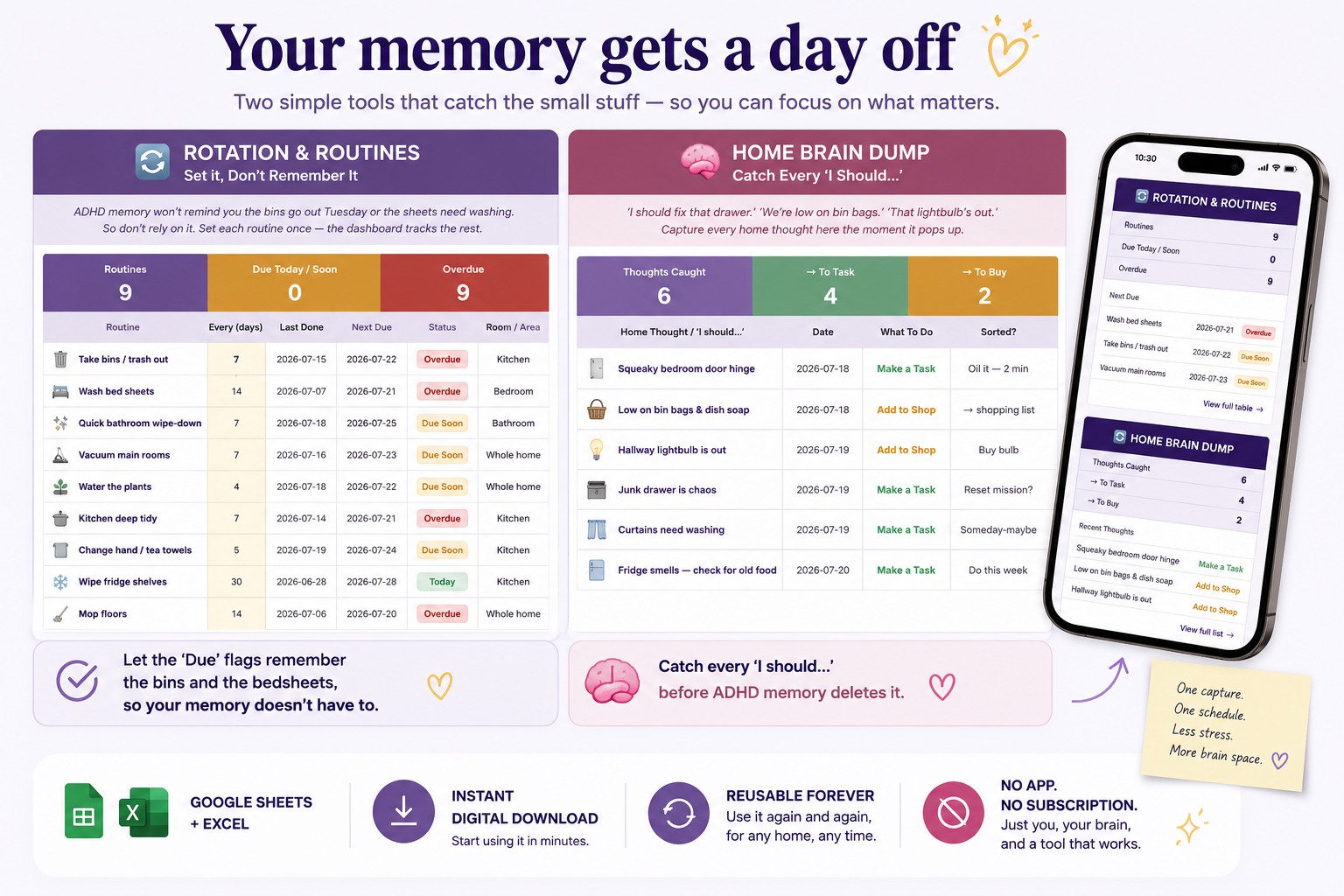
Similarly, letting a system remember your recurring jobs — bins, sheets, the things you only need to do every so often — takes them off your mental load entirely. Not remembering them isn’t a personal failing either; they’re exactly the kind of low-frequency, non-urgent, easy-to-forget items that ADHD memory reliably drops.
Lower the bar on purpose
The last principle is the one people resist most and benefit from most: aim for good enough, deliberately.
Shoving things into a basket to sort later is a valid clean. A surface that’s clear but not polished is fine. A room that’s better than it was counts, even if it isn’t finished. Perfectionism is one of the biggest drivers of ADHD cleaning paralysis — if the only acceptable outcome is properly clean, and properly clean is currently impossible, then the rational response is to do nothing. Lowering the bar isn’t giving up; it’s what makes any action possible at all.
Done beats perfect. A five-minute tidy you actually do beats a deep clean you keep avoiding — every single time.
An important, caring note
Please note: this is about organisation and self-compassion — it is not medical, psychological, or therapeutic advice, it is not a treatment for ADHD or any condition, and it guarantees no result. It doesn’t replace support from a doctor or therapist. And if home, clutter, or overwhelm feels genuinely unmanageable or distressing — if it’s affecting your health, safety, or how you feel day to day — please reach out to a qualified professional or someone you trust. That’s a situation where real support helps, and asking for it is a strength, never a weakness.
If you want it broken down for you
I built an ADHD cleaning planner in Google Sheets around exactly these principles — every job already broken into its tiniest next step, tagged by time and energy so you can filter to what you can actually manage, plus a room-by-room tracker, automatic due flags for routines, and a brain dump:
👉 ADHD Cleaning Planner for Google Sheets & Excel
Whether you use mine or a scrap of paper, stop asking yourself to clean the kitchen. Ask yourself to put five things away. The mess isn’t there because you’re lazy — it’s there because a vague, thirty-step task with no entry point is genuinely hard for your brain to start. Give it a handle to grab, and be kind to yourself about the rest. 🧡
This reflects ADHD-friendly organising principles — not medical, psychological or therapeutic advice, not a treatment for any condition, and it guarantees no result. If overwhelm feels unmanageable, please reach out to a qualified professional or someone you trust. What’s your go-to tiny first step? Share it in the comments — someone stuck right now needs it.