

Money Is Badly Designed for an ADHD Brain
You’re not bad with money. You’re running a system built on delayed rewards and invisible future dates, with a brain that only really registers “now.” Here’s what actually helps.
If money is a special kind of hard for you, and you have ADHD, there’s a good chance you’ve concluded you’re just bad with it. You had the money for the bill and still got a late fee. You meant to save and the money quietly disappeared. You know roughly what you earn but genuinely couldn’t say where it went. That story — I’m irresponsible, I lack discipline — is both very common and, I’d argue, wrong. Budgeting with ADHD fails for a structural reason: personal finance is built almost entirely out of things ADHD brains struggle to register — future dates, invisible balances, and rewards that arrive months from now. It isn’t a discipline problem. It’s a visibility problem, and that’s a much more fixable one.
Now versus not-now
The single most useful concept here: many ADHD brains sort time into two categories — now, and not-now. Things in “now” feel real and motivating. Things in “not-now” barely register, regardless of how important they are or how well you understand them intellectually.
Money is almost entirely a not-now activity. A bill due in three weeks is not-now. Savings you’ll use in two years is deeply not-now. The consequence of a small purchase — that it slightly reduces a balance you can’t see — is abstract and invisible.
Meanwhile, spending is aggressively now. The coffee is now. The thing in your basket is now, and it comes with a small hit of dopamine — which an ADHD brain is often quietly short of. So the contest isn’t fair: a vivid, immediate, rewarding “now” against a vague, invisible, unrewarding “not-now.” Your brain picks the coffee. That’s not a moral failure; it’s the predictable result of the two options as your brain actually experiences them.
Which points straight at the fix: stop trying to win that fight with willpower, and start dragging the “not-now” things into “now” by making them visible.
The one number that matters: what’s left
The most useful thing you can put in front of yourself isn’t a detailed budget with fifteen categories. It’s a single, current, easily-read number: what’s actually left to spend.
Traditional budgets fail ADHD users partly because they require you to hold a whole system in your head — this category has this much left, that one’s overspent, and you must remember which is which at the moment of purchase. That’s an executive-function task performed under exactly the conditions (in a shop, distracted, tempted) where executive function is weakest.
“What’s left” collapses that into one glanceable figure. It’s concrete, it’s current, and it makes the consequence of a purchase immediate rather than abstract. It converts an invisible not-now constraint into a now-visible fact.
Start there. If detailed categories help you later, add them. But the single number is what makes the difference between a budget you use and one you abandon in week two.
Bills: let something else remember
Late fees are perhaps the purest example of the ADHD money problem, because they’re not about money at all. You had the money. You simply didn’t register the date, because a due date two weeks away lives in not-now and produces no urgency until it’s overdue — at which point urgency arrives along with a fee.
The solution isn’t a better memory. It’s to stop using memory for this job entirely. Record each bill’s due date once, and let something flag it as it approaches — due soon, due today, overdue. Then the date doesn’t need to live in your head, and it enters “now” at the moment it becomes actionable rather than after it’s cost you.
The same visibility fixes the subscription problem: charges you agreed to once and forgot exist, quietly leaving your account for months. They’re invisible by design. Listing them in one place makes them visible, and visible subscriptions are ones you can actually decide about.
Savings: make the future something you can see
Saving is the hardest ADHD money task, because it’s the most not-now thing there is: give up something real today for something abstract later. Framed that way, it’s remarkable anyone with ADHD saves at all.
What changes it is visual progress. A goal with a bar that fills up as you contribute turns an invisible abstraction into something concrete you can watch move. It borrows the mechanic that makes games compelling: visible progress toward a defined target. Suddenly saving has a “now” component — the satisfaction of the bar moving — instead of being pure delayed gratification.
Naming the goal specifically helps too. “Savings” is not-now and abstract. “The trip in April” is something you can picture, which gives your brain something to actually want. The more vivid and visible the goal, the more it can compete with the coffee.
Build for the money you actually have
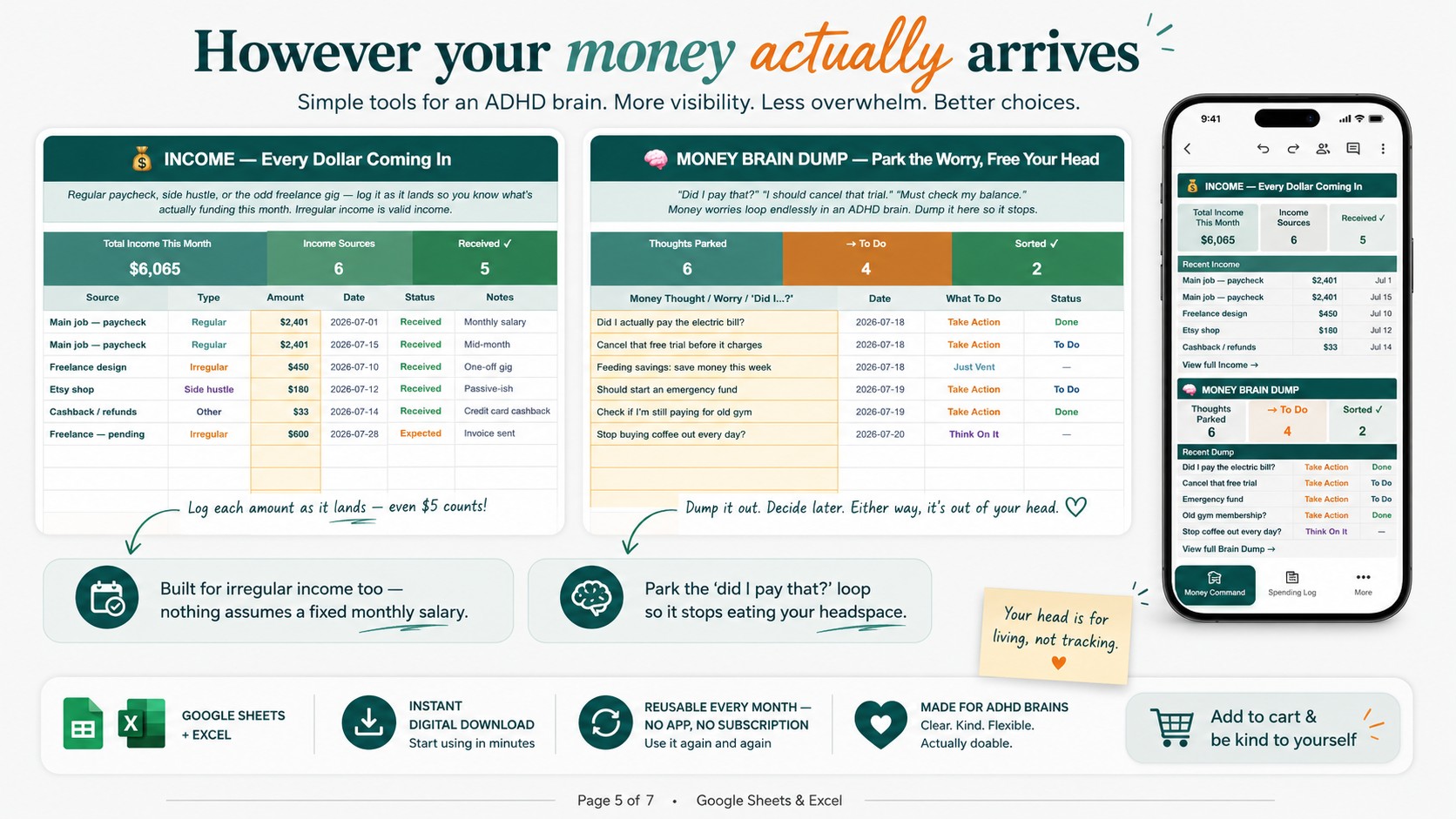
One last practical thing: many ADHD adults have irregular income — freelance work, side hustles, variable hours. Most budgeting advice assumes a fixed monthly salary, and when the model doesn’t match your life, the system breaks and you conclude you failed at budgeting. You didn’t; you were handed the wrong tool.
A system that lets you log income as it actually arrives, in whatever amounts, fits reality. And reality-shaped systems are the only ones that survive contact with an ADHD life.
An important, caring note
Please note: this is about organisation and visibility, not financial guidance. It is not financial, investment, tax, or debt advice, it is not a treatment for ADHD or any condition, and it guarantees no result. It doesn’t replace a qualified financial professional, accountant, or therapist. And if money or debt feels genuinely unmanageable or distressing, please reach out — to a qualified professional, a non-profit debt advice service, or someone you trust. Support exists and seeking it is a strength, never a failure.
If you want money made visible
I built an ADHD budget planner in Google Sheets around exactly this — a live “left to spend” figure, automatic bill alerts before the fee, visual savings bars, an income page built for irregular earnings, and a money brain dump, all in warm, shame-free language:
👉 ADHD Budget Planner for Google Sheets & Excel
Whether you use mine or a note on your phone, stop trying to out-discipline a system that was never designed for how your brain handles time. Make what’s left visible. Let something else hold the dates. Give your savings a bar to fill. You’re not bad with money — it just wasn’t built for your brain, and that’s something you can change. 🧡
This reflects ADHD-friendly organising principles — not financial, investment, tax or debt advice, not a treatment for any condition, and it guarantees no result. If money or debt feels unmanageable, please reach out to a qualified professional or someone you trust. What’s the one money thing that finally stuck for you? Share it in the comments.

