Running HR for a Small Company Means Being Ten People at Once
There’s no HR department — there’s just you, a pile of mismatched spreadsheets, and a stack of monthly software bills. Here’s how to build one connected small business HR system instead.
In a big company, HR is a department full of specialists. In a small company, HR is one person doing all of it in the cracks between their actual job — and that person is often the founder or office manager who never signed up for it. You’re the recruiter, the interviewer, the payroll clerk, the benefits administrator, the scheduler, the equipment manager, and somehow also the person expected to know how everyone’s feeling. Usually you’re doing it with a chaotic pile of mismatched spreadsheets and a monthly software bill that stings. Building a proper small business HR system — one connected setup rather than scattered chaos — is one of the highest-leverage things a small company can do. Here’s the problem, and the shape of the fix.
The “ten people at once” problem
The core difficulty of small-company HR isn’t that any single task is hard. Tracking applicants isn’t hard. Running payroll isn’t hard. Scheduling isn’t hard. The difficulty is that you’re doing all of them, switching contexts constantly, with no specialist for any of it and no system tying it together.
So HR becomes a collection of disconnected activities, each handled in its own improvised way — a spreadsheet here, a document there, some of it in your head, some of it in an email thread you’ll never find again. Nothing connects. The candidate you hired lives in one place; their payroll lives in another; their equipment in a third; their schedule in a fourth. When you need the full picture of a person, you’re hunting across half a dozen locations.
This is manageable with two employees. It quietly becomes a nightmare as you grow, because the number of connections between all these moving parts grows faster than the team does. What worked at three people is chaos at fifteen.
Two bad default solutions
Faced with this, small companies usually drift toward one of two unsatisfying defaults.
The scattered-spreadsheets approach. You make a new spreadsheet each time a need arises — a hiring one, a payroll one, a schedule one — with no consistency and no connection between them. It’s free and flexible, but it’s a mess: nothing talks to anything, data is duplicated and inconsistent, and there’s no coherent system, just an accumulating pile of files with no design behind them.
The expensive-software approach. You sign up for HR platforms to bring order — a recruiting tool, a payroll service, an HR system. These are genuinely capable, but they charge per employee, per month, forever, and for a small team those subscriptions stack up into a real recurring cost. You end up paying enterprise-style prices for a handful of employees, and often using a fraction of what you’re paying for.
Both leave something to be desired: one is cheap but chaotic, the other is orderly but expensive (and often overkill at your size).
The middle path: one connected, owned system
There’s a third option that suits most small companies better: a set of structured, consistent templates that cover the whole of HR and are designed to work as one system — but that you own rather than rent.
This captures the best of both defaults. It’s structured and coherent like the software (real design, consistent, everything in its place), and it’s affordable and yours like the spreadsheets (no per-seat fees, no monthly bill, reuse it for any team size forever). For a small company that doesn’t need enterprise features but does need to stop drowning in chaos, this middle path is often exactly right.
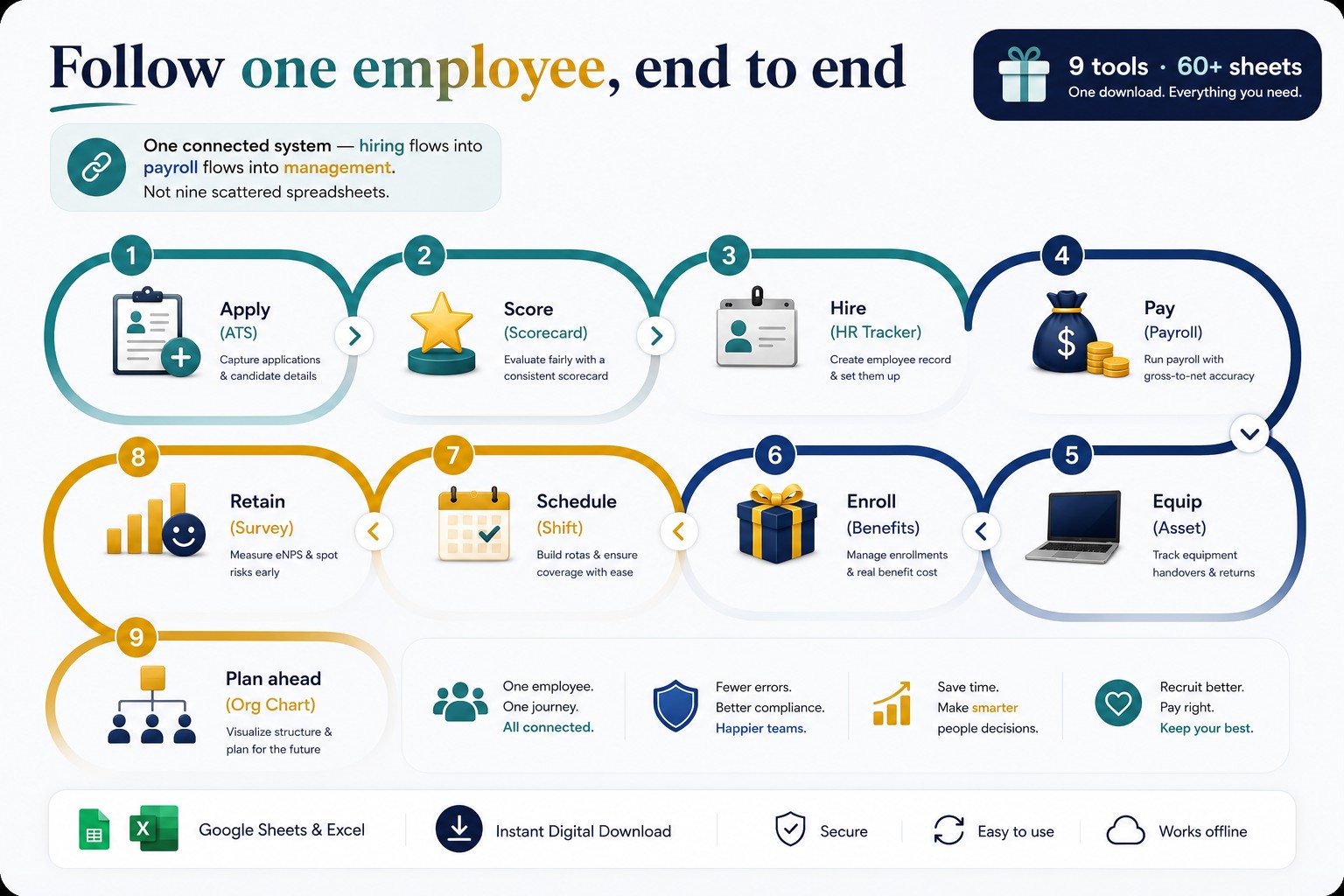
The key word is connected. The value isn’t nine separate tools; it’s that they follow a consistent structure and cover the whole employee journey, so your HR stops being a scattered pile and becomes a system. The person you hire flows naturally into the person you pay, equip, schedule, and retain — one coherent picture instead of six disconnected ones.
When you genuinely should buy the software
Let me be fair, because this isn’t anti-software. As you grow past a certain size, dedicated HR platforms earn their cost: automation, employee self-service, deep integrations, and — critically — guaranteed payroll compliance become worth paying for. Payroll especially: a template helps you understand and organise your numbers, but for the actual filing and compliance, dedicated tools or a professional are the responsible choice, because the downside of getting it wrong is real.
The point isn’t that software is bad. It’s that most small companies adopt it too early and too much, paying for enterprise capability they won’t use for years, when a connected set of owned templates would serve them better and cheaper until they genuinely grow into the software.
A necessary note on data and compliance
One crucial thing, because HR handles sensitive information: however you build your system, you are responsible for how you collect, store, and handle employee data, including complying with any privacy laws that apply to you (such as GDPR). And nothing here is HR, legal, tax, payroll, or employment advice — these are organising tools, and they guarantee no result. For payroll, tax, and employment-law decisions, consult a qualified professional. Handle your people’s data with the care it deserves.
If you want the whole system ready to go
I put together an HR and hiring toolkit in Google Sheets — nine connected templates covering the entire employee lifecycle, from applicant tracking and interview scoring through payroll, benefits, equipment, and scheduling, to engagement surveys — owned once, not rented monthly:
👉 HR & Hiring Toolkit Bundle for Google Sheets & Excel
Whether you use mine or build your own, stop running HR as ten disconnected jobs on a pile of random spreadsheets. Build one connected system that covers the whole employee journey, own it instead of renting it, and bring in dedicated software when you genuinely outgrow it. Being ten people at once is hard enough — at least give those ten people one system to work in.
This reflects my own perspective and describes organising tools — not HR, legal, tax, payroll or employment advice, and they guarantee no result; you’re responsible for employee data and any privacy laws that apply. How do you run HR at your company — scattered sheets, expensive software, or something in between? Tell me in the comments.