Offboarding: The Moment You Find Out You Never Really Tracked Your Assets
When an employee leaves, you discover exactly how good your asset tracking is. Here’s how to make employee offboarding a clean checklist, not a scramble.
Offboarding is a moment of truth. When an employee leaves, you have to recover everything the company issued them — the laptop, the phone, the monitor, the access, the software licenses. And it’s precisely at that moment that you discover whether you ever actually tracked your assets, or just thought you did. For companies with good tracking, it’s a quick checklist. For everyone else, it’s a scramble of “wait, what did we even give this person?” — and often, things never come back. Here’s how to make employee offboarding clean, and why it depends entirely on what you did before the person resigned.
Offboarding exposes your tracking, good or bad
Here’s the uncomfortable truth. You can’t recover assets you didn’t know you assigned. If there’s no clear record of what a departing employee was issued, offboarding becomes guesswork. You rely on the employee to remember and return everything (they won’t remember all of it), and on your own fuzzy memory of what they had (also incomplete). The result is predictable: some equipment comes back, some doesn’t, and the stuff that doesn’t is quietly written off as a cost of doing business.
Multiply that across every departure, and the losses add up. Each un-recovered laptop, each forgotten license still being paid for, each phone that walked out the door — small individually, real collectively. And it all traces back to one thing: whether you had a clear record of what that person had before they left.
The recovery checklist you wish you’d set up earlier
Clean offboarding is simple if you tracked assignments. When someone gives notice, you pull up everything assigned to them and work through it:
- Physical equipment — laptop, phone, monitor, peripherals, access cards. Each one checked back in against the record, so you know exactly what’s outstanding.
- Software licenses — the paid seats and subscriptions assigned to them, reclaimed or reassigned so you stop paying for a departed employee’s access.
- A clear “returned vs outstanding” status — so nothing is ambiguous. You know precisely what’s back and what you’re still chasing.
With good tracking, this is a ten-minute, unambiguous process. Without it, it’s a stressful reconstruction that still misses things. The checklist isn’t the hard part; having the underlying records is. The checklist just reads out what you already tracked.
Licenses are the invisible offboarding leak
Physical equipment at least is visible — a missing laptop is obvious eventually. The sneakier offboarding leak is software licenses. When someone leaves and their paid seats aren’t reclaimed, you keep paying for them, often for months or years, because subscription charges are easy to overlook. Across multiple departures, this quietly inflates your software spend with seats for people who left long ago.
Tracking which licenses are assigned to whom means that offboarding automatically flags the seats to reclaim. That single habit can save meaningful recurring cost — you stop paying for ghosts. It’s one of the clearest examples of how good tracking pays for itself.
Onboarding benefits too
The same tracking that makes offboarding clean makes onboarding smooth. When a new person starts, you can see what equipment is available (that you’ve recovered from leavers), assign it to them, and record it — all from the same system. Assets flow cleanly from departing employees to arriving ones, instead of everyone getting new gear while recovered equipment gathers dust. Good tracking turns your asset pool into something that actually circulates, which is exactly what keeps hardware spend down.
Set it up before you need it
The lesson of offboarding is really a lesson about before offboarding. The scramble happens because tracking wasn’t set up when the asset was first assigned. The fix is to track assignments from the start — log what each person is issued when they get it — so that when they eventually leave (and everyone eventually leaves), recovery is a checklist, not an archaeology project. The best time to set up asset tracking is before the first person resigns. The second-best time is now.
If you want a system ready to go
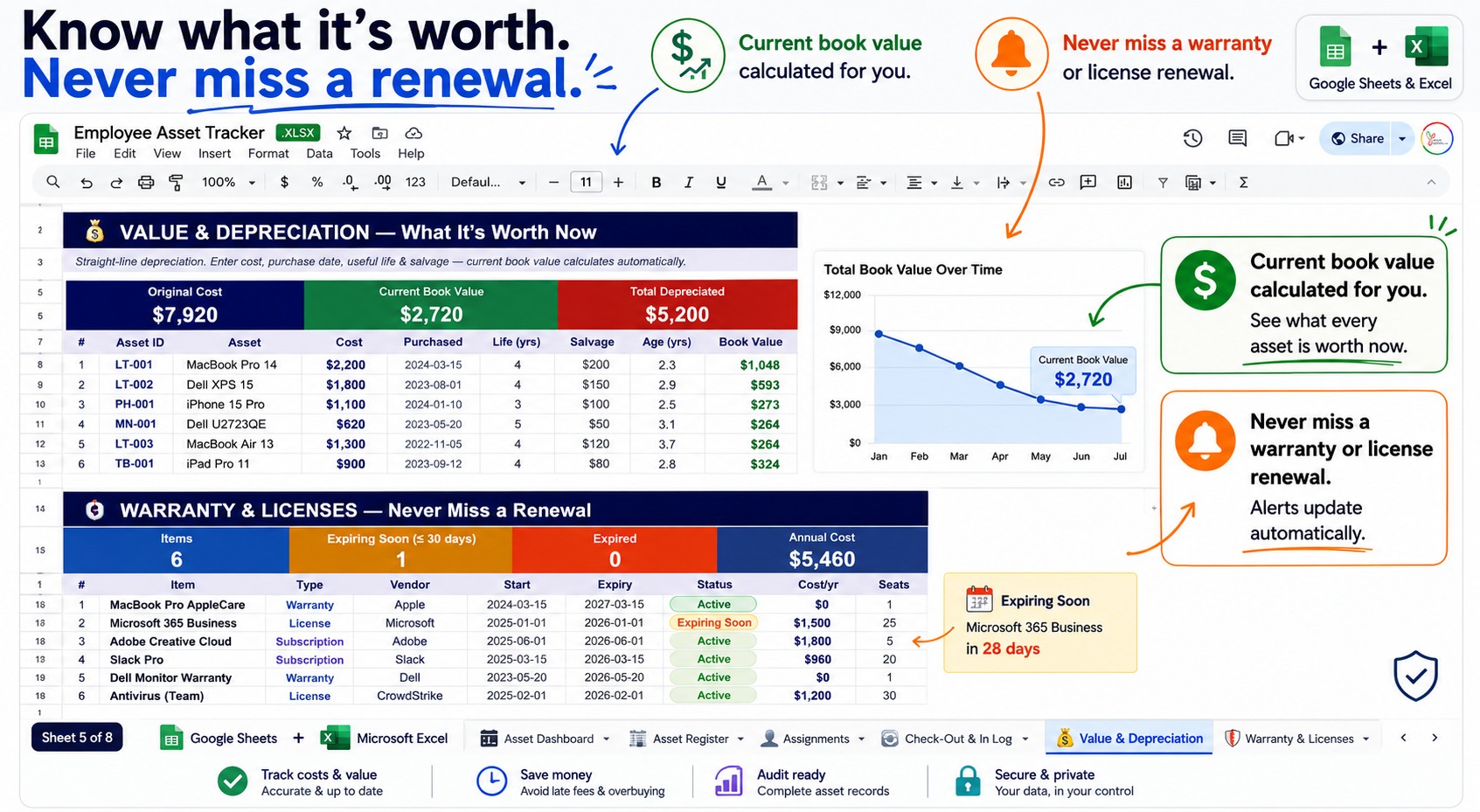
I built my employee asset tracker in Google Sheets with exactly this in mind — assignment tracking and a check-in/out log that make offboarding a clean checklist, plus license tracking so you reclaim paid seats when people leave, all on a live dashboard:
👉 Employee Asset Tracker for Google Sheets & Excel
Whether you use mine or build your own, set up assignment tracking before your next departure. Offboarding will tell you the truth about your asset tracking either way — the only question is whether it’s a quick checklist or an expensive scramble. Track from the start, and it’s always the former.
This reflects my own experience and is an organizational tool — not HR, accounting or legal advice; keep employee data secure and follow your local rules. What’s walked out the door on you during an offboarding? Tell me in the comments.