Chasing Late Payments Is the Worst Part of Freelancing — Here’s My System
Late-paying clients are the tax on being your own boss. Here’s the simple invoice tracking system that gets me paid on time, with far less awkwardness and stress.
Ask any freelancer what they hate most about running their own business, and “chasing payments” will be near the top of the list. You do the work, you send the invoice, and then… you wait. And sometimes you wait too long, and you have to send the awkward follow-up, and maybe another, all while wondering if you’re being too pushy or not pushy enough. For a while, this was the most stressful and disorganized part of my freelance life — mostly because I had no system, just a vague memory of who owed me what. Building a simple invoice tracking system changed that completely. Here’s how it works and why it made getting paid so much less painful.
Why late payments are so stressful (beyond the money)
The obvious problem with late payments is cash flow — you need the money, and it’s not there. But the stress goes deeper than that. When you’re disorganized about invoices, you carry a constant low-level anxiety: Did that client pay? Was that invoice due last week or this week? Did I forget to follow up with someone? You’re holding fragile information in your head, and the fear of dropping it — of letting an unpaid invoice slip through and losing money you earned — is genuinely draining.
Then there’s the awkwardness. Chasing payment feels uncomfortable, so we avoid it, which lets invoices age, which makes the eventual chase even more awkward. Disorganization feeds the avoidance: if you’re not even sure exactly what’s owed and how overdue it is, you hesitate to follow up confidently. The whole thing becomes a source of dread. A system fixes not just the tracking, but the confidence to act.
Step one: know exactly what’s owed
The foundation of the system is simply having every invoice logged with its status. Which invoices are outstanding, how much, due when, and paid or not. That sounds basic, but most disorganized freelancers can’t actually answer “how much am I owed right now?” without digging. When every invoice is in one place with a clear status — paid, unpaid, partial, overdue — that question has an instant answer.
This visibility alone reduces the stress enormously. The anxiety of “have I forgotten something?” disappears when you can see everything. Nothing is lurking, forgotten, in an email thread. You know your position at a glance. And knowing your position is the prerequisite for doing anything about it.
Step two: let overdue invoices surface themselves
The real magic is in tracking overdue invoices specifically. The whole problem with late payments is that they’re easy to lose track of — an invoice quietly passes its due date and, without a system, nothing flags it. It just sits there, unpaid and unnoticed, until you happen to remember.
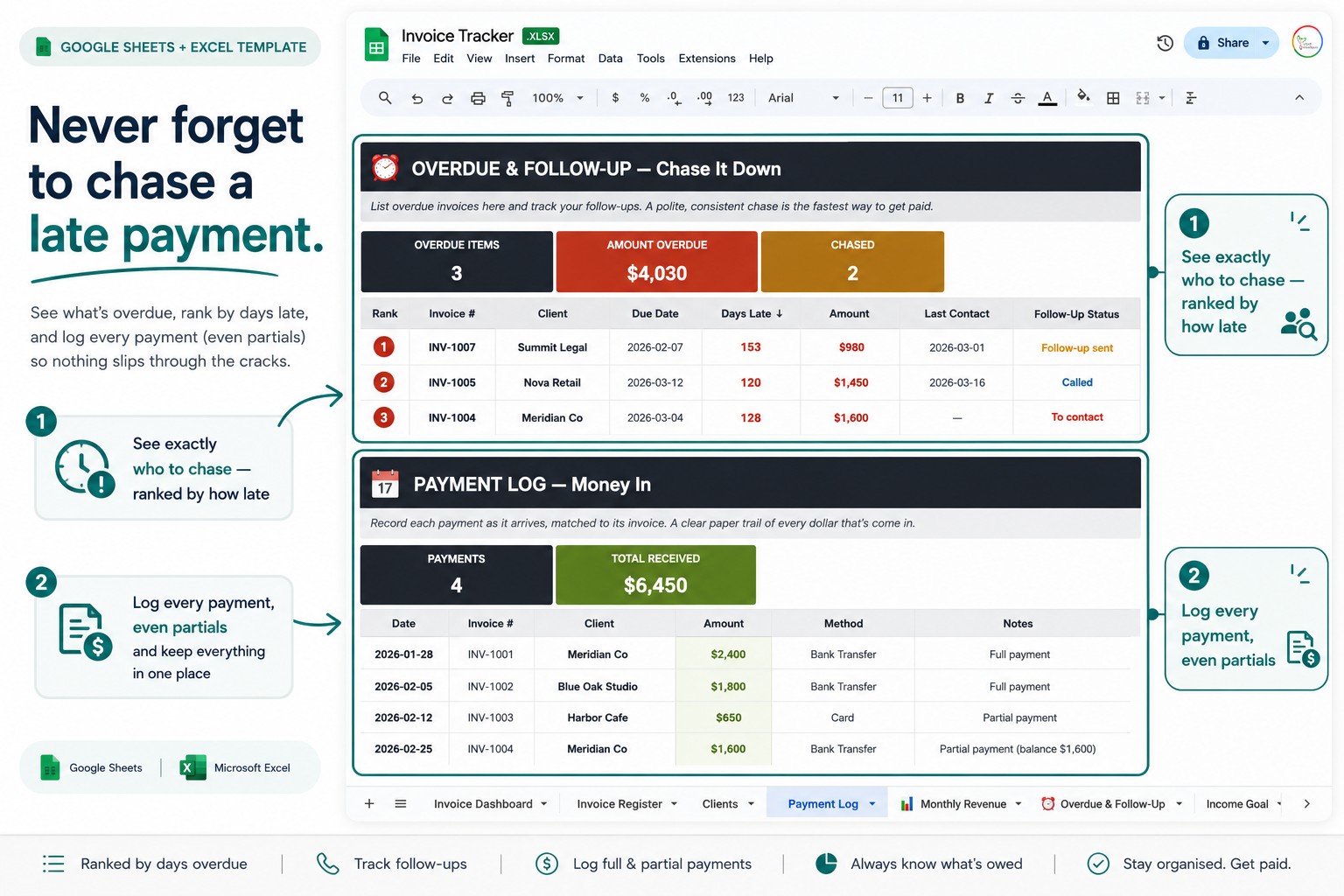
A good system flips this: it automatically identifies which invoices are overdue and how many days late they are, so the ones needing attention rise to the top. Instead of trying to remember who hasn’t paid, you look at your overdue list — ranked by how late — and know exactly who to follow up with, in priority order. The invoices chase themselves to your attention, rather than depending on your memory. That’s the difference between reliably getting paid and occasionally losing track of money you’re owed.
Step three: follow up with confidence
Here’s where the system helps with the awkwardness. When you have clear records — exactly what was invoiced, when it was due, how overdue it is — following up stops feeling like a confrontation and becomes a simple, professional matter of fact. “Invoice #123 for $X was due on [date] and is now [N] days overdue” is a confident, businesslike message, not an awkward guess. Good records give you the standing to follow up firmly and professionally, because you know exactly where things stand.
Tracking your follow-ups helps too: noting who you’ve reminded and when means you can escalate appropriately (a gentle nudge, then a firmer reminder) instead of either forgetting to follow up or accidentally pestering someone who just paid. The system turns chasing from an anxious, avoided chore into a calm, routine part of business.
Getting paid on time is a skill you can systematize
The deeper truth I learned is that getting paid on time isn’t about luck or having nicer clients — it’s a system. Freelancers who reliably get paid aren’t just lucky; they’re organized. They track what’s owed, they notice overdue invoices immediately, and they follow up promptly and professionally. That consistency trains clients to pay on time, too, because they learn you’re on top of it. Disorganized freelancers get paid late partly because clients sense they can get away with it.
Systematizing your invoicing is, in a real sense, systematizing your cash flow and your peace of mind. It’s one of the highest-leverage bits of admin a freelancer can set up.
A quick note
One sensible caveat: an invoice tracker is a tool for organizing and tracking your own invoices — it’s not accounting, tax, or financial advice, and it doesn’t replace proper bookkeeping. Keep your official records, and consult a qualified professional for your bookkeeping and tax obligations. Use tracking to stay on top of getting paid; use a professional for the accounting.
If you want a system ready to go
I built an invoice tracker in Google Sheets to do exactly this — log every invoice with an automatic status, see what’s outstanding and overdue at a glance, track days overdue and follow-ups, and know exactly who to chase:
👉 Invoice Tracker for Google Sheets & Excel
Whether you use mine or build your own, get a system for your invoices. Chasing payments will never be your favourite part of freelancing — but with everything tracked and overdue invoices surfacing automatically, it stops being a source of dread and becomes a quick, confident routine. And you get paid what you’re owed, when you’re owed it.
This reflects my own experience and is a tracking tool — not accounting, tax or financial advice; keep official records and consult a professional. What’s your system for chasing late payments? Tell me in the comments.