

The Missing Laptop Problem: Why “It’s Assigned to Someone, Probably” Costs You
Too many companies can’t say who has what. Untracked equipment quietly drains money. Here’s why IT asset tracking matters — even for a small team.
Here’s a question that has stumped more companies than you’d think: “Where’s that laptop, and who has it?” It sounds trivial. But in a surprising number of businesses — including ones I’ve worked in — the honest answer is a shrug. The equipment is somewhere, assigned to someone, tracked maybe, in a spreadsheet possibly. That fuzziness feels harmless until you add up what it actually costs. Getting serious about IT asset tracking — even a simple version — closes a money leak most companies don’t realize they have. Here’s why it matters.
Untracked assets are a silent money leak
When you can’t confidently say who has each piece of equipment, several expensive things happen quietly. You buy new laptops because you can’t find the ones you already own — paying twice for hardware you have. Equipment walks out the door when people leave and never comes back, because nobody tracked that they had it. Devices sit unused in drawers while you purchase more, because you have no visibility into what’s actually available.
None of these show up as a line item called “money wasted on untracked assets.” They hide inside your normal hardware spend, which is exactly why they persist. A company that tracks its assets tightly simply spends less on equipment than an identical company that doesn’t — because it uses what it has, recovers what it lends, and buys only what it genuinely needs. The leak is invisible until you close it and notice the spend drop.
“It’s in a spreadsheet somewhere” isn’t tracking
Most companies think they track assets because there’s a spreadsheet somewhere. But a stale, half-maintained list that nobody updates isn’t tracking — it’s the illusion of tracking, which is arguably worse because it gives false confidence. Real asset tracking answers, at any moment: what do we own, what’s it worth, who has each item, and what’s its status.
The difference is that real tracking is current and complete. Every asset logged with its details. Every assignment recorded — who has it, since when. Every status up to date — assigned, available, in repair, retired. When that exists, “who has that laptop?” has an instant, confident answer instead of a shrug. And that single capability — always knowing who has what — is what stops the money leak.
What good asset tracking actually captures
You don’t need enterprise software to do this well. The essentials are straightforward:
- An asset register — every device logged with its type, serial number, purchase date, cost, and status. The single source of truth for what you own.
- Assignments — who currently has each asset, and since when. This is the heart of it: the link between an asset and a person.
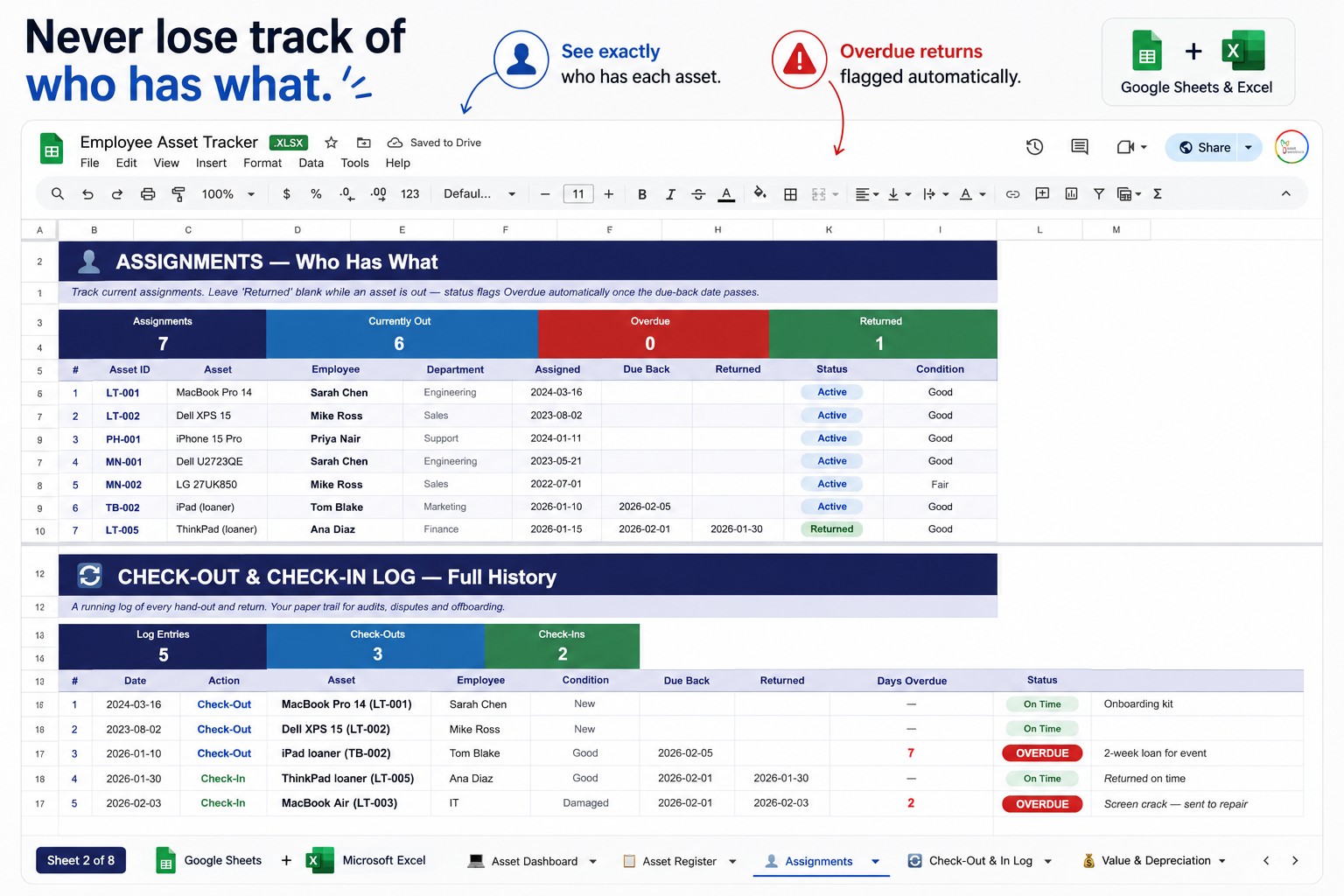
- A check-out / check-in log — a record of equipment lent out and returned, so nothing gets lent and forgotten. Overdue returns flagged, so you actually chase them.
That’s the core. With just those, you go from “somewhere, probably” to “here’s exactly who has it.” For most small and mid-sized companies, that’s a night-and-day improvement, and it’s entirely achievable in a well-built spreadsheet.
It’s about accountability, not surveillance
One framing note, because this matters for how it lands with your team. Asset tracking isn’t about distrusting employees or monitoring people. It’s about basic operational accountability — knowing what the company owns and where it is, the same way you’d track any other valuable resource. Framed well, it actually helps employees: they know what they’ve been issued, returns are clear and fair, and nobody gets wrongly chased for equipment they returned. Good tracking protects everyone, including the people using the assets.
If you want a system ready to go
I built my own employee asset tracker in Google Sheets — an asset register, assignment tracking, a check-out/check-in log with overdue flags, plus depreciation, warranty and license tracking, all on a live dashboard showing who has what and what it’s worth:
👉 Employee Asset Tracker for Google Sheets & Excel
Whether you use mine or build your own, get to where you can answer “who has that laptop?” instantly. Untracked equipment is a quiet, ongoing cost that most companies never see — and closing that leak is one of the easier operational wins available. You probably own more than you think, in more places than you know.
This reflects my own experience and is an organizational tool — not accounting, tax or legal advice; keep employee data secure and follow your local rules. What’s the most expensive thing your company has “lost track of”? Tell me in the comments.

