

The hidden cost of yes: For most of my career, I treated saying yes as a virtue. I was available, accommodating, and responsive. I also felt chronically overwhelmed, scattered, and unable to make meaningful progress on the things that actually mattered to me. The problem wasn’t that I was working too little. The problem was that I had filled every available hour with other people’s priorities — and left almost none for my own.
Why saying no is so hard — and it isn’t rudeness
The difficulty of saying no is not primarily about politeness or social norms — though those play a role. It is primarily about three deeper psychological forces that the socially acceptable explanation of “I don’t want to be rude” conveniently obscures.
Fear of missing out. Every opportunity we decline could have been significant. The meeting might have led somewhere. The favor might have built a relationship. The project might have opened a door. Saying no carries the weight of foreclosed possibilities, and the mind naturally resists that foreclosure even when the opportunity is genuinely not worth the time.
Desire for approval. Most people have a meaningful need to be perceived as helpful, cooperative, and valued. Saying no, regardless of how diplomatically it’s framed, risks disturbing that perception. The discomfort that follows a no is often not guilt about the decision — it is anxiety about how it was received.
Identity as a capable person. For high-achieving people especially, saying yes is tied to identity. Being the person who can handle it, who delivers, who doesn’t let people down. Saying no can feel like an admission of limitation — which the identity structure resists.
Understanding these forces doesn’t make them disappear. But it reframes the difficulty of saying no as a psychological habit to be worked on rather than a character virtue to maintain.
Read also: Why Vivid Events Feel More Probable Than They Actually Are
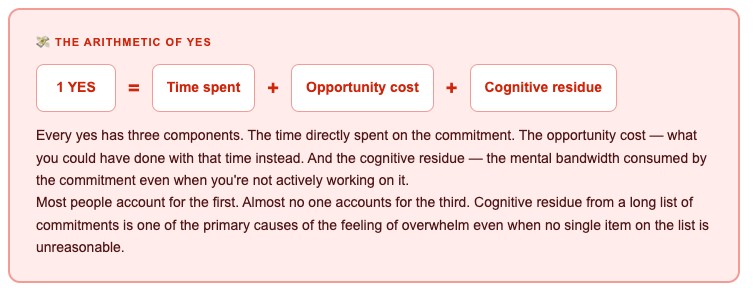
The real cost of every yes
“You can do anything, but not everything.”— David Allen
The capacity constraint is not time — time is finite and visible. The real constraint is attention and cognitive bandwidth — which are finite and often invisible until they’re exhausted. Every yes you say occupies a background thread in your mind whether you’re consciously attending to it or not. A large pile of yeses produces a background processing load that degrades the quality of everything you’re actually working on.
The reframe that changed my relationship with no
The reframe that made saying no sustainable was this: saying no is not a negative act. It is an affirmative act in service of the things you are saying yes to.
When I say no to an additional meeting, I am saying yes to the focused work that meeting would have displaced. When I decline a favor I’m not positioned to do well, I am saying yes to the person getting a better version of that help from someone more capable. When I decline a project that isn’t in my core, I am saying yes to the projects that are.
Every no is an implicit yes to something else. Making that implicit yes explicit — writing down what you are saying yes to by saying no — transforms the experience of the no from a refusal into a deliberate affirmation of priority.
My personal criteria for saying yes vs no
Before I developed explicit criteria, my yes/no decisions were made on a combination of social pressure, immediate availability, and vague obligation. After applying the 80/20 principle to my activity audit, I developed a cleaner filter.
I now say yes to a new commitment only if it meets at least two of the following three criteria:
Criterion 1 — Strategic alignment. Does this move me meaningfully toward a goal I have explicitly prioritized? Not a goal I should have or a goal someone else thinks I should have — a goal I have consciously chosen and recorded.
Criterion 2 — Genuine capability and interest. Am I actually the right person for this — not merely an available person — and do I have genuine interest in it? Commitments taken on out of availability rather than fit produce mediocre outcomes for everyone involved.
Criterion 3 — The “hell yes” test. Derek Sivers famously articulated this: if it’s not a clear, enthusiastic yes, it’s a no. Applied literally, this is too strict for professional obligations that are genuine but not exciting. Applied as a tiebreaker for discretionary commitments, it is extremely useful. If the honest internal response to “do I want to do this?” is a tepid “I guess I should,” that is informative data.
Read also: The Mental Model That Changed How I See Everything
The exact scripts I use — for different contexts
Professional — declining a meeting request
“Thank you for thinking of me for this. I’m at capacity right now with some commitments I’ve already made, and I want to be honest that I wouldn’t be able to give this the attention it deserves. I hope you find the right person — and if anything changes on my end, I’ll let you know.”
Note: specific about capacity, not vague about busyness. Acknowledges the value of what’s being asked without pretending to want to help when you can’t.
Declining a favor or additional project
“I appreciate you asking. I’m going to have to pass on this one — I have a few existing commitments I need to protect, and I don’t want to take this on half-heartedly. You deserve someone who can give it full attention.”
Note: “I don’t want to take this on half-heartedly” reframes the no as protecting quality, not protecting your time. More honest and usually better received.
Declining a social obligation that doesn’t serve you
“I really appreciate the invitation — I’m going to sit this one out. I hope it goes well.”
Note: no justification required. A clear, warm no without explanation is more honest than a fabricated excuse and models the behavior you want others to use with you.
Buying time before committing
“I want to give this the consideration it deserves before I respond. Can I get back to you by [specific date]?”
Note: always specify a date. “I’ll think about it” is an indefinite deferral that creates more anxiety than a clear timeline. A date is a commitment — and it signals that you’re being thoughtful, not avoidant.
Declining the same recurring request
“I’ve thought about this and I’m going to keep my answer consistent — this isn’t something I’m going to be able to take on. I wanted to be clear about that rather than keep revisiting it.”
Note: for persistent requests that keep returning, a clear, final no that names the pattern is more respectful than an endless series of soft declines.
Handling the discomfort that follows a no
Saying no is the easier half of the practice. The harder half is managing what happens in the five to sixty minutes after you say it. The anxiety about how it was received. The second-guessing about whether the criteria were too strict. The concern that the relationship has been damaged. The temptation to follow up with reassurance or to partially reverse the no with a “but maybe later.”
The discomfort is almost always worse than the actual consequences. In my experience across dozens of professional and personal nos: the overwhelmingly most common response from the person who received the no was immediate acceptance and either a thank-you for being honest or a simple “okay, understood.” The catastrophic responses I feared never materialized with any regularity.
The practice I use: after delivering a no, I write down the worst realistic consequence I can imagine. Then I ask whether I can live with that consequence. If yes — which it almost always is — I commit to the decision and redirect my attention rather than monitoring for the feared response.
Read also: How I Built Multiple Income Streams — Without Quitting My Day Job
What happened after I started saying no more
Saying no more became a consistent practice approximately two years ago. The results were not immediate — there was a period of adjustment during which some relationships cooled slightly (the ones most dependent on my availability) and some anxiety spiked (particularly around professional nos). By about month four, a different pattern had emerged.
The projects I said yes to received markedly better work because I was giving them full attention rather than partial attention divided among many obligations. The relationships I invested in deepened because I was present in them rather than perpetually distracted. The goals I had identified as priorities were actually advancing rather than perpetually being deferred by the urgent.
What surprised me most: the people who received the most nos — my most demanding professional contacts — were among those whose respect for my work increased most noticeably. Scarcity of access had changed how they related to the access they did have.
Conclusion: no is the most complete sentence in the English language
The famous saying — “no is a complete sentence” — is often quoted as an argument for terse refusals without explanation. That is not the point I am making. Warmth and specificity in a no are professional virtues.
The point is that no requires no justification that you haven’t chosen to offer. It does not require an apology. It does not require a substitute solution. It does not require the fiction that you would help if only circumstances were different. The circumstances are what they are. Your priorities are what they are. A clear no in service of those priorities is not a failure of character. It is an expression of it.
Start with the next request that arrives
The next time someone asks you for something — a meeting, a favor, a project, a social commitment — before responding, ask the two-question filter: does this meet at least two of my three criteria? And if I said yes to this, what specific thing would I be saying no to?
You don’t have to decline everything. You just have to make the decision consciously, with full visibility into the real cost of the yes, rather than by default because the request arrived and declining felt socially uncomfortable.

