The short version: I spent years copying what successful people did — their morning routines, their frameworks, their strategies. It didn’t work. The day I discovered first principles thinking, I stopped asking “what should I do?” and started asking “why does this work?” Everything changed after that.
What first principles thinking actually means
For most of my adult life, I was an excellent imitator.
I read every book about high performers. I studied the habits of billionaires. I copied morning routines from podcasts. I adopted productivity systems from bloggers I admired. And every time I borrowed someone else’s strategy, I waited for it to transform my results.
It rarely did.
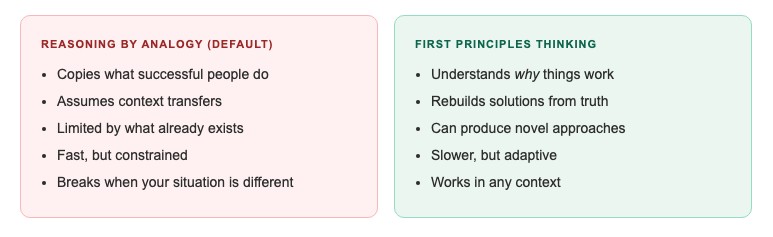
Not because those strategies were wrong. But because I was applying solutions designed for different problems, different contexts, and different people — to my own life, wholesale, without ever understanding why they worked in the first place.
This is what first principles thinking is designed to fix.
First principles thinking is a method of reasoning where you strip away every assumption, convention, and borrowed belief about a problem — until you’re left with only what is fundamentally, verifiably true. From that bedrock of truth, you build your reasoning up again from scratch.
It’s the opposite of reasoning by analogy — the far more common approach where we look at what’s already been done and do something similar. Analogy-based thinking is efficient. First principles thinking is powerful.
“I think it’s important to reason from first principles rather than by analogy. The normal way we conduct our lives is we reason by analogy. [With first principles] you boil things down to the most fundamental truths you can imagine and then reason up from there.”— Elon Musk
The expensive mistake that made me rethink everything
A few years ago, I was trying to grow a small consulting practice. A mentor I respected had built a successful practice by doing the same thing every serious consultant seemed to be doing: building a robust LinkedIn presence, publishing thought leadership content, attending industry events, and converting connections into clients.
So I did exactly that. I spent eight months executing a near-perfect replica of his strategy.
I posted consistently. I attended conferences. I refined my profile. I sent thoughtful connection requests. My network grew. My follower count climbed. And yet — the clients didn’t come. Not at the rate I needed. Not in the right industries.
I was frustrated. I was doing everything “right.” Or so I thought.
The problem revealed itself one afternoon when I sat down and asked a simple but devastating question: Why did his strategy work for him?
When I actually analyzed it, the answers were sobering. He had 15 years of industry relationships before he started posting. His content resonated because his audience already trusted him personally. He got speaking invitations because he already had credibility — not the other way around.
I had none of those assets. I had copied the surface behavior without understanding the underlying mechanism. I was reasoning by analogy when I needed to reason from first principles.
Read also: The Exact Formula for Wealth Creation
How first principles thinking actually works
The ancient Greek philosopher Aristotle is generally credited with formally defining the concept. He wrote that a first principle is “the first basis from which a thing is known” — the foundational truth beneath any argument or system.
More practically: a first principle is a statement that you know to be true, not because someone told you, not because it seems obvious, but because you’ve verified it directly.
The process has two distinct phases:
Phase 1: Deconstruction — breaking everything down
You take any problem, belief, or assumption and ask: Is this actually true, or is this just what everyone assumes?
You keep asking that question — Socratically, relentlessly — until you hit bedrock. Until you find statements that cannot be broken down further. Things like: energy cannot be created or destroyed. Customers pay for value. People are more motivated to avoid loss than to pursue gain.
These are first principles. They are building blocks.
Phase 2: Reconstruction — building up from truth
Once you’ve identified the fundamental truths, you build your solution back up — but now you’re building on a foundation of verified reality rather than borrowed assumptions. The solution you arrive at may look completely different from what convention dictates. That’s the point.
Read also: How Better Thinking Leads to Better Outcomes
Why Elon Musk uses this — and how to steal the method
The most widely cited example of first principles thinking in the modern world involves SpaceX and the cost of rocket launches.
When Elon Musk started SpaceX, the aerospace industry consensus was that building a rocket cost around $65 million. That was simply the price. That was “how much rockets cost.” Everyone in the industry accepted it as fact.
Musk didn’t accept it. He asked a first principles question: What are rockets actually made of, and what do those materials cost?
He broke down a rocket into its raw components — aerospace-grade aluminum alloys, titanium, copper, carbon fiber. He calculated the commodity price of those materials. The answer was approximately 2% of the quoted industry price.
That discovery was the intellectual foundation of SpaceX. Not a better marketing strategy. Not a disruptive business model borrowed from another industry. A fundamental inquiry into what was actually, verifiably true — followed by a reconstruction of the problem from that bedrock.
SpaceX now launches rockets for a fraction of the industry’s historical cost.
Key insight
The $65M rocket price wasn’t a fact. It was an assumption layered on top of decades of industry convention, overhead, institutional inertia, and legacy contracts. First principles thinking cuts through all of that.
The question isn’t “what does a rocket cost?” The question is: “what does it need to cost, given only what is fundamentally true?”
How I apply it in real life — with examples
You don’t need to be building a rocket company to use this. Since I learned to apply first principles thinking consistently, it has changed how I make decisions across multiple domains.
Example 1: Content strategy
After my consulting failure, I went back to first principles. I asked: Why do people hire consultants? Not “how do consultants get hired,” but why.
The first principles answers: because they have a specific problem they can’t solve internally. Because they need expertise or objectivity they don’t have in-house. Because the cost of the consultant is lower than the cost of the problem remaining unsolved.
That reframe changed my entire strategy. Instead of broadcasting thought leadership to a broad audience, I started writing hyper-specific content targeting one narrow, painful, verifiable problem. The results came within three months.
Example 2: Personal finance
I once spent years following generic “wealth building” advice: maximize your 401(k), pay down debt, keep an emergency fund, invest in index funds. Good advice, standard advice.
But I never asked first principles questions: What is wealth, fundamentally? What is the mechanism by which assets generate more assets? What is risk, really?
When I finally went first principles, I realized that the advice I was following was designed for someone with a stable salary, predictable expenses, and no major asymmetric opportunities. My situation had none of those features. I was running a variable-income business with a high-risk, high-reward professional trajectory. The advice wasn’t wrong — it just wasn’t designed for me.
Example 3: Learning a new skill
Most people learn skills by imitating others. Watch videos of experts. Copy their technique. Practice the motions. This works — to a point.
First principles learning asks: What is the underlying mechanism of mastery in this domain? For public speaking, it’s not “speak slowly and make eye contact.” Those are outputs. The mechanism is: conviction reduces nervous energy; specificity creates credibility; structure reduces cognitive load for the listener.
When you learn the mechanism, you can adapt technique to context. When you just copy technique, you’re performing someone else’s solution to someone else’s context.
Read also: A Deep Anthropological Review of Simon Sinek’s Leaders Eat Last
A step-by-step framework you can use today
Here is the exact process I use when I need to apply first principles thinking to any problem:
- Write down what you believe to be true about this problem Don’t filter. Write every assumption, conviction, and “obvious” truth you hold about the situation. Be exhaustive.
- Challenge each item with the Socratic question: “How do I know this is true? “For each item on your list, ask whether you verified it directly, or whether you inherited it from convention, authority, or analogy. Mark the inherited ones.
- Remove or quarantine the assumptions Set aside every belief you cannot independently verify. You’re not saying they’re wrong — you’re removing their authority over your reasoning.
- Identify what remains — these are your first principles What’s left after the assumptions are removed? These are your bedrock truths. They may be fewer than you expect.
- Build your solution upward from those truths Now reconstruct your approach — not by copying what others have done, but by designing the most logical response to the actual, verified reality you’ve uncovered.
The pitfalls I wish I’d known sooner
First principles thinking is not a silver bullet. There are real traps, and I’ve fallen into most of them.
Pitfall 1: Using it on everything
First principles thinking is cognitively expensive. If you apply it to every decision — what to eat for breakfast, which route to take to work — you’ll be mentally exhausted by noon. Reasoning by analogy is genuinely useful for routine, low-stakes decisions. Reserve first principles thinking for high-stakes, novel, or chronically unsolved problems.
Pitfall 2: Stopping at the wrong level
Sometimes we think we’ve reached bedrock, but we’ve only cleared one layer of assumptions. I’ve caught myself declaring “I’ve identified the first principles!” only to realize I was still working with borrowed concepts. The test: can you explain this principle to a 10-year-old using only verifiable observations? If not, dig further.
Pitfall 3: Ignoring useful conventions
Not all conventional wisdom is wrong. Some of it represents centuries of compressed first principles thinking — solved problems whose solutions have been codified into norms. The discipline is knowing when a convention reflects genuine first principles (follow it) versus when it reflects institutional inertia or historical accident (challenge it).
Read also: The Hidden Distribution of Breakthrough Ideas
Conclusion: the most powerful question you can ask
I’ve come to believe that the single most powerful question in any domain — business, relationships, learning, finance, creativity — is this:
Is this true because it is fundamentally true, or because everyone has agreed to treat it as true?
That question is uncomfortable. It challenges authority. It demands intellectual honesty. It requires you to do the hard work of thinking rather than the easy work of copying.
But it is also the doorway to every genuinely original solution I have ever found.
The advisors who shaped me were not wrong. Their strategies worked — for their contexts. The frameworks I borrowed were not useless. They encoded real wisdom. But none of it was mine until I went back to the foundation and rebuilt it from what I knew to be true.
First principles thinking doesn’t mean ignoring what others know. It means not letting what others know replace what you think.
Start with one belief you’ve held for years — about your career, your money, your potential — and ask: How do I know this is true?
You might be surprised what falls away. And what you build from what remains.