Could You Retire Earlier Than You Think? Most People Never Check.
You picked a retirement age years ago — probably by default — and never tested it. “When can I retire” deserves a real answer, calculated at every age, not a number you inherited.
Ask most people when they plan to retire and they’ll name an age. Ask them why that age, and the answer is usually vague: it’s the state pension age, or it’s when a workplace scheme kicks in, or it’s just what people do. Almost nobody has actually tested it. They picked a number by default, years ago, and have never checked whether the maths supports retiring earlier — or, uncomfortably, whether it supports that age at all. Given that this single decision shapes how the next decade of your life looks, that’s a strange thing to leave unexamined. “When can I retire” deserves an actual calculation, and the way to get one is to stop testing a single age and start testing all of them. Here’s why.
The default age is not an answer
The retirement age most people carry around wasn’t chosen; it was absorbed. It came from a pension scheme’s normal retirement date, from a government benefit age, from what colleagues and parents did. None of those things is a statement about your finances. They’re institutional defaults, and they can be years away from what your own numbers actually support — in either direction.
This matters because the cost of being wrong is enormous and asymmetric in an interesting way. If you could have retired three years earlier and didn’t, you’ve spent three years of your healthiest remaining time working for money you didn’t strictly need. That’s not a rounding error; it’s a meaningful slice of your life. And if you’re planning to retire at an age your numbers don’t support, you’re heading for a very unpleasant discovery at the worst possible moment.
Both errors come from the same root: treating retirement age as a fixed input rather than a variable to test.
Why one age tells you so little
Here’s the trouble with checking a single age: retirement age isn’t one input among many — it’s the input that changes everything else at once. Move it, and the whole calculation rebuilds:
- Your pot has more (or fewer) years to grow, and compounding over those extra years is not linear — later years add disproportionately.
- You contribute for more (or fewer) years, adding directly to the pot.
- The pot has to last fewer (or more) years, which changes what it can safely pay you annually.
- Your income sources shift relative to your stop date — retire before a pension starts and you create gap years the pot must carry alone.
Four significant effects, all moving together, some in opposite directions. That’s why intuition is so unreliable here: people assume the relationship is smooth and gradual, when in practice the answer can shift sharply around particular ages, especially where a pension or benefit starts.
You genuinely cannot eyeball it. The only way to know is to run the full calculation at each age and compare.
Run them all, side by side
The approach that actually answers the question is to calculate your complete picture at every plausible retirement age — say 58, 60, 62, 65, 67, 70 — and lay them out side by side. Each column is a full rebuild: pot value at that age, what it can sustainably pay, income sources that have started by then, costs at that point in time, and the resulting coverage.
Then you can simply look for the earliest age where coverage reaches 100% — the earliest point where your projected income covers your projected needs. That’s the “earliest age that works,” and for many people it lands earlier than they’d assumed, which is exactly why it’s worth checking. Others discover their default age doesn’t work, which is far better learned now than later.
The side-by-side view also shows you the shape of the trade-off. Sometimes one extra year of work moves you dramatically — because a pension starts, or because compounding does something large in that window. Sometimes three extra years barely move the needle. Knowing which situation you’re in is genuinely decision-changing: it tells you whether “just one more year” is worth it or a waste of your time.
If the answer is “short,” it’s a to-do list
An uncomfortable verdict isn’t a dead end. If your target age comes back short, the useful next question is which changes would actually close the gap — and the honest answer is that the available levers differ enormously in impact.
Broadly, you can retire later, save more each year, spend less in retirement, work part-time in early retirement, adjust your withdrawal rate, or change your investment approach (with all the risk that carries). What’s worth understanding is that these are not equal. For some people, a modest reduction in planned retirement spending moves the needle far more than a big increase in contributions. For others, a couple of years of part-time work in early retirement does more than either. Ranking the levers by their actual impact on your numbers turns a discouraging shortfall into a practical, prioritised plan — and lets you make the change that costs you least for the most benefit.
That’s the real value of running the numbers early: a gap found at 45 is a to-do list, while the same gap found at 64 is a crisis with no levers left.
The honest caveats, which matter enormously here
I have to be very clear, because this is the area where false confidence is most dangerous. Any multi-age comparison is built on assumptions — a constant rate of return, an inflation rate, a withdrawal rate, a life expectancy. Change any of them and the “earliest age that works” moves. That’s not a flaw to hide; it’s the most important thing to understand about the exercise.
Real markets are volatile, not steady. Sequence risk — poor returns in the first years of retirement — can damage outcomes far more than any average-return assumption implies, and it’s precisely the risk that early retirees are most exposed to. Tax, fees, and changes in law aren’t typically modelled and can be significant. Withdrawal-rate guidelines like the 4% rule are historical starting points, not promises, and testing a more cautious rate (3% or 3.5%) is a sensible reality check that often changes the answer materially.
So: results from any calculation like this are illustrative, not a forecast, and real outcomes will differ, potentially by a wide margin. Investments can fall as well as rise and you may get back less than you put in. This is an educational way to explore trade-offs and ask better questions — it is not financial, investment, tax, pension, or retirement advice, and no one should retire on the strength of a spreadsheet. Before making a decision this consequential, speak to a qualified, regulated financial adviser who can see your full circumstances.
If you want every age calculated for you
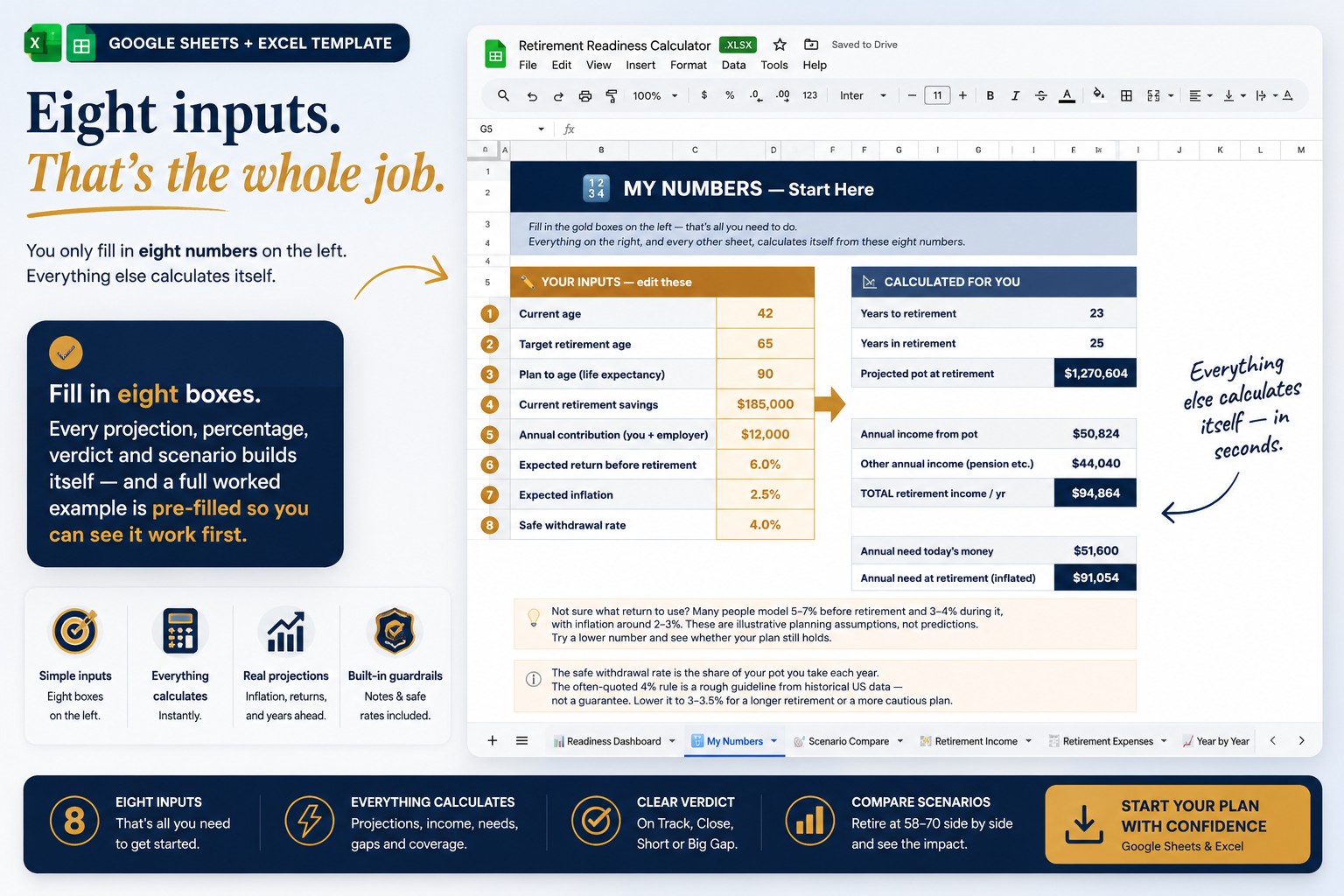
I built a retirement readiness calculator in Google Sheets that runs your complete calculation at ages 58 through 70 side by side, identifies the earliest age that reaches full coverage, and — if there’s a gap — ranks six levers by how much each would actually close it, with everything recalculating live when you change a single input:
👉 Retirement Readiness Calculator for Google Sheets & Excel
Whether you use mine or an adviser’s model, don’t leave your retirement age as a number you absorbed from someone else. Test it — properly, at every age, with honest assumptions and a cautious withdrawal rate. You might find you could stop years earlier than you assumed. Or you might find you need to change something, while there’s still plenty of time to change it. Either answer is worth having, and both beat the default you never questioned.
This is an educational perspective and describes an estimation tool — it is NOT financial, investment, tax, pension or retirement advice, and it is not a forecast or guarantee. Projections assume constant returns and ignore tax, fees, volatility and changes in law; real results will differ, potentially by a wide margin, and investments can fall as well as rise. Always consult a qualified, regulated financial adviser before making decisions. Have you ever tested a retirement age other than your default one? Tell me in the comments.