

Your Retirement Balance Is a Big Number That Answers Nothing
You check the balance, feel briefly reassured, and close the app — because the real question is sitting right behind it. “Am I saving enough for retirement?” needs a different kind of number entirely.
There’s a small ritual a lot of people over forty perform. You log in, look at the retirement balance, note that it’s a big number, feel a vague flicker of reassurance — and then close the app quickly, because right behind that number sits a question nobody has ever given you a straight answer to. Is that actually enough? Enough for how long? Enough after twenty-odd years of inflation quietly doubling the price of everything? The balance can’t tell you, and neither can most retirement tools, because they answer a different question — they track what you’re saving, not whether it will be enough. If you’ve ever wondered “am I saving enough for retirement” and come away with no real answer, here’s why, and what to look at instead.
Why a balance tells you nothing
A retirement balance is a large number with no context attached. It’s impressive-looking and completely uninterpretable, for three reasons.
First, it says nothing about what your life will cost. A given pot might be luxurious for one person and inadequate for another, depending entirely on their spending. Without knowing the costs it has to cover, the number is meaningless.
Second, it’s in today’s money, and you’ll spend it in tomorrow’s. Over the decades between now and retirement, inflation meaningfully erodes what any sum can buy. A pot that sounds comfortable today may buy a very different life in twenty years, and our intuitions about this are terrible — we simply don’t feel the compounding effect of inflation on a distant future.
Third, it ignores everything else. Your pension, state benefits, any rental income, part-time work — these can transform the picture, and none of them appear in your balance. Someone with a modest pot and a solid pension may be in far better shape than someone with a bigger pot and nothing else.
So the balance is not an answer. It’s raw material for an answer nobody has assembled.
The question that actually matters: coverage
The useful question isn’t “how big is my pot?” It’s “what percentage of what I’ll need does my projected income actually cover?” That’s a coverage percentage, and it’s a genuinely different way of thinking about retirement readiness.
The logic is simple. Work out what your retirement will realistically cost each year — in future money, inflation included. Work out what income you’d actually have: what your pot can sustainably pay you each year, plus your pension, plus any other income sources. Divide the second by the first, and you get one number.
100% means your projected income covers your projected costs. 104% means a small surplus. 80% means you’d be around 20% short and something needs to change.
That one figure does what a balance can’t: it combines everything — pot size, contributions, growth assumptions, inflation, your actual planned lifestyle, and all your income sources — into a single interpretable answer. And it’s expressed in a form you can act on: not “you have this much,” but “you’re covered / you’re short by this much.”
Why the two halves both matter
Coverage forces you to do something most people avoid: actually estimate your retirement spending. This is the half everyone skips, and it’s the half that determines the answer. It’s easy to obsess over the pot and never seriously ask what your life will cost when you stop working — which is like optimising the supply side of an equation while ignoring the demand side entirely.
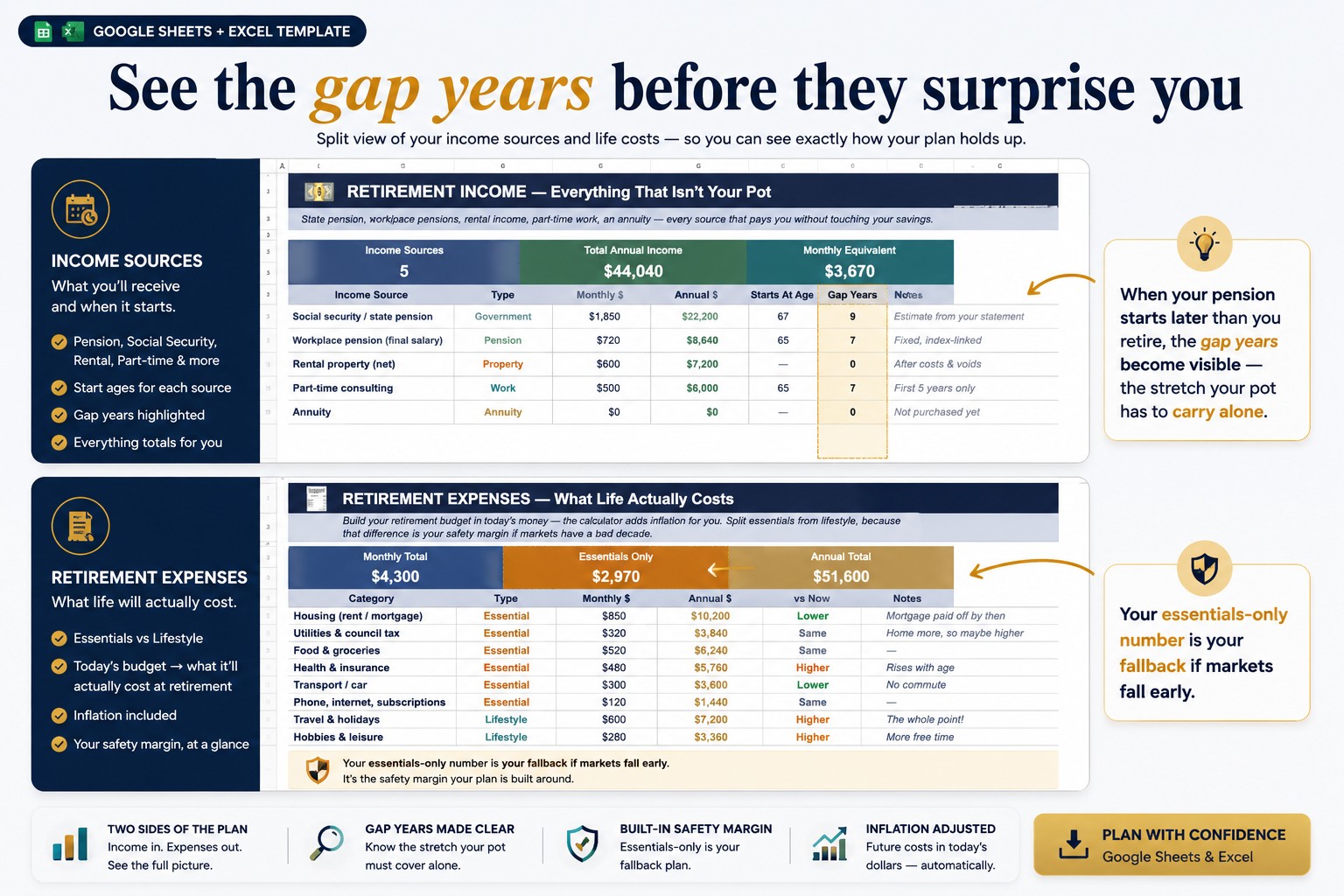
Building an actual retirement budget — split between essentials and lifestyle — is uncomfortable but revealing. And that split matters more than it seems: your essentials-only figure is your fallback number, the level you could live at if markets fell badly early on. Knowing it gives you a real sense of your margin of safety, rather than a single, fragile “plan” that only works if everything goes right.
On the income side, the detail that catches people out is timing. Your pension or state benefits may not start the day you stop working. If you retire at 60 and your pension starts at 67, those seven “gap years” have to be carried by your pot alone — a much heavier load than the averages suggest. Coverage calculated year by year, with income start ages included, makes those gap years visible. A plan that looks fine on average can be badly strained in exactly that stretch.
The honest limits of any projection
Here’s where I have to be direct, because retirement is the area where overconfidence does the most damage. Any projection like this is an estimate built on assumptions, not a forecast. It assumes a steady rate of return, when real markets are volatile. It typically ignores tax, fees, and changes in law. It can’t know your health, your career, or what markets will do in the years that matter most.
Real results will differ from any projection, potentially by a wide margin. Investments fall as well as rise, and you can get back less than you put in. And sequence risk — the danger of poor returns in the early years of retirement — can affect outcomes far more than any average return figure suggests.
So a coverage number is not a promise. What it is good for is asking better questions and understanding trade-offs: seeing roughly where you stand, seeing which assumptions matter most, and seeing whether a change would move you meaningfully. That’s genuinely valuable — as a thinking tool. It is not financial advice, and it should never be the basis for an actual decision on its own. For that, speak to a qualified, regulated financial adviser who can see your whole situation.
Vague dread versus a number you can work with
There’s one more benefit worth naming. Most people carry a low-grade, unexamined anxiety about retirement — a feeling that they’re probably behind, never quantified, never addressed. That vague dread is genuinely unpleasant and useless, because you can’t act on a feeling.
Replacing it with a rough coverage figure changes the emotional texture entirely. If you’re in decent shape, you get real reassurance instead of nervous hoping. If you’re short, you get a specific gap and — crucially — years of warning in which to do something about it. A shortfall spotted at 45 is a plan; the same shortfall discovered at 64 is a crisis. Even an uncomfortable answer is better than no answer, because an answer is something you can work with.
If you want to run your own numbers
I built a retirement readiness calculator in Google Sheets that produces exactly this — fill in eight inputs and it projects your pot, converts your budget to inflation-adjusted future costs, adds your income sources with their start ages, and gives you one coverage percentage with a plain verdict (On Track, Close, Short or Big Gap) plus the gap in dollars:
👉 Retirement Readiness Calculator for Google Sheets & Excel
Whether you use mine or a professional’s model, stop staring at a balance that can’t answer your question. Work out what your retirement will actually cost, add up what you’d actually have, and get a coverage figure you can interpret. Then take it to a qualified adviser and have a much better conversation than “here’s my balance, is it okay?” The balance was never the answer — but it’s a decent place to start looking for one.
This is an educational perspective and describes an estimation tool — it is NOT financial, investment, tax, pension or retirement advice, and it is not a forecast or guarantee of any outcome. Projections assume constant returns and ignore tax, fees, volatility and changes in law; real results will differ, potentially by a wide margin, and investments can fall as well as rise. Always consult a qualified, regulated financial adviser about your own circumstances. Have you ever calculated whether your savings actually cover your plan? Tell me in the comments.

