Nobody Warns You Adulthood Is the Hard Part of ADHD
School handed you a timetable and deadlines. Then it all stops, and you’re supposed to just remember everything. Here’s why adult ADHD executive function feels so hard — and how to build the scaffolding that vanished.
There’s a cruel surprise waiting for a lot of people with ADHD: adulthood is harder than school was. That sounds backwards — school is supposed to be the demanding part, and adulthood the freedom. But school, for all its stress, handed you something invaluable: external structure. A timetable that told you where to be. Deadlines someone else set. Terms, bells, and a whole system organising your time for you. Then you graduate, that scaffolding disappears overnight, and suddenly you’re expected to generate all of it yourself — remember the rent, the car insurance renewal, the dentist, the work report you’ve been avoiding — with no external structure and no one setting the deadlines. For an ADHD brain, that’s not a small adjustment. It’s the removal of the exact support that was quietly holding everything together. Understanding this is the key to managing adult ADHD executive function — and to being a lot kinder to yourself. Here’s how.
Why the structure mattered so much
To understand why losing external structure hits ADHD brains so hard, you have to understand executive function — the set of mental skills that handle planning, prioritising, initiating tasks, managing time, and following through. These are exactly the skills ADHD affects, and they’re exactly the skills adult life demands you supply entirely on your own.
In school, a lot of executive function was outsourced. The system planned your time, set your priorities (this class now, this deadline Friday), and created urgency through external deadlines. Your ADHD brain could lean on that scaffolding. Adult life removes it and hands you the full executive-function load: you must decide what matters, when to do it, how to break it down, and how to make yourself start — all internally, all without the external cues that used to carry you. For a brain that struggles with precisely these skills, being handed the whole load at once is genuinely overwhelming. The pile of undone tasks grows, and — because our culture frames this as a personal failing — so does the shame.
You’re not behind. You’re missing scaffolding.
Here’s the reframe that changes everything: if you’re struggling with adult admin, you’re not lazy, incapable, or “behind.” You’re a person whose brain needs external scaffolding, operating in an environment that stopped providing it. The problem isn’t you; it’s the mismatch between how your brain works and an adult world that assumes everyone can generate their own structure effortlessly.
This matters because the shame is often the most disabling part. When you believe your struggle means something is wrong with you, you waste enormous energy on self-criticism and feel too defeated to build solutions. When you understand it as a missing-scaffolding problem, it becomes solvable: you don’t need to fix your character, you need to rebuild the scaffolding that school used to provide — externally, deliberately, in a form that fits your brain. That’s a practical project, not a personal verdict.
Building your own scaffolding
So what does self-built scaffolding look like? It’s an external system that supplies the executive function adult life expects you to generate internally:
- It breaks tasks down for you. Adult tasks arrive as intimidating walls — “do the taxes,” “sort out the car.” Your brain bounces off them. Scaffolding shrinks each one to a do-able next step (“find last year’s return”), because starting is the hard part, and a small enough first step is one your brain can actually begin.
- It creates the deadlines and urgency school used to. Countdowns to appointments and flagged due dates manufacture the external urgency your brain needs, so time-sensitive things feel real before they’re a crisis, working around time blindness.
- It holds the information so your brain doesn’t have to. Everything due, every bill, every appointment, in one place you can glance at — instead of juggling it all in your head and inevitably dropping half. A brain dump clears the mental swirl so your mind can rest.
- It supplies reward the tasks don’t. Since most adult admin has no built-in payoff (and ADHD brains struggle to start unrewarding tasks), attaching a small dopamine reward to boring tasks gives your brain a reason to begin.
The goal isn’t to force yourself to be someone who doesn’t need structure. It’s to accept that you do need it and build it deliberately — the way school built it for you, but designed for your brain and owned by you.
Energy is fuel, not character
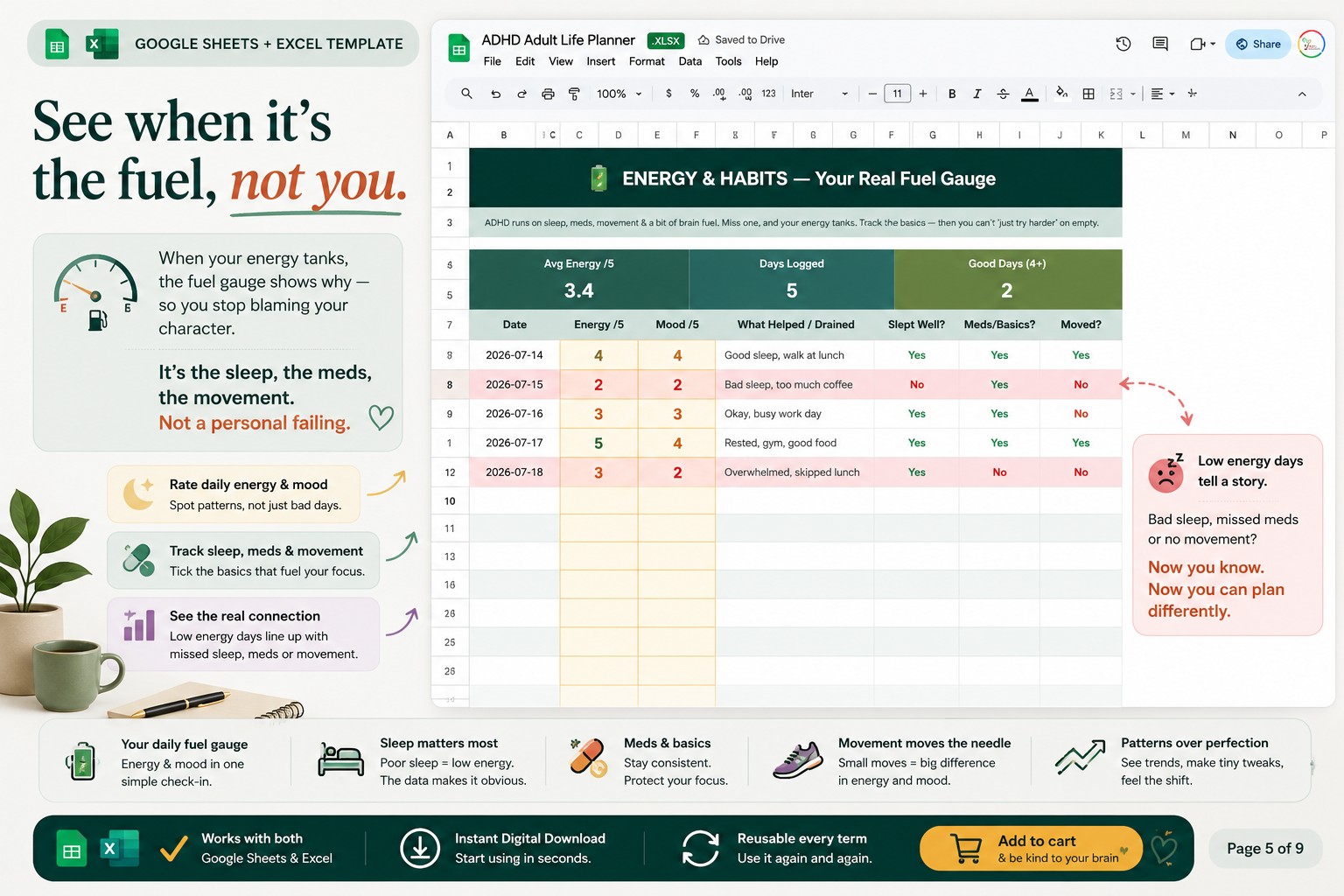
There’s one more piece that’s easy to miss and important to get right: your capacity fluctuates, and that’s not a character flaw. ADHD symptoms vary enormously with sleep, medication, movement, stress, and mood. On a well-rested, well-regulated day, the strategies work and tasks feel possible. On a depleted day, everything is harder — starting, focusing, remembering — no matter how hard you try.
The mistake is to read a low-capacity day as evidence of personal failure (“what’s wrong with me today?”). It usually isn’t a failure at all — it’s a fuel problem. When you track your energy alongside the basics (sleep, meds, movement), you start to see the patterns: the bad days line up with poor sleep, or a skipped routine, or high stress. That reframe is liberating. Instead of blaming your character on a hard day, you can see the cause, treat yourself with compassion, and adjust your expectations for the day — do the gentle version, protect the basics, and know that capacity will return. You stop fighting yourself and start working with your actual fuel level. That self-compassion isn’t soft; it’s what lets you keep going sustainably instead of burning out on shame.
An important, caring note
Please hear this: this is about self-organisation with ADHD-friendly principles — it is not medical, psychological, therapeutic, financial, or legal advice, it is not a treatment for ADHD or any condition, and it guarantees no result. Building scaffolding can genuinely help, but it doesn’t replace support from a doctor, psychologist, therapist, or other professional, and adult ADHD is best supported with proper professional guidance — including, for many people, formal diagnosis and treatment. If you’re struggling, please reach out to a qualified professional or someone you trust. Asking for help is a strength, not a weakness.
If you want scaffolding ready to build on
I built an ADHD adult life planner in Google Sheets to be exactly this kind of scaffolding — do-able next steps, bill and appointment tracking with countdowns, a brain dump, an energy-and-habits tracker to spot your patterns, and a dopamine reward shop, all in warm, shame-free language:
👉 ADHD Adult Life Planner for Google Sheets & Excel
Whether you use mine or build your own, stop blaming yourself for struggling with a load that school used to help you carry. The structure that held everything together really did disappear — and rebuilding it, deliberately and in a form that fits your brain, is a practical, achievable thing. You’re not behind. Your brain just needed the right system. Build the scaffolding, be kind to yourself on the low-fuel days, and adult life becomes a lot more manageable than it feels right now. 💚
This reflects ADHD-friendly principles and is an organising tool — not medical, psychological, therapeutic, financial or legal advice, not a treatment for any condition, and it guarantees no result. If you’re struggling, please reach out to a qualified professional or someone you trust. What scaffolding has helped you most as an adult with ADHD? Share it in the comments.