

Which Vehicle Is Quietly Bleeding You? The True Cost-Per-Vehicle Question
Somewhere in your fleet, one vehicle is costing far more to run than it earns — and your overall numbers hide it. Here’s why tracking cost per vehicle is how you find the money-pit and know when to replace.
Ask a fleet owner what their vehicles cost to run and they’ll usually give you a total — a monthly or annual figure across the whole fleet. It’s a fine number to know, but it hides the one thing that could actually save them money: the fact that their vehicles almost certainly don’t cost the same to run. Somewhere in most fleets is a money-pit — a vehicle quietly consuming far more in fuel, repairs, and downtime than it’s worth, subsidised in the overall total by the healthier vehicles around it. You can’t see it in the total. You can only see it when you break costs down to the level of the individual vehicle. Tracking true cost per vehicle is how you find the money-pit, and how you make smart, data-based decisions about what to keep and what to replace. Here’s why it matters.
The total hides the outliers
The problem with a fleet-wide cost total is the same problem as any average or sum: it blends very different realities into one number that describes none of them. Your reliable, efficient vehicles and your problem vehicle all get poured into the same pot, and the total comes out looking like “the fleet costs X.” What that total can’t tell you is that one vehicle is costing two or three times what a comparable one costs — because it’s averaged in with the good ones.
So the money-pit hides in plain sight. It’s costing you significantly more every month — more fuel, more repairs, more time off the road — but because you only look at the total, you never single it out. You might even be fond of it, or assume it’s fine because it’s still running. Meanwhile it’s quietly dragging down your whole fleet’s economics, and you’re paying for that without ever deciding to. The total isn’t wrong; it’s just hiding the decision you most need to make.
What cost-per-vehicle reveals
When you total each vehicle’s costs separately — fuel, servicing, repairs, and everything else attributed to that specific vehicle — the outliers jump out immediately, and with them, a set of clear, actionable insights:
- Your most expensive vehicle. The money-pit becomes obvious. Once you can see that one vehicle costs dramatically more to run than the others, you can investigate why (an ageing vehicle needing constant repairs, poor fuel efficiency, misuse) and decide what to do about it.
- The repair-versus-replace decision, informed. This is the big one. Every fleet owner faces the question of when an old vehicle stops being worth keeping. Cost-per-vehicle answers it with data: when a vehicle’s running costs are consistently high, the numbers make the case for replacement that “it still runs” obscures. You replace based on total cost of ownership, not on whether it happens to start each morning.
- Fuel efficiency outliers. Tracking fuel cost per mile per vehicle reveals which vehicles are thirsty — whether because of their age and condition, or because of how they’re being driven (or misused). Either way, it’s a cost you can now see and address.
- Fairer, clearer budgeting. Knowing what each vehicle actually costs lets you budget and price your work properly, rather than working off a fleet average that hides the spread.
The through-line is that cost-per-vehicle turns “the fleet costs roughly X” into “this vehicle is the problem, here’s the evidence, here’s the decision.” That’s a far more powerful place to run a business from.
Repair-or-replace: the decision cost-per-vehicle transforms
It’s worth dwelling on the repair-versus-replace question, because it’s where cost-per-vehicle earns its keep most dramatically. Owners tend to keep old vehicles too long, because each individual repair feels cheaper than buying a replacement, and because a running vehicle feels like a working asset. But a series of “cheap” repairs, plus poor fuel economy, plus downtime while it’s in the shop, can quietly add up to far more than a newer vehicle would cost to run.
The trouble is that this creeps up invisibly — no single repair triggers the realisation. Tracking the vehicle’s total cost over time makes the pattern undeniable: here’s what this vehicle has actually cost me this year, and it’s more than a replacement would. That evidence is what lets you make the replace decision confidently and at the right time, instead of pouring money into a vehicle out of inertia because you never added up what it was really costing you.
An important note
To be clear: tracking cost per vehicle is about organising and understanding your own numbers — it is not financial, tax, accounting, or business advice, and it guarantees no result. Any figures are illustrative examples; your real numbers depend on your vehicles, usage, and situation. Decisions about repairing, replacing, or financing vehicles have financial and tax implications that are yours to weigh, ideally with a qualified professional. And as ever, meeting your vehicles’ and drivers’ compliance obligations remains your responsibility.
If you want cost-per-vehicle calculated for you
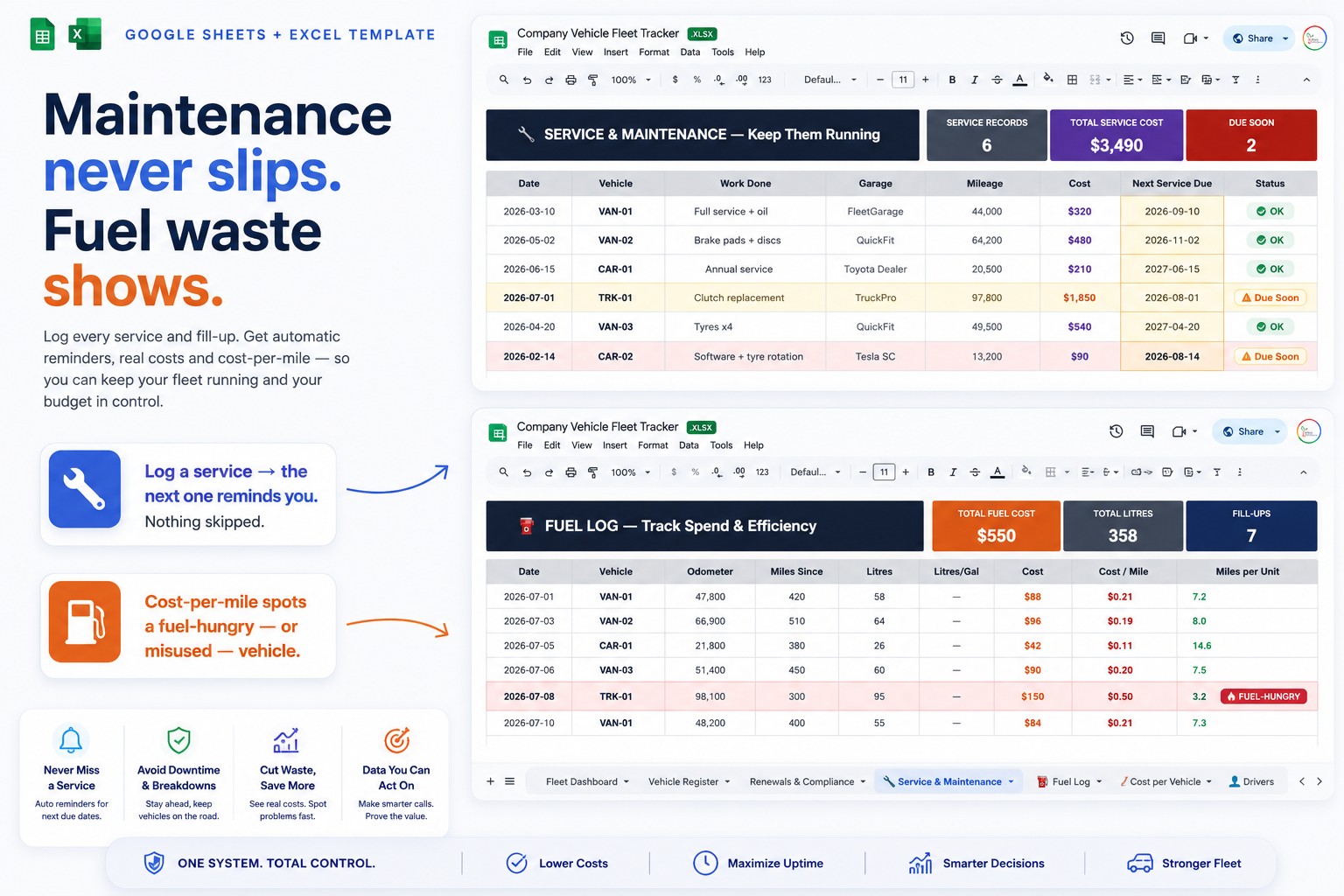
I built true cost-per-vehicle and cost-per-mile into my company vehicle and fleet tracker in Google Sheets — log fuel, service, and other costs, and it totals them for every vehicle automatically, so your money-pit can’t hide, alongside renewal alerts, service reminders, and a full fleet dashboard:
👉 Company Vehicle & Fleet Tracker for Google Sheets & Excel
Whether you use mine or build your own, stop judging your fleet by its overall cost and start looking at what each vehicle actually costs you. The money-pit hiding in your total is a decision waiting to be made — and you can only make it once you can see the number. Find your most expensive vehicle, understand why, and decide what it’s really worth keeping. That’s how a fleet gets leaner instead of just older.
This reflects my own perspective and is an organising tool — not financial, tax, accounting or business advice, and it guarantees no result; figures are examples, and vehicle decisions have implications best weighed with a professional. Fleet owners: have you ever discovered one vehicle was costing you far more than the rest? Tell me in the comments.

