You Know the Number. You Don’t Know the Date.
You’ve added it up at 2am more than once. What you’ve never had is the only figure that actually helps: when it ends. Here’s why most debt trackers can’t tell you, and what does.
If you’re carrying debt across several accounts, you almost certainly know the total. You’ve added it up, probably late at night, probably more than once. What you don’t know — what almost nobody knows — is the answer to the question that would actually change how the next two years feel: when does this end? Most debt trackers can’t tell you. They give you a list, a total, and a percentage bar, which is your existing knowledge presented more attractively. A debt free date requires something different: an actual simulation of what happens, month by month, from your own numbers. Here’s why that distinction matters more than it sounds.
Before anything else
One thing first, because it matters more than any of the rest. If you’re struggling to make even the minimum payments, please don’t start with a spreadsheet. Speak to a free, reputable debt advice service in your country. They can do things no planning tool can — negotiate with creditors, get interest frozen, and protect you legally — and going early gives you far more options than going late. There is genuinely no shame in it; it’s what those services exist for.
What follows is for people who can meet their minimums and want a route out with a date on it.
Why a percentage bar tells you nothing useful
A progress bar showing “23% paid off” feels like information. It isn’t, in any way you can act on.
It can’t tell you when you’ll finish, because that depends on interest rates, minimum payments and how your extra payment is allocated — none of which a percentage knows about. It can’t tell you what the remaining journey will cost you in interest. And it can’t tell you whether you’re on a five-year path or a two-year one, which are wildly different lives.
Worse, it’s misleading in a specific way: debt payoff isn’t linear. Early on, a large share of your payments is servicing interest, so the bar crawls. Later, as balances fall and freed-up minimums pile onto remaining debts, it accelerates dramatically. A bar that’s moved slowly for six months feels like failure when it’s actually just the shape of the curve — and that feeling is exactly what makes people give up right before the fast part.
A date doesn’t have that problem. A date is a fact you can hold onto through the slow months.
What a real simulation actually does
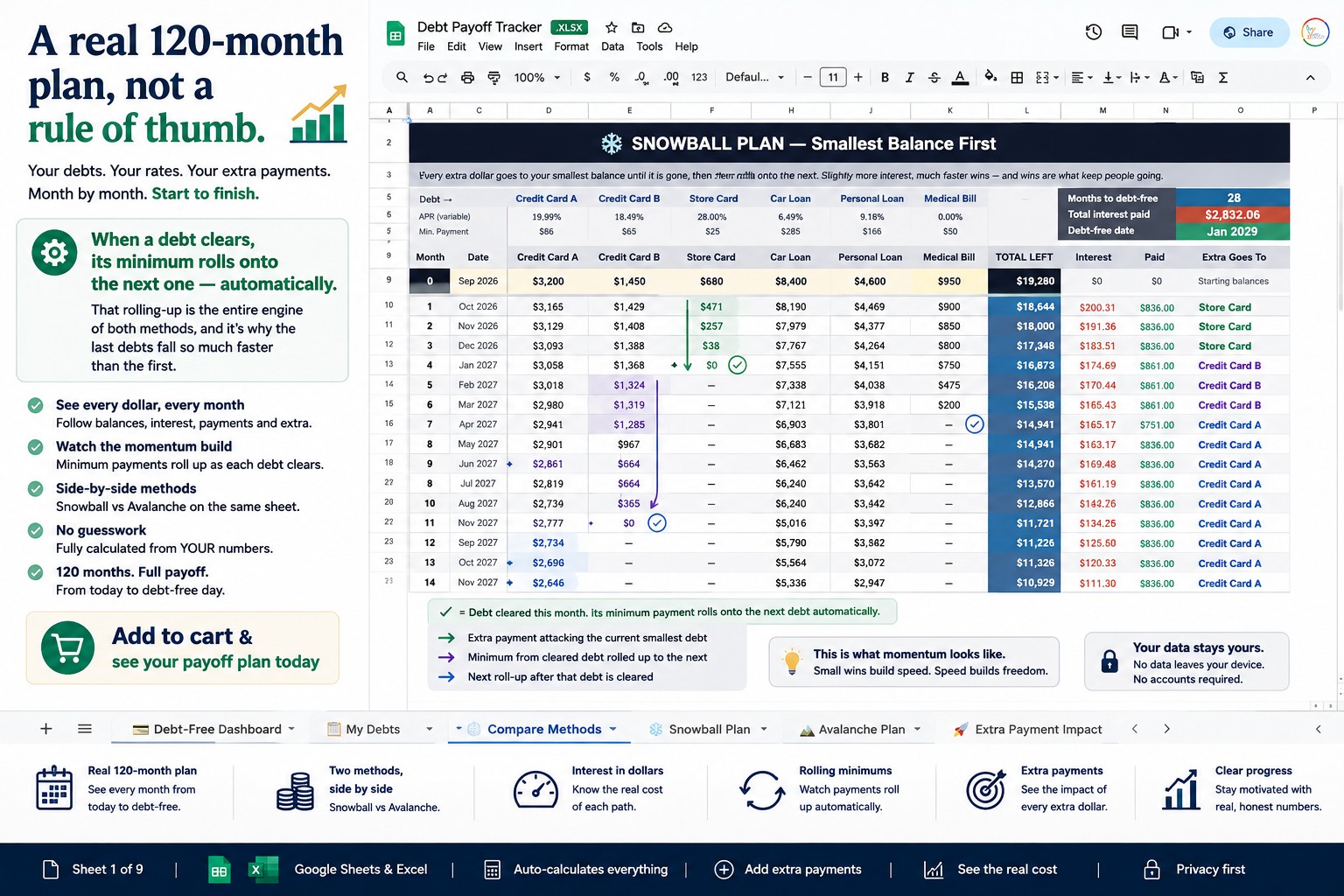
To produce a date, you have to model what genuinely happens each month across all your debts at once:
- Minimum payments go to every debt.
- Interest is added to each remaining balance.
- Your extra payment goes to one target debt, chosen by whichever method you’ve picked.
- When that debt clears, its minimum is freed — and rolls onto the next target, on top of your extra.
That last step is the whole engine. It’s why the process accelerates: your effective attack payment grows every time a debt falls, without you finding another penny. The first debt takes ages; the last one collapses in weeks.
Run that forward across ten years and you get two things a rule of thumb can never give you: the month you become debt-free, and the total interest you’ll pay getting there. Both from your balances, your rates, your minimums — not from an average or an assumption.
That second number, total interest, is often the one that changes behaviour. Seeing what the journey costs, in currency, tends to be far more motivating than any encouragement.
Compare the methods with your own numbers
Once you can simulate, you can do something the internet argues about endlessly and rarely resolves: run both common methods on your actual debts and see the real difference.
Snowball targets the smallest balance first — you clear debts sooner and get visible wins early. Avalanche targets the highest interest rate first, which is mathematically always the cheapest. The debate about which is “correct” is usually conducted in the abstract, with strong opinions and no numbers.
Run both and the argument dissolves, because you can see the actual gap for your situation. And here’s the thing most people find: the gap is smaller than expected. If avalanche saves a couple of hundred dollars and a month over two years, and snowball is the one whose early wins will keep you going, then snowball is the better plan for you — because a plan you abandon saves nothing at all.
That’s a decision you can only make properly with both numbers in front of you. Without them, you’re choosing between two pieces of advice rather than two real options.
Be honest about what an estimate is
A date is powerful, and it deserves an honest caveat: it’s an estimate, to the nearest month, based on assumptions.
Any simulation like this assumes your rates, minimum payments and extra payment stay exactly as entered. Reality moves: minimum payments usually fall as balances drop (which slows you down unless you keep paying the original amount), promotional 0% periods end and revert to a rate that’s often the highest you have, and fees and charges typically aren’t modelled at all.
So expect close, not identical to your lender’s figures. That’s fine — the value isn’t precision, it’s direction and scale. Knowing you’re roughly 28 months out rather than “sometime in the next few years” is the difference that changes how you behave. Just don’t book anything on the exact month, and re-run it if something changes.
An important note
To be clear: this is a general explanation and a way of organising your own figures. It is not financial, debt, credit, tax, legal, or professional advice; it is not a debt solution or a regulated debt-management service; and it guarantees no outcome. All figures mentioned are illustrative. Calculations of this kind assume monthly interest on the remaining balance with everything held constant; real agreements vary and fees aren’t modelled. Rules on credit, default, insolvency and debt collection differ by country. If you’re struggling to meet minimum payments, contact a free and reputable debt advice service, and consult a qualified financial adviser before making decisions about your debts.
If you want the date calculated for you
I built a debt payoff tracker in Google Sheets that runs a real month-by-month simulation — up to 8 debts over 120 months, with freed minimums rolling onto the next target automatically, producing your debt-free date and total interest, and calculating both snowball and avalanche so you can compare them side by side with a plain verdict on which wins and by how much:
👉 Debt Payoff Tracker for Google Sheets & Excel
Whether you use mine or build the simulation yourself, get a date. You already know the number — that part was never the problem. What changes the next two years is knowing when they end, and having a plan that names what to do each month. Not a list. A plan. 💳
This reflects my own perspective and describes a planning tool — NOT financial, debt or credit advice, not a debt solution, and it guarantees no outcome; results are estimates and will differ from your lender’s figures. If you’re struggling to meet minimum payments, please contact a free, reputable debt advice service. Do you know your debt-free date, or just your total? Tell me in the comments.