Sold for $68. Paid $6. You Made $42.49.
Every reseller does the same sum — sale price minus what you paid. The gap between that number and the real one is what decides whether reselling is a business or an expensive hobby you enjoy.
A pair of vintage jeans, sourced for six dollars, sold for sixty-eight. Every reseller I’ve ever met does that sum the same way: sixty-eight minus six, sixty-two dollars of profit, brilliant day. And it was a good day — but it wasn’t sixty-two dollars. The platform fee was $9.31. Shipping was $9.40. The polymailer, the tissue paper and the tape came to eighty cents. Actual reseller profit: $42.49. Still a good flip. Just not the one you told your partner about. And when you apply that gap across a whole year of sales, it stops being a rounding error and starts being the difference between a business and a hobby with good stories.
A third of it, gone before anyone counted
In a worked example of eight sold items, the quick sum says $454 of profit. The real number, once fees, shipping and packaging come out, is $302.71.
That’s roughly a third of the money — and crucially, it disappears before anyone counts it. The reseller experiences the sale, sees the payout, and mentally banks the flattering figure. The costs arrive separately: a fee deducted at the platform end, shipping paid at the counter, packaging bought in bulk weeks earlier and never attributed to any particular item.
Three different moments, three different places, none of them next to the sale. So the gap never appears anywhere you’d notice it.
What actually comes out
Four things, and the last one is the one nearly everyone omits:
Platform fees. Usually a percentage, often with a payment-processing charge on top, and frequently different by category. This is the biggest single bite.
Shipping. If you offer free shipping, it comes out of your money — which is the entire point of “free” shipping, and it’s remarkable how often it’s mentally treated as costing nothing.
Packaging. The mailer, the tape, the tissue, the label, maybe a thank-you card. Pennies per item, and it’s the one people wave away. Across a few hundred sales it isn’t pennies at all.
The cost of the item. Which everyone does count.
Work out your packaging cost per parcel once — buy in bulk, divide by units, and you have a number you can apply to every sale forever. It takes ten minutes and it’s the difference between an estimate and a fact.
Your fees, not published ones
Here’s a warning worth taking seriously: don’t build your numbers on fee percentages you read somewhere, including in an article like this one, which is why I haven’t quoted any.
Platform fee structures change several times a year. They differ by category. They differ by country. Many carry a separate payment-processing charge that isn’t in the headline rate. A percentage that was right when someone wrote a blog post is quite likely wrong now.
The only reliable source is your own account. Look at what an actual completed sale shows you was deducted, and build your calculations on that. Ten minutes with a real payout screen beats any table you’ll find online, and it means every number you calculate afterwards is genuinely yours.
The same applies to shipping. Rates change, bands differ, and what you pay depends on your carrier and your service. Build your own band table from your own prices.
Price backwards from what you keep
Once you know your true net, the most useful thing it unlocks is pricing.
Most resellers price forwards: this looks like it’s worth about thirty dollars, so list it at thirty. Which means the fees, shipping and packaging come out of whatever’s left, and sometimes there isn’t much left.
Pricing backwards is better. Decide what you want to keep from an item, then add the fee, the shipping and the packaging to get the listing price. Now the price is derived from the outcome you wanted rather than from a guess about the market.
That won’t always work — the market has its own opinion, and sometimes the honest answer is that an item can’t be sold at a price that pays you. But that’s genuinely useful information too, and it’s better learned before you buy than after you’ve listed.
Which leads to the single most valuable habit: know your target return before you’re standing in a thrift store holding something. If you know what multiple you need, sourcing decisions become fast and unemotional instead of hopeful.
Two more numbers worth having
Beyond net profit per item, two figures tell you most of what you need about the health of the operation.
ROI as a multiple, not just as a dollar figure. Making $20 on a $5 item is a completely different business from making $20 on a $60 item, and only a multiple shows that. It’s also the number that makes sourcing decisions instant.
Days to sell. A $40 profit in four days and a $40 profit in fourteen months are not the same thing — the second one tied up your money and your shelf space for a year. Tracked across your inventory, days-to-sell tells you which categories actually move, which is the thing that determines whether you can keep buying.
Together with sell-through rate — what proportion of what you bought has actually sold — these three turn a pile of individual flips into something you can see the shape of.
An important note
To be clear: this is a general perspective on tracking your own numbers. It is not tax, accounting, legal, financial, or business advice, and it guarantees no outcome. All figures mentioned are illustrative examples, and any fee percentages are placeholders rather than current rates — replace them with what your own accounts show. Platform fees, payment charges, shipping prices, customs rules and the tax treatment of reselling all differ by country and change frequently. Whether your selling counts as a hobby or a business, when you need to register, what you may deduct, and what platforms report on your behalf are questions for a qualified accountant in your own country. Also check each platform’s rules on what may be sold, and any laws covering second-hand goods, safety labeling and counterfeits where you live.
If you want it calculated for you
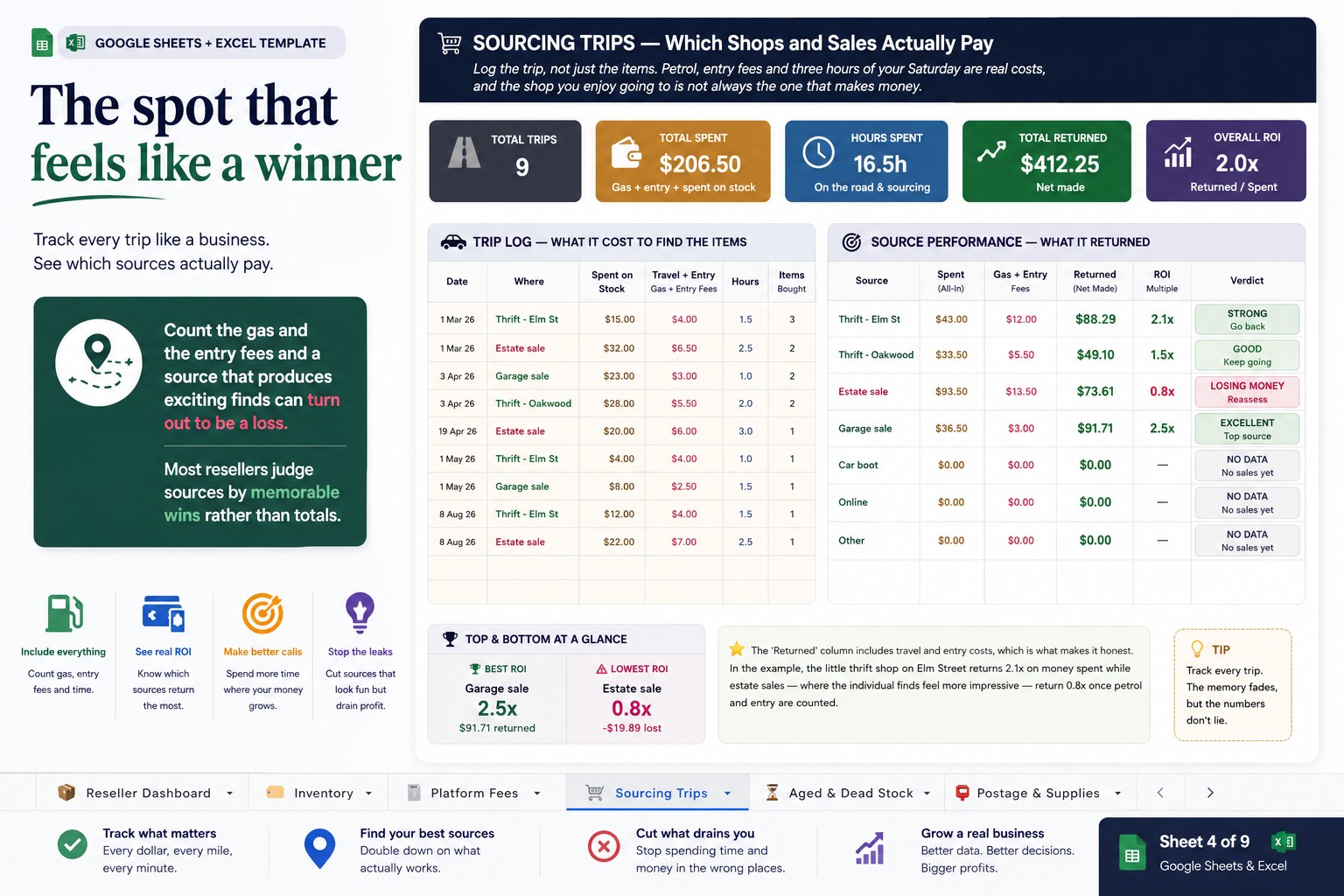
I built a reseller inventory and profit tracker in Google Sheets that does this per item — sale price minus the fee (looked up from a rate table you fill in with your own account’s numbers), minus shipping, minus packaging, minus cost, giving real net profit, ROI as a multiple, days to sell and sell-through, plus a headline figure showing what percentage of your apparent profit the fees actually took:
👉 Reseller Inventory & Profit Tracker for Google Sheets & Excel
Whether you use mine or a calculator, do the honest sum on your last ten sales. Fees, shipping and packaging included. The number will be lower than the one in your head, and knowing it is what lets you price properly, source better and decide whether this is paying you. Revenue is what you tell people. Margin is what you keep. 📦
This reflects my own perspective and describes a tracking tool — NOT tax, accounting or business advice, and it guarantees no outcome; figures are illustrative and any fee rates are placeholders. Tax treatment of reselling differs by country — ask a qualified accountant. Resellers: what was your gap between the quick sum and the real one? Tell me in the comments.