You’ve experienced this: You learn a new word, encounter a concept you’d never heard of, or buy a car model you’d never noticed — and within days it seems to be everywhere. On billboards, in conversations, in articles you open at random. The world hasn’t changed. You have. The Baader-Meinhof Phenomenon is the name for this experience — and it reveals something important about how your mind filters reality.
The strange origin of the name
The name is one of the more peculiar origin stories in cognitive psychology. In 1994, a commenter on a discussion forum hosted by the St. Paul Pioneer Press — who went by the name Frequency Illusion — posted about an experience: they had recently learned about a German terrorist organization called the Baader-Meinhof Group, and within days seemed to encounter references to it everywhere they looked.
The post resonated with other readers who had had the same experience with different topics. The phenomenon was named after the specific example — which is why a fairly obscure mid-twentieth century German terrorist organization has its name attached to one of the most commonly experienced cognitive phenomena in everyday life.
The technical name — the one psychologists prefer — is the frequency illusion, coined by Stanford linguistics professor Arnold Zwicky in 2006. Both names describe the same thing: the experience of a newly learned word, concept, or object appearing with seemingly implausible frequency immediately after you first encounter it.
Read also: What I Learned After Getting It Badly Wrong
What the Baader-Meinhof Phenomenon actually is
The phenomenon is not real — in the sense that the frequency of encounters has not actually increased. The word was always in books you were reading. The car model was always on roads you were driving. The concept was always being discussed in places you frequented. What changed is not the world — what changed is your perceptual filter.
Before you learned a word, your brain had no reason to flag it. You encountered it and filtered it out unconsciously, as you filter out most of the information in your environment at any given moment. The moment you learn it and find it meaningful, your brain updates that filter. Now it flags the word every time it appears — and because it was always appearing, it now seems to be appearing everywhere, suddenly.
The “illusion” in frequency illusion is precisely this: the impression that something has become more frequent when the actual change is in your perceptual filter, not in the world’s behavior.
The two cognitive mechanisms that create it
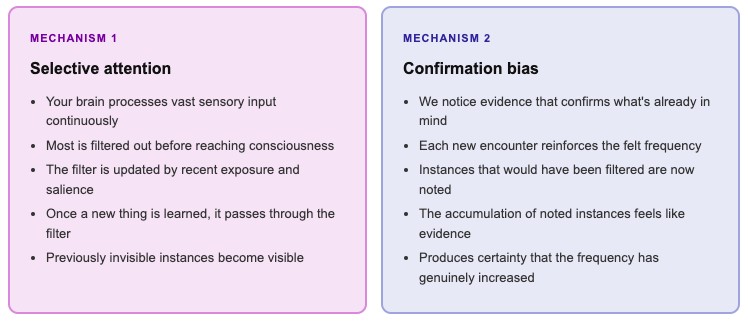
The two mechanisms work together: selective attention makes the previously invisible visible, and confirmation bias makes each newly visible instance feel like evidence of a real trend rather than a perceptual update. The result is a genuinely convincing experience of increased frequency — one that feels real precisely because the perceptual mechanism creating it operates below the threshold of conscious awareness.
Where you’ve already experienced it
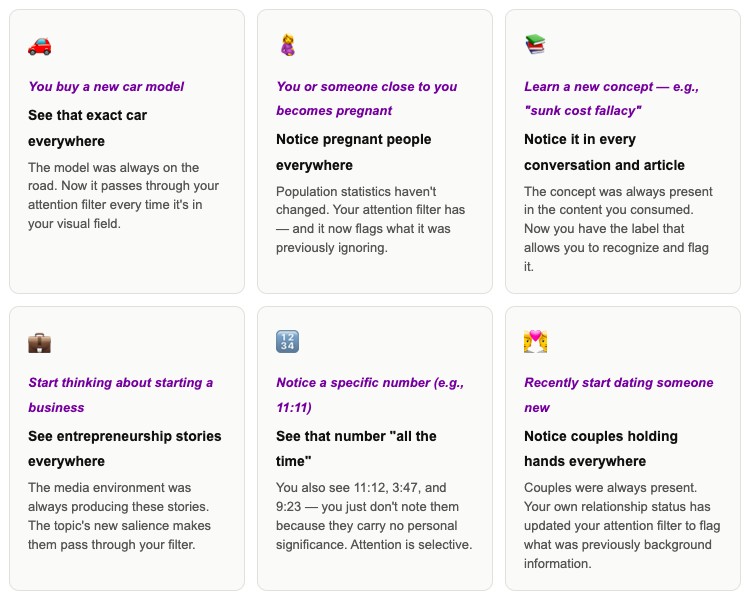
Why it matters — the decision implications
📈 It can make you overestimate market opportunity Entrepreneurs frequently report noticing their problem everywhere after deciding to build a solution for it. This experience feels like market validation. It isn’t. It’s the Baader-Meinhof Phenomenon — your filter updating to flag instances you were previously ignoring. Actual market validation requires data, not felt frequency.
📰 It amplifies confirmation bias in belief formation Once you form a belief, the frequency illusion makes confirming evidence feel more prevalent than disconfirming evidence — not because it is, but because confirming evidence now passes through your attention filter more readily. Combined with confirmation bias, this produces an increasingly compelling but potentially distorted picture of reality.
💊 It can produce false medical patterns After reading about a medical condition or symptom, people frequently notice symptoms they previously ignored. This can produce genuine anxiety about health conditions based on symptoms that were always present but previously filtered out. The felt frequency of symptoms increases not because they have increased but because attention to them has.
💰 It influences investment and trend-following decisions After learning about a new technology, investment trend, or business model, people frequently conclude that it is becoming ubiquitous — and make investment or career decisions based on that perceived ubiquity. The frequency illusion cannot distinguish between a genuine trend and a perceptual update.
Read also: Why Vivid Events Feel More Probable Than They Actually Are
How to use it deliberately — and productively
While the Baader-Meinhof Phenomenon is most often discussed as a cognitive distortion, it can also be used as a deliberate learning tool. The mechanism — that newly acquired knowledge causes your brain to flag related instances it was previously filtering out — means that learning a concept genuinely expands what you notice in your environment.
Learning the term “sunk cost fallacy” means you now notice sunk cost reasoning in conversations and articles where you would previously have had no label for what you were observing. Learning about anchoring bias means you begin noticing anchoring in negotiations, pricing, and persuasion that was previously invisible to you. The frequency illusion is the mechanism by which new vocabulary and concepts increase the richness of what you observe in the world.
This is why the study of cognitive biases, mental models, and decision frameworks is more practically valuable than it might initially appear: each new concept you genuinely understand becomes a new channel of perception — a new frequency your attention can now receive. The Feynman Technique is useful partly because it produces genuine understanding that unlocks this perceptual expansion.
The limits of using it intentionally
The perceptual expansion the phenomenon enables is real. But it carries the same risks as all pattern recognition: it can produce false positives as readily as genuine insights. Seeing anchoring bias everywhere after learning about it doesn’t mean anchoring is present in every situation you notice. Noticing potential sunk cost reasoning in every decision doesn’t mean sunk cost reasoning is the operative bias.
The corrective is the same as for availability heuristic and confirmation bias: felt frequency is not actual frequency. The felt impression that you’re now seeing a thing everywhere needs to be checked against actual evidence before conclusions are drawn. The phenomenon makes patterns visible — but pattern recognition still requires the discipline of verification.
Read also: The Mental Model That Changed How I See Everything
Conclusion: the filter you don’t know you’re running
The Baader-Meinhof Phenomenon is ultimately about the gap between what exists in the world and what you perceive — a gap that is much larger than most people intuitively believe, and that is shaped by your current mental state, recent experiences, and the concepts and labels you have available.
Every cognitive concept you learn, every mental model you internalize, every framework you genuinely understand updates that filter. The world you perceive becomes incrementally richer, more structured, and more legible — not because the world changed, but because you did.
That is both a description of a cognitive quirk and a fairly good summary of why intellectual development matters.
An experiment you can run right now
Pick a word or concept you encountered recently for the first time — something in this blog, a conversation, a book. Write it down.
Over the next week, simply notice how often you encounter it. Don’t seek it out. Just track the encounters.
You will see it more often than you expected. That experience is the Baader-Meinhof Phenomenon in real time — and it is also the mechanism by which every new concept you genuinely learn expands what you’re able to perceive in the world around you.