

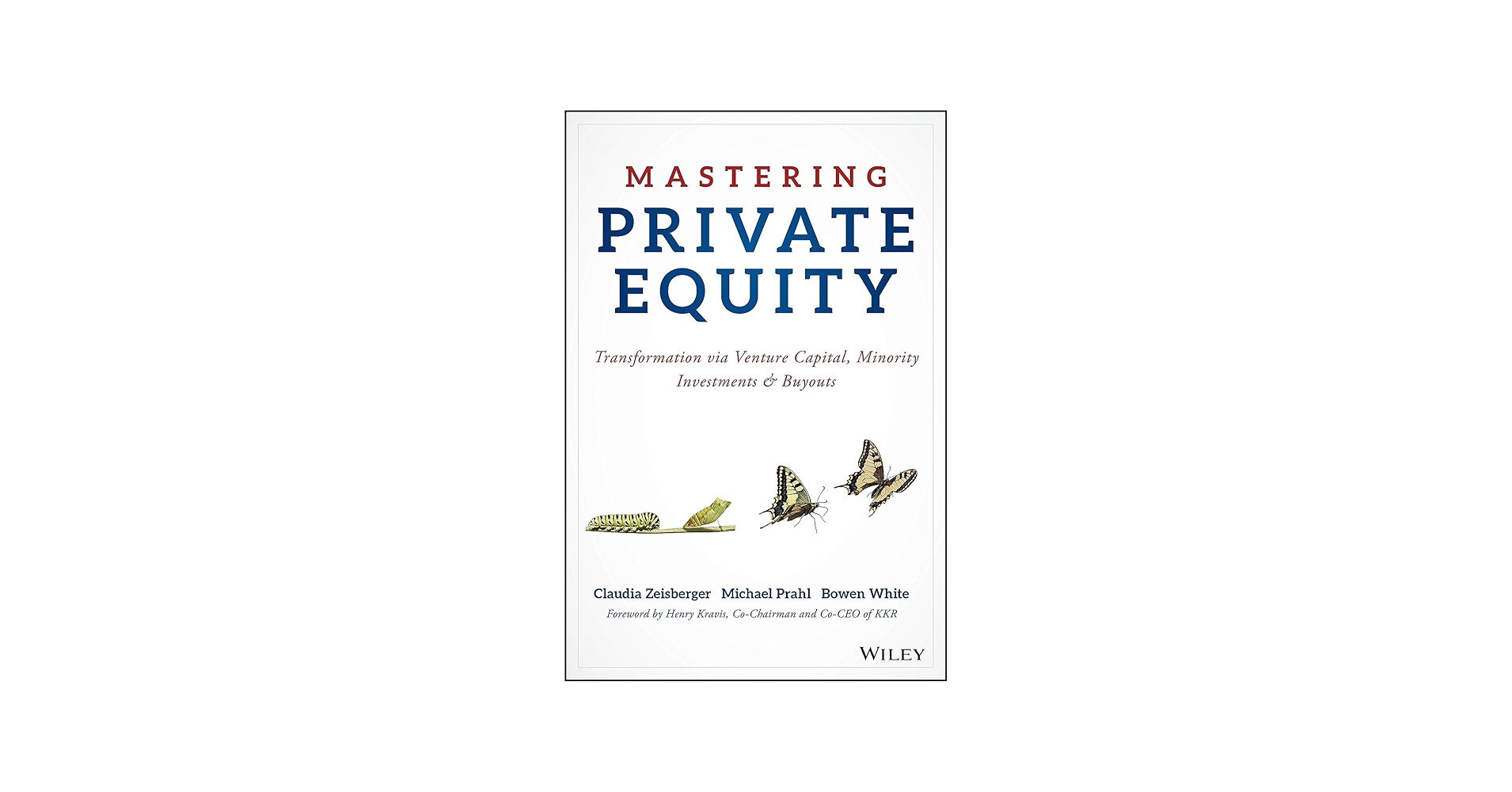
- Star Rating: ⭐⭐⭐⭐⭐ (5/5 Stars)
- One-Sentence Verdict: Private Equity is the ultimate “transformation agent,” leveraging the strategic alignment of interests and long-term capital to professionalize, scale, and revitalize businesses at critical developmental junctures.
- Best For: Entrepreneurs seeking sophisticated funding, finance professionals pivoting into alternatives, and business leaders aiming to adopt a rigorous “owner mindset.”
- Difficulty: Intermediate—requires a foundational grasp of financial statements and a professional understanding of EBITDA and balance sheet mechanics.
- Purchase Link: [Mastering Private Equity on Amazon]
1. INTRODUCTION: THE REALIZATION
Early in my career, sitting across the table from corporate boards and family business owners, I was acutely aware of the “barbarians at the gate” stigma that shadowed the Private Equity (PE) industry. To the uninitiated, we were the financial engineering wizards of the 1980s—predatory forces focused on hostile takeovers and stripping assets for a quick gain. However, as I transitioned from the periphery of finance into the seat of a Senior Principal, my perspective shifted entirely. I realized that PE is not a weapon of destruction, but rather a surgical “transformation agent.”
This realization is rooted in the architectural elegance of the 10-year fund model. In the public markets, CEOs are often handcuffed by the “quarterly earnings treadmill,” forced to prioritize short-term optics over long-term health. Private Equity operates on a different temporal plane. By locking in capital for a decade—what we call “patient capital”—we earn the right and the responsibility to think about long-term value creation. Whether we are providing “visionary capital” to a start-up struggling with commercialization or helping a third-generation family business navigate the “shirtsleeves to shirtsleeves” succession crisis, we are the catalyst for change.
The “Power of Capital” in our world isn’t just about the size of the check; it’s about the structural alignment it creates. Understanding this system is essential for any modern business leader because it represents the purest form of active ownership. This article will deconstruct that system—moving from the architecture of the PE ecosystem to the operational toolkits we use to build businesses that are not just bigger, but fundamentally better.
Read also: How I Upgraded My Thinking with Adler’s 4 Levels of Reading
2. THE PRIVATE EQUITY ECOSYSTEM: THE ARCHITECTURE OF POWER
To understand how capital moves, one must first understand the vehicle. A PE fund is typically a stand-alone, closed-end limited partnership. It operates as a “blind pool,” meaning Limited Partners commit their capital before we have even identified the target companies. This structure is a strategic necessity; it grants us the agility to move with high conviction when a deal surfaces, without the delays of an investor vote.
The ecosystem is defined by three primary players, each bound by a rigorous incentive structure:
| Player | Role & Characteristics | Key Incentives & Mechanics |
| Limited Partners (LPs) | Passive investors like pension funds, endowments, and sovereign wealth funds. They provide the vast majority of capital. | Seeking market-beating returns to cover future liabilities. They face a strict 10-day notice period for capital calls. |
| General Partners (GPs) | The PE firm (e.g., KKR, Apax). We source, execute, and manage the investments under a fiduciary duty. | The “2 & 20” model: A 1.5–2% management fee for operations and 20% Carried Interest (net profits). |
| Portfolio Companies | The “investee” or “target” companies. These are the entities undergoing transformation. | Access to capital, mentorship, and the Operational Value Creation levers required to scale or restructure. |
One of the most critical aspects of this ecosystem is Incentive Alignment. We don’t just ask LPs to trust our spreadsheets; we put our own money on the line. Most GPs commit 1% to 5% of the fund’s total capital—often representing the lion’s share of the partners’ personal net worth. This “skin in the game” is non-negotiable. As Henry Kravis famously noted in the foreword to Mastering Private Equity, when a management team has a significant portion of their own capital at risk—as they do through Sweet Equity structures—they don’t just “recommend” a budget; they agonize over the results of every single drilling site or manufacturing line.
Furthermore, we’ve seen a trend toward 100% management fee offsets, where fees we collect from portfolio companies are credited back to the LPs, further narrowing the focus to pure investment performance. From my seat on the Investment Committee (IC), every deal is scrutinized through this lens of shared destiny.
Read also: How I Learned to Solve Complex Problems in a Non-Linear World
3. THE TRIFECTA: VENTURE CAPITAL, GROWTH EQUITY, AND BUYOUTS
“Private Equity” is an umbrella term for a spectrum of risk and return profiles. As an investment strategist, I view these through the lens of a company’s lifecycle, and the toolkit required for each is vastly different.
- Venture Capital (VC): This is the “hit-or-miss” game. We invest minority stakes in start-ups that are often pre-revenue. The technical reality is that two-thirds of these investments may lose money. To reach a target Internal Rate of Return (IRR) of 40–80%, we need “home runs”—investments that return 10x or 100x our capital. We guide these firms through three critical stages:
- Proof-of-Concept: Feasibility studies and prototype development.
- Commercialization: Translating the idea into an operating business with a high burn rate.
- Scaling Up: Exponential growth and market penetration.
- Growth Equity: This is the dominant strategy in emerging markets. We take minority stakes in established, fast-growing companies (SMEs). The challenge here is managing multiple stakeholders without absolute control. We focus on Professionalization—implementing governance, reporting systems, and succession planning. It is about helping a family-run business make the “transformational leap” to a global stage without the “shirtsleeves” decline.
- Leveraged Buyouts (LBOs): This is the heavy lifting. We acquire controlling stakes in mature companies, often using significant debt. The “disciplining effect of debt” is real; it forces management to prioritize high net present value projects because the interest must be paid. In an LBO, we use the company’s own cash flow to deleverage the balance sheet, systematically shifting value from debt-holders to equity holders.
The “So What?” layer here is clear: the operational toolkit for a start-up is mentorship and hiring; for a buyout, it is restructuring and Operational Value Creation. As we move from the types of investments to the timing of returns, we encounter the industry’s most misunderstood metric: the J-Curve.
Read also: How Small Actions Trigger Massive Change
4. THE J-CURVE: THE TEMPORAL REALITY OF RETURNS
The J-Curve is the visual representation of “patient capital.” It tracks the cumulative net cash flow of an LP, and for the first few years, it is a valley of red ink. Understanding the strategic importance of the “10+2” year model is vital for anyone managing a PE portfolio.
- The Investment Period (Years 1–5): Large cash outflows occur as the GP calls capital. During this stage, management fees (charged on Committed Capital) and transaction costs further depress the curve.
- The “Valley”: Cumulative net cash flow reaches its low point. LPs must maintain liquidity to meet Capital Calls within 10 business days. As a GP, when you are sitting in the trough of the J-Curve in year three, you aren’t just watching the clock; you are obsessing over the 100-Day Plan metrics that will eventually drive the upward trajectory.
- Harvesting (Years 6–10+): As the GP begins to exit investments, distributions cross the x-axis. The final point on the J-Curve represents the LP’s total net profit.
This temporal reality is why we track Dry Powder—uninvested committed capital—so closely. A common misconception is that dry powder is always rising. If we look at the data (Exhibit 1.4), dry powder hit a massive peak in 2007–2008 at approximately $745 billion before the financial crisis forced a reset. By 2015, the “war chest” had recovered to roughly $661 billion, but with a crucial nuance: $531 billion of that was from “fresh” 2013–2016 vintages, while older “zombie” capital from 2000–2009 had dwindled to $68 billion. While the J-Curve tracks the money, it is the engine of value creation that determines the slope of the recovery.
Read also: A Macro-Historical Deconstruction of Yuval Noah Harari’s Homo Deus
5. VALUE CREATION: BEYOND FINANCIAL ENGINEERING
The persistent myth that PE is just “buying low and selling high” is a relic of the past. In the modern, hyper-competitive landscape, “buying right” is only the entry ticket. Success is driven by an “Industrialist” mindset—a term championed by Bill Cornog of KKR Capstone. We hit the ground running the day a transaction closes with a 100-Day Plan designed to create value with a sense of urgency.
We leverage three primary pillars to move the needle:
- Deleveraging: Using the portfolio company’s free cash flow to pay down the senior and junior debt. This is the bedrock of the LBO leveraged buyout mechanics.
- Multiple Expansion: Buying a company at 9x EBITDA and selling it at 10x or 11x. This isn’t just luck; it happens because a more professional, larger, and more stable company—one with better governance and a cleaner balance sheet—is fundamentally worth more to the next buyer.
- Operational Improvements: This is the most vital lever. We focus on margins, topline growth, and “Operational Value Creation Levers.” As Exhibit 4.4 illustrates, in a successful LBO, roughly 47% of value created can come from EBITDA growth, while only 20% might come from multiple expansion and 33% from debt reduction.
Operations—the ability to make a company better, faster, and leaner—is now the primary driver of PE success. We aren’t just financiers; we are practitioners of transformation.
Read also: The Exact Formula for Wealth Creation
6. EXIT STRATEGIES: THE MOMENT OF TRUTH
A PE fund is only as good as its last exit. Because we are in a “closed-end” structure, we are contractually obligated to return capital to our LPs. A “clean exit” is the ultimate measure of a GP’s success, and our toolkit includes:
- Initial Public Offering (IPO): High visibility and validation, but it leaves us subject to market volatility and “lock-up” periods.
- Trade Sale: Selling to a Strategic Buyer (a corporation in the same industry). These buyers often pay a “control premium” because they can realize synergies—cost savings or revenue boosts—that a Financial Buyer cannot.
- Secondary Buyout: Selling the company to another PE fund. This has become common as funds specialize; a mid-market fund might take a company from $100M to $500M in revenue, then sell it to a “mega-fund” equipped to take it to $2B.
During these exits, the fund is often protected by Liquidation Preferences. In VC and Growth Equity, this ensures that preferred shareholders (the fund) get their invested capital back first before any distributions are made to common shareholders. This safety net allows us to take the significant risks required to back disruptive innovation.
Read also: How Better Thinking Leads to Better Outcomes
7. CRITICAL ANALYSIS: BARBARIANS OR BENEFACTORS?
The public perception of our industry is undeniably cyclic, often swinging based on the latest headline-grabbing default. However, the reality of active ownership is far more nuanced than the “boogeyman” narrative suggests.
| Critics’ View | Supporters’ View |
| Asset Stripping: High leverage increases the risk of financial distress and bankruptcy. | Disciplining Agent: PE forces efficiency in “zombie” companies that would otherwise stagnate. |
| Short-termism: Cost-cutting can lead to layoffs and “pass-the-parcel” follow-on transactions. | Growth Engine: Active ownership saves companies by providing capital for R&D, international expansion, and ESG. |
| Opacity: The industry is traditionally opaque, leading to misinterpretation of its benefits. | Alignment: Management ownership programs turn employees into owners, driving better outcomes for all. |
The key lesson is the Alignment of Interest. Henry Kravis’s story of the 1980s oil and gas company budget remains the gold standard for this concept. When management realized that their 10% stake meant they were putting $10 million of their own money at risk, they didn’t just spend the $100 million exploration budget; they cut it in half and focused intensely on the success of every single drilling site. This is the “disciplining effect of ownership.” When people think like owners, they don’t just spend capital; they steward it.
Read also: A Deep Anthropological Review of Simon Sinek’s Leaders Eat Last
8. CONCLUSION: THINKING LIKE AN OWNER
Reflecting on the principles of Mastering Private Equity, I realize that my shift in perspective was not just about learning a new asset class; it was about adopting a new way of thinking about business management. PE is about Transformation via Venture Capital, Minority Investments, and Buyouts. It is the process of taking a struggling corporate division or a “shirtsleeves” family business and giving it the governance, capital, and “shot in the arm” it needs to survive the 21st century.
This mindset—the “Owner Mindset”—is rooted in a fascinating history. The modern “Carry” structure of 20% traces its origins to the “Third for a Quarter” deals in the old oil-and-gas business. If you had a lease to drill, you found an investor to put up 75% of the cost. In return for your 25% “skin” and your expertise, you took a third (roughly 33%) of the interest. We have refined the math into the Hurdle Rate and Carried Interest we see today, but the principle remains: we succeed only when our partners succeed.
Whether you are an entrepreneur looking for a partner or a manager looking to optimize your division, the lessons of PE are universal. It is about transparency, accountability, and a relentless focus on creating long-term value.
Read also: The Hidden Distribution of Breakthrough Ideas
9. CALL TO ACTION
In an age of rapid disruption, the “PE way of thinking”—focusing on operational levers, rigorous due diligence, and the absolute alignment of interest—is no longer optional; it is a competitive necessity. I encourage you to adopt this “owner mindset” in your own career.
- Deepen Your Knowledge: Purchase “Mastering Private Equity” on Amazon
- Master the Mechanics: For those ready to dive into the spreadsheets, I highly recommend pursuing advanced Financial Modeling training to master the nuances of LBO mechanics, distribution waterfalls, and the math behind the J-curve.

