Every senior executive and sales leader understands the mounting pressure of “making the number.” However, most are attempting to navigate today’s complex markets using a fundamentally flawed map. In my decades of designing sales systems, I have found that the most sophisticated dashboards are often the most deceptive because they prioritize visibility over influence. Before we dissect the engineering behind a high-performance sales force, I want to provide a high-level snapshot of the systemic shift required to move from reactive reporting to proactive input control.
- Star Rating: 5/5 (The “Operating Manual” for Sales).
- One-Sentence Verdict: An essential pivot from managing lagging indicators to controlling the high-leverage activities that mathematically drive revenue.
- Best For: Sales Executives, VPs of Operations, and Frontline Managers buried in CRM data.
- Difficulty: Moderate (Requires high systemic discipline to implement).
This snapshot provides the “what” of our objective, but the journey to systemic predictability begins with a personal realization: most sales leaders are currently failing because they are attempting to manage the unmanageable.
——————————————————————————–
1. THE ILLUSION OF CONTROL: MY CRM REVELATION
I have spent years in Fortune 100 “War Rooms” where every wall was covered in vividly colored charts—aggregate revenue data, regional pipeline slices, and historical win rates. While this creates a satisfying sense of transparency, it offers zero power to change the future. In my analysis of 306 unique sales metrics, I discovered a startling manageability split: only 17% are Activities (manageable), 59% are Objectives (influenceable), and 24% are Results (completely unmanageable).
The paradox is that we have more data than ever, yet less control. I often use the Babysitter Analogy to illustrate this “War Room” mentality. Imagine a babysitter watching a toddler teetering at the top of a steep staircase. The sitter says, “Don’t worry, I have full visibility into her movements.” Watching the child fall is not the same as preventing it. CRM data allows us to watch the disaster in high definition without providing the levers to stop the descent.
- Visibility: Knowing that revenue is down or the pipeline is thin.
- Control: Knowing exactly which input behaviors to adjust today to ensure a predictable output next quarter.
This realization shifted my focus from the end of the causal chain to the inputs that actually possess structural integrity.
Read also: What “Mastering Private Equity” Taught Me About How Capital Really Moves
——————————————————————————–
2. THE FUNDAMENTAL ERROR: ATTEMPTING TO MANAGE RESULTS
The strategic folly of most sales organizations is “Result-Based Management.” We treat revenue as a manageable metric, but revenue is a lagging indicator. You cannot command revenue; you can only influence it through the activities that precede it.
My research confirmed that the metrics leadership obsesses over most—Business Results—are the ones they control the least. These are categorized into three areas:
- Financial Results: Revenue, profit, and gross margins.
- Satisfaction Results: Customer and employee perceptions.
- Market Share: The percentage of the targeted opportunity captured.
These represent the “Company’s Health” indicators. They are the report card, not the study habits. Attempting to manage these directly leads to “analysis paralysis” and systemic volatility. Since Results cannot be managed, we must find the closest manageable proxy, which leads us to the A-O-R framework.
——————————————————————————–
3. THE A-O-R FRAMEWORK: THE THREE LEVELS OF SALES METRICS
To crack the code, one must understand the “Mathematical Code” of sales: the Activities-Objectives-Results (A-O-R) framework. This framework establishes the causal relationship between what we do and what we earn.
Level 1: Business Results (Unmanageable)
These metrics (e.g., Revenue Growth, Market Share) represent the ultimate outcomes of our efforts. They are high-profile but possess zero manageability. They are the destination, not the vehicle.
Level 2: Sales Objectives (Influenceable)
These are the mandates we give the sales force—the guideposts that ensure activities are pointed in the right direction. We categorize these into four types: Market Coverage, Salesforce Capability, Customer Focus, and Product Focus. While you cannot command a win rate (Capability), you can influence it through specific management actions.
Level 3: Sales Activities (Manageable)
These are the drivers of performance. These are the “doings” we can direct: sales calls, account plans, and coaching sessions. These are the only metrics on the wall that a manager can truly control.
The Causal Chain of Manageability
| Manageability Level | Examples | Management Action Required |
| Business Results | Revenue, Profit, Market Share | None (Lagging Outcome) |
| Sales Objectives | Market Coverage, Salesforce Capability | Influence & Strategy Alignment |
| Sales Activities | Calls per day, Account plans completed | Direct Execution & Coaching |
The framework provides the “why,” but the Five Critical Processes provide the “how.”
Read also: How I Upgraded My Thinking with Adler’s 4 Levels of Reading
——————————————————————————–
4. THE FIVE CRITICAL SALES PROCESSES: TRANSLATING ACTIVITY INTO IMPACT
Sales processes act as “Gears and Levers” that translate raw activity into strategic outcomes. Selecting the wrong process for a specific sales role is a primary cause of systemic failure.
- Call Management: Improving the quality of individual customer interactions.
- So What? Directly drives Salesforce Capability by ensuring reps use their limited interaction time effectively.
- Opportunity Management: Qualifying and analyzing multi-stage deals.
- So What? Enhances Customer Focus and win rates by ensuring reps pursue the right “size” and “type” of deals rather than chasing every lead.
- Account Management: Maximizing long-term value from specific clients.
- So What? Influences Product Focus and “Share of Wallet” by aligning company solutions with the ongoing needs of key clients.
- Territory Management: Optimizing market coverage through segmentation.
- So What? Drives Market Coverage. This is critical when reps lack sufficient time to make proactive outbound calls to every prospect; it forces prioritization of the highest-value opportunities.
- Sales Force Enablement: Recruiting, training, and resource allocation.
- So What? Accelerates Salesforce Capability and decreases “Time to Productivity” for new hires.
——————————————————————————–
5. ENGINEERING ALIGNMENT: THE 6-STEP IMPLEMENTATION PROCESS
Cracking the code requires reverse engineering your sales plan. We start with the result and work backward to the daily behavior.
- Define Business Results: (e.g., 10% Revenue Growth).
- Identify Sales Objectives: (e.g., Increase Market Coverage).
- Select Influential Processes: (e.g., Territory Management).
- Choose Daily Manageable Activities: (e.g., Number of target accounts per rep).
- Quantify Targets (A-O-R): Assign numerical values to each level of the chain.
- Execute Management: Monitor activities and coach the gaps.
Case Example:
- Result: 15% Growth in New Customer Revenue.
- Objective: Increase “Percentage of target accounts contacted.”
- Process: Territory Management.
- Activity: “15 prospecting calls per week to Tier 1 accounts.”
Read also: How I Learned to Solve Complex Problems in a Non-Linear World
——————————————————————————–
6. CRITICAL ANALYSIS: FROM MOTIVATOR TO SYSTEM BUILDER
This framework demands a shift from “Gut Feeling” management to “Scientific” management. The frontline manager is the single most powerful point of leverage in this system.
I advocate for the 30,000% ROI concept: it is far more effective to train 10 managers than 100 reps. Training reps is a perishable investment; when they leave, the knowledge leaves with them. Training managers to oversee the system creates a permanent structural upgrade. Their methodology is replicated across every current and future rep, creating systemic durability that outlasts individual turnover.
- The Motivator (Old Model): Manages by “gut,” focuses on rah-rah tactics, and obsesses over the end-of-month revenue report.
- The System Builder (New Model): Manages by analysis, utilizes formal agendas, and obsesses over the quality and frequency of sales activities (input control).
——————————————————————————–
7. THE PRAGMATIC AUDIT: PROS, CONS, AND LIMITATIONS
Adopting this rigorous approach requires intellectual honesty regarding the trade-offs.
- Pros: Exceptional mission clarity, perfect alignment of behavior to strategy, and predictable revenue through input control.
- Cons & Challenges: Requires extreme data discipline and a shift away from “hero selling.” There is a risk of over-reporting if you attempt to track all 306 metrics instead of focusing on the “Critical Few.”
Read also: How Small Actions Trigger Massive Change
——————————————————————————–
8. CONCLUSION: TAKING COMMAND OF THE INPUTS
The strategic necessity of the A-O-R shift is rooted in the physics of sales. In my evolution as a strategist, I reached a state of calm authority once I embraced this truth: I no longer manage the quota; I manage the behaviors that make the quota inevitable. Control does not exist at the level of the spreadsheet; it exists at the level of the sales call, the account plan, and the coaching session. By cracking the code, you stop being a passenger to your results and start ensuring the structural integrity of your revenue.
——————————————————————————–
9. CALL TO ACTION: THE METRIC AUDIT
Your immediate next step is to perform a Manageability Test on your current reports.
- Audit Your CRM: Label every metric on your dashboard as “Activity,” “Objective,” or “Result.” If more than 80% are Results, you are experiencing the “Babysitter Paradox”—visibility without control.
- Identify the “Critical Few”: Determine the 3-5 Sales Activities that most directly influence your top-priority Sales Objective today.
- Manage the Inputs: Set targets for those activities and hold your managers accountable for the activity, not just the outcome.
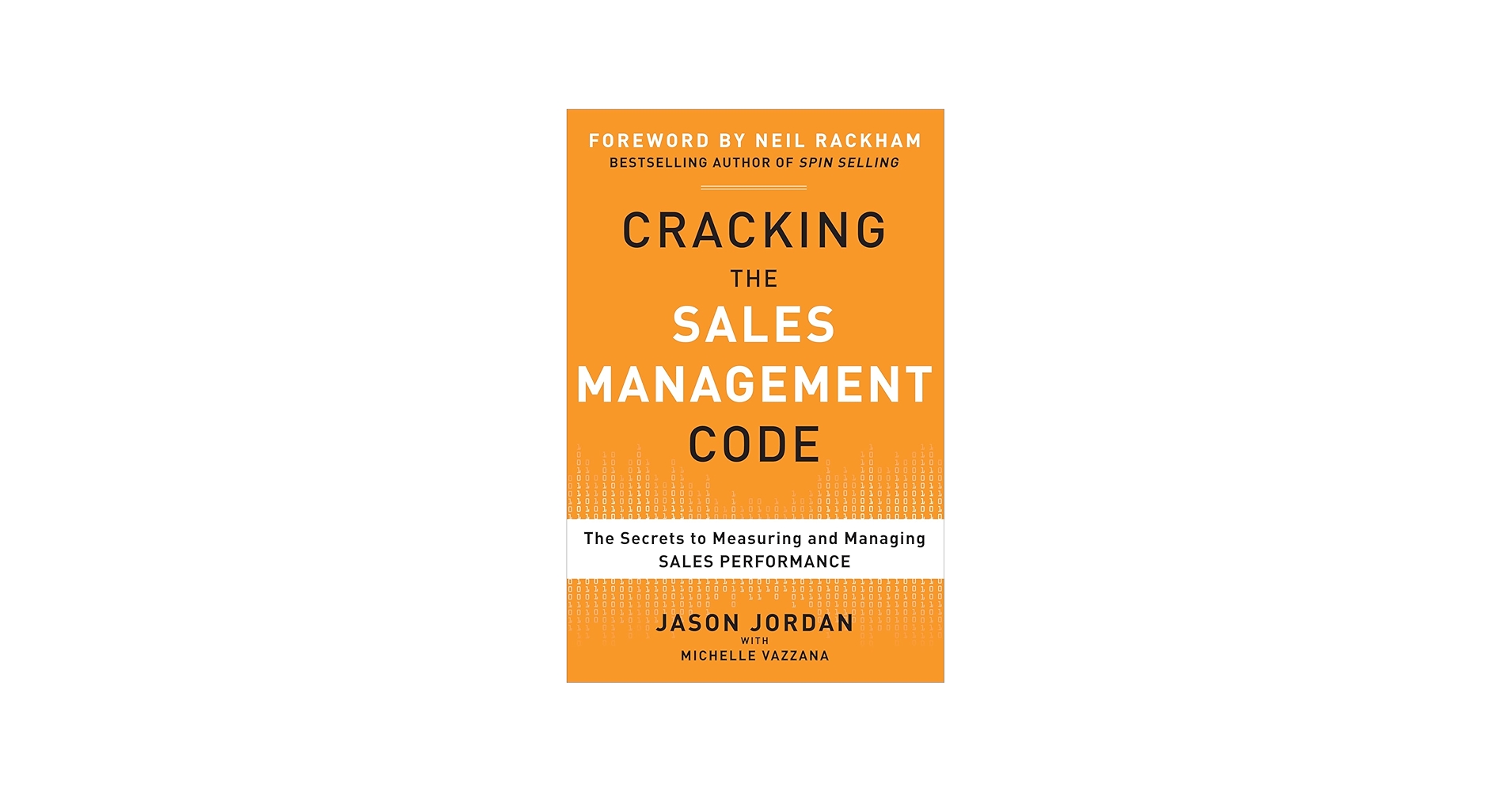
For the full operating manual and detailed research, I recommend Cracking the Sales Management Code by Jason Jordan and Michelle Vazzana.