

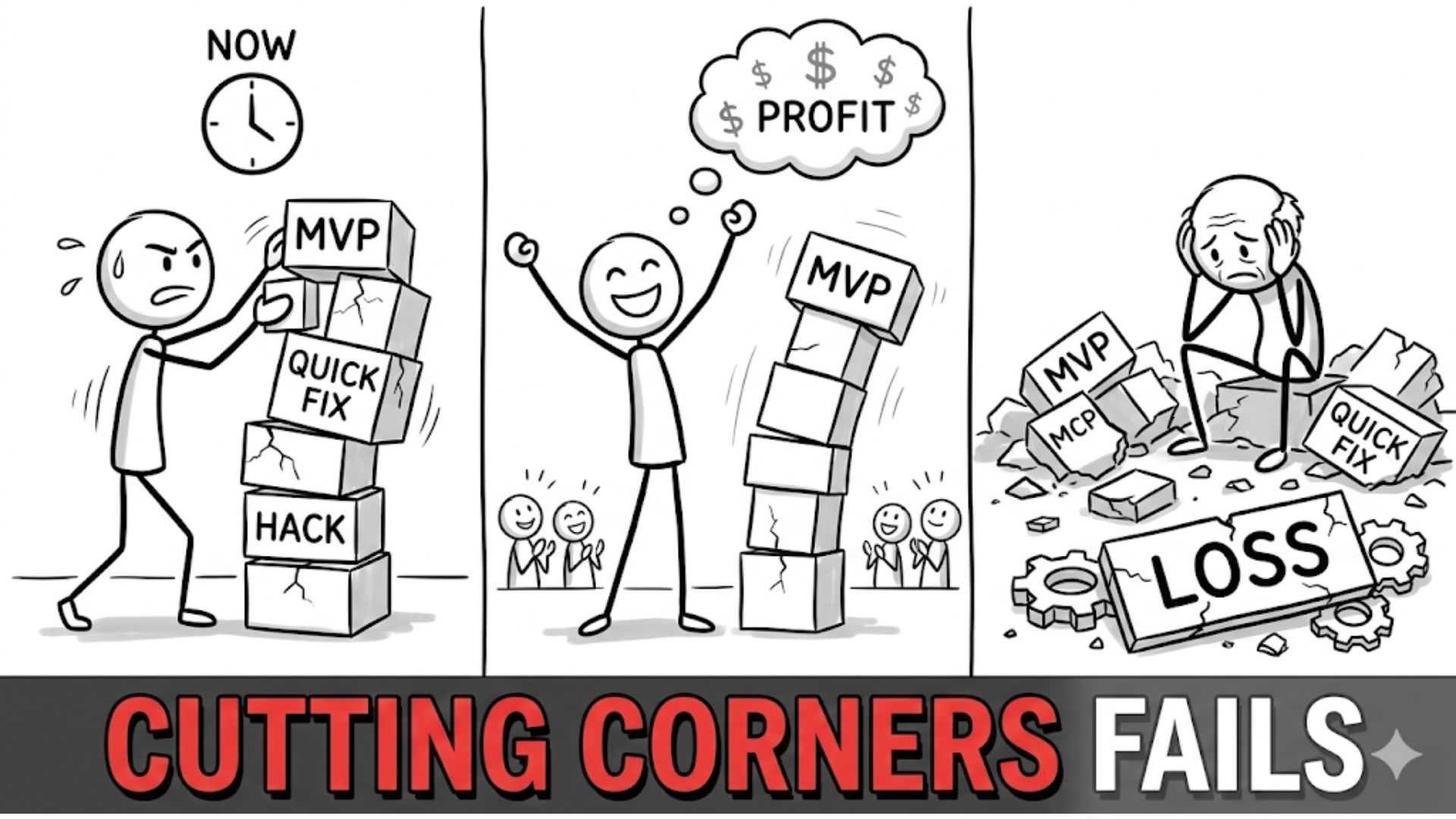
Introduction: The Illusion of Efficiency
In the contemporary landscape of high-stakes decision-making, “efficiency” is often conflated with “optimization.” However, a rigorous analysis through the lens of systems thinking reveals a profound tension between immediate measurable improvement and long-term structural health. This tension is manifested in the phenomenon of short-term optimization: the systematic prioritization of proximal, high-fidelity metrics at the expense of distal, low-fidelity—but more critical—systemic outcomes.
Short-term optimization frequently presents as a rational, even virtuous, response to environmental constraints. In competitive markets, the pressure to produce quarterly returns, hit monthly career milestones, or satisfy immediate political demands creates an environment where the “long term” is treated as an abstract luxury rather than a strategic requirement. The result is a mirage of efficiency. While a system may appear highly optimized according to its primary metrics, it is often accumulating “hidden debt”—structural, reputational, or operational costs that remain invisible until they reach a threshold of catastrophic failure. To understand the true cost of this behavior, one must move beyond surface-level critiques and examine the underlying causal mechanisms that drive actors toward local optima at the cost of global survival.
Defining Short-Term Optimization as a Structural Behavior
In decision theory, short-term optimization is characterized by the selection of actions that maximize utility within a narrow temporal window, without regard for the intertemporal trade-offs involved. It is essential to distinguish this from legitimate short-term action. All long-term strategies require short-term execution; however, structural short-term bias occurs when the execution of current tasks actively erodes the capacity to perform future ones.
The behavior is fundamentally a problem of local vs. global optimization. In mathematics and computer science, a local optimum is a solution that is the best within a neighboring set of candidate solutions but is inferior to the global optimum—the best possible solution across the entire domain. Metric-driven environments, such as corporate finance or algorithmic digital marketing, essentially “trap” decision-makers in local optima. This is exacerbated by Goodhart’s Law, which states that “when a measure becomes a target, it ceases to be a good measure.” When an organization or individual optimizes solely for a proxy metric (e.g., clicks, quarterly profit, or standardized test scores), the metric eventually decouples from the underlying value it was intended to represent. The result is a system that is “efficient” at hitting the target but “ineffective” at fulfilling its ultimate purpose.
Read also: The Psychology of Holding vs Selling Assets
The Core Mechanism: Time Horizon Misalignment
The primary driver of short-term optimization is the misalignment of time horizons between different layers of a system. In finance, career development, and institutional governance, the window through which success is evaluated is often orders of magnitude shorter than the duration required for a system to mature or a strategy to bear fruit.
This misalignment distorts the allocation of capital and effort. When the evaluation window is compressed—for instance, to a ninety-day earnings cycle—investments in “high-variance” long-term growth (such as Research and Development or organizational culture) are systematically deprioritized in favor of “low-variance” short-term gains (such as cost-cutting or financial engineering). This reshapes the perception of risk. On a short horizon, the “risk” of missing a quarterly target appears much larger than the “risk” of systemic obsolescence a decade in the future.
Furthermore, temporal discounting plays a critical role. Hyperbolic discounting—the tendency for humans to prefer smaller, immediate rewards over larger, delayed rewards—is not merely a cognitive bias; it is often baked into the discounted cash flow models and performance appraisals that govern modern institutions. By heavily discounting the future, decision-makers effectively treat terminal system health as having zero present value, making the destruction of the long term a mathematically “rational” move in the short term.
Incentive Structures and the Engineering of Short-Term Behavior
Structural short-termism is rarely the result of individual myopia; it is an engineered outcome of specific incentive architectures. Rational actors optimize for what is measured and rewarded. When compensation systems, political election timelines, and performance evaluations are focused on immediate output, the system effectively mandates short-term behavior.
In the corporate world, the transition from “owner-operator” models to “managerial-agent” models has deepened this problem. Under the Principal-Agent problem, a manager (the agent) is incentivized to maximize the metrics that determine their bonus or career progression during their tenure, which may only be three to five years. If a decision yields a massive benefit in year six but incurs a cost in year two, the agent is structurally disincentivized from making that decision.
Similarly, political cycles create an environment where the “policy lag”—the time between an implementation and its effect—is longer than the time until the next election. This forces a focus on “high-visibility” first-order effects rather than “high-impact” second-order systemic changes. In both cases, the cost of optimization is externalized to future stakeholders, creating a state of systemic fragility where the present “consumes” the future.
Read also: Why Simplicity Wins in Personal Finance
Feedback Loop Distortion and Delayed Consequences
Learning within a system requires a high-fidelity feedback loop: the ability to link an action directly to its consequence. Short-term optimization persists because it creates a feedback loop distortion. The “gains” of short-term optimization are immediate, measurable, and highly visible, whereas the “costs” are delayed, probabilistic, and often obscured by environmental noise.
In systems with long payoff periods, such as infrastructure development or deep-tech innovation, the signal-to-noise ratio is extremely low in the early stages. The volatility of immediate metrics (e.g., stock price fluctuations or monthly user growth) can obscure the long-term signal of fundamental progress. Consequently, long-term projects are often abandoned or underfunded during periods of noise, precisely when they require the most stability.
Furthermore, delayed feedback weakens causal learning. If a company cuts its training budget to save money today, the erosion of institutional knowledge may not manifest for years. By the time the consequence arrives, the link to the original decision has been severed by intervening events, allowing the short-term behavior to be repeated without the corrective pressure of experience.
Compounding Systems and Irreversible Damage
One of the most profound costs of short-term optimization is the interruption of compounding. While compounding is most frequently discussed in the context of financial interest, it is a universal mechanic that applies to trust, brand equity, reputation, skill accumulation, and organizational culture.
Compounding is a non-linear process that requires duration and stability. A “brand,” for example, is the compounded result of years of consistent behavior and fulfilled promises. Short-term optimization often involves “extracting” value from this compounded asset. A company may trade its hard-won brand equity for a temporary surge in sales by lowering product quality or engaging in deceptive marketing. In the short-term model, this appears as an increase in efficiency. In the systems model, this is an irreversible extraction.
Once a compounding system is interrupted or its base is eroded, it cannot be easily restarted. The “lost time” cannot be bought back. Short-term optimization permanently reduces long-term optionality by burning the very fuel—trust and reliability—required for the exponential phase of growth. The true cost of the gain is the terminal value of the growth that was sacrificed to achieve it.
Read also: How Loss Aversion Impacts Portfolio Decisions
Second-Order and Third-Order Effects
Short-term optimization is typically characterized by a hyper-focus on first-order effects: “If I do X, I get result Y.” Strategic failure, however, usually occurs at the level of second-order and third-order effects—unintended consequences that propagate through a system over time.
For instance, optimizing a professional career for immediate salary (first-order) may lead to selecting high-stress, low-learning roles. The second-order effect is talent burnout and a stagnation of the skill set. The third-order effect is a loss of career optionality and market relevance a decade later. Similarly, in supply chain management, optimizing for “Just-in-Time” efficiency (first-order) reduces warehousing costs. The second-order effect is a reduction in buffer capacity. The third-order effect is total system fragility, where a single minor disruption cascades into a complete failure of the network.
When first-order metrics are optimized in isolation, they often degrade the resilience of the overall system. Resilience is, by definition, “inefficient” in the short term; it requires redundancy, buffers, and “idle” resources. By eliminating these “inefficiencies” to maximize immediate margins, decision-makers unknowingly transform a robust system into a fragile one, where a single “tail-risk” event can wipe out decades of accumulated gains.
Path Dependency and Loss of Optionality
Every decision made to optimize the short term creates a degree of path dependency. Path dependency is the idea that current decisions are constrained by previous ones, often in ways that are difficult to reverse. Repeated short-term optimization creates a structural “lock-in” effect.
As an organization or individual continuously optimizes for a specific short-term metric, they build their entire infrastructure—hiring, software, culture, and capital—around that metric. This reduces their ability to pivot when the environment changes. They become “trapped” by their previous successes. This is the opportunity cost across time: by saying “yes” to a local optimum today, you are effectively saying “no” to a global optimum tomorrow.
The loss of optionality is the most insidious cost. Optionality is the ability to take advantage of unexpected positive events (upside volatility). Short-term optimization typically narrows the focus, eliminating the “excess capacity” required to explore new frontiers. Over time, the decision-maker finds themselves on a narrowing path where the only available moves are further, more aggressive short-term optimizations, until the system eventually reaches an “absorbing barrier”—a point from which no further progress is possible.
Read also: The Cost of Overconfidence in Investing
Why Short-Term Optimization Persists
If the long-term costs of short-term optimization are so severe, why does the behavior remain the dominant mode of operation? The answer lies in a combination of cognitive bias, institutional inertia, and cultural normalization.
Cognitive biases like present bias and overconfidence ensure that humans consistently underestimate future risks while overestimating their ability to “deal with them later.” Institutional inertia plays a role as well; once a system is optimized for quarterly results, changing the time horizon requires a catastrophic level of energy and a complete realignment of stakeholders—a process that is itself “inefficient” in the short term.
Furthermore, market pressure and the “tyranny of the immediate” create a prisoner’s dilemma. If your competitors are using short-term tactics to gain an immediate edge, staying long-term requires an extraordinary level of strategic durability and capital. Finally, the cultural normalization of speed—the belief that “faster is always better”—provides a moral and intellectual cover for short-term behavior. In a culture that celebrates the “sprint,” the “marathon” is often dismissed as being too slow or out of touch with modern reality. Awareness of these dynamics rarely eliminates them, as they are baked into the very incentives of the environment.
Misconceptions About Long-Term Strategy
To analyze short-term optimization accurately, one must avoid the common misconceptions that often cloud the discussion of long-term strategy.
First, long-term thinking does not mean ignoring short-term performance. A system that cannot survive the short term will never see the long term. The goal is time-consistent optimization, where short-term actions are evaluated based on their impact on long-term capacity. Second, patience is not a guarantee of success. “Playing the long game” with a flawed business model or a declining skill set is not strategic; it is merely a slower way to fail.
Third, long-term thinking is often over-romanticized as being “easy” or “noble.” In reality, it is technically difficult and emotionally taxing. It involves enduring periods of “underperformance” relative to short-term peers, managing the anxiety of delayed feedback, and resisting the powerful social signals that demand immediate results. Confusion between “delay” and “discipline” is a frequent cause of strategic failure; true long-term strategy requires more, not less, rigor in daily execution.
Read also: Why Long-Term Thinking Is a Financial Advantage
Structural Principles for Better Time Alignment
Moving away from short-term optimization requires a move toward structural principles that prioritize system resilience over metric maximization. While the specific tactics vary, the underlying principles remain consistent:
- Incentive Alignment: Rewards should be tied to the lifecycle of the decision. If an investment takes five years to mature, the evaluation and compensation for that investment must be deferred accordingly.
- Time-Consistent Evaluation Metrics: Organizations should move away from single-point metrics toward “cohort analysis” and “trailing-indicator” metrics that capture the long-term trend rather than the temporary fluctuation.
- Second-Order Impact Assessment: Every major “optimization” decision should require a formal analysis of its potential second- and third-order consequences on the system’s resilience.
- Optionality Preservation: Systems should be designed with “redundancy” and “buffers.” While these appear as costs in the short term, they are the “premiums” paid to maintain the ability to survive and pivot in the future.
- Resilience Over Efficiency: When a system reaches a certain level of complexity, the goal should shift from “maximizing output” to “minimizing fragility.”
Broader Conceptual Connections
The cost of short-term optimization is a central theme across several academic and strategic disciplines. In systems thinking, it is viewed as a “shifting the burden” archetype, where a short-term solution for a problem symptom makes the underlying problem worse over time. In behavioral finance, it explains the “equity premium puzzle” and the tendency for investors to churn portfolios at the cost of long-term compounding.
Institutional economics analyzes how the “rules of the game” (e.g., tax laws or corporate governance codes) favor short-term extraction over intergenerational capital allocation. In all these frameworks, the core insight is the same: the “cost” is almost always the decay of the structural commons—the shared trust, infrastructure, and resilience that allow the system to function in the first place. Strategic durability is not about predicting the future; it is about building a system that is robust enough to survive the unpredictable.
Read also: How Anchoring Bias Affects Financial Choices
Conclusion: Reframing Optimization as a Time-Based Decision
The true cost of short-term optimization is rarely found in the immediate balance sheet; it is found in the “counter-factual” history of what the system could have become had it not been cannibalized for proximal gains. When we optimize for the day at the expense of the decade, we are not being efficient; we are being myopic.
Optimization must be reframed as a question of time horizon rather than speed. A decision that is “optimal” for 24 hours is rarely “optimal” for 24 years. In the long run, the most successful individuals and institutions are not those who were the most “efficient” in every single quarter, but those who were the most durable over many cycles. The cost of short-term optimization is often invisible until it has compounded into a terminal state. By the time the bill arrives, the ability to pay it has often been optimized away. True strategic mastery lies in the ability to identify the hidden costs of immediate gains and to recognize that the most important metrics are often those that cannot be measured in the short term.

