Your Reading Life Shouldn’t Live in Someone Else’s App
A decade of books, ratings and thoughts is genuinely valuable — and most of us keep it somewhere we don’t control. Here’s the case for a reading tracker spreadsheet you own.
If you’ve been tracking your reading for a few years, you’ve built something quietly valuable: a record of what you read, when, what you thought of it, and how your taste has changed. It’s a small autobiography. And for most readers, it lives entirely inside an app — one that can change its terms, alter its features, get acquired, or disappear, and that in the meantime surrounds your private reading with other people’s opinions and an algorithm’s suggestions. A reading tracker spreadsheet is an unglamorous alternative that solves all of that, and — this is the part that surprises people — it usually does the actual tracking better too. Here’s the case.
What you give up without noticing
Reading apps are genuinely convenient, and I’m not going to pretend otherwise. But the trade has three parts that are easy to miss.
You don’t own the record. Your history sits on someone else’s servers under terms you agreed to once and haven’t read since. Export options exist, until they don’t. Companies change hands, pivot, or shut down. A decade of reading history is exactly the kind of thing you’d be sad to lose and unlikely to reconstruct.
Your reading gets social whether you want it or not. You finish a book, feel something about it, and are immediately shown what a thousand strangers thought. That’s fine sometimes and genuinely corrosive at others — it’s remarkably easy to have your own impression of a book overwritten by the consensus before you’ve finished forming it. Some readers love the community aspect. Others are quietly annoyed that a private pleasure came bundled with an opinion feed.
Your attention is the product. Recommendations shaped by an algorithm, notifications, and prompts to engage all exist to keep you in the app. That’s not a moral scandal; it’s just worth being clear that the app’s goals and your reading goals aren’t identical.
A spreadsheet in your own drive has none of this. No account, no feed, no algorithm, nothing collected. It will open in ten years whatever has happened in the meantime, and the only person who ever sees your one-line thoughts on a book is you.
Privacy isn’t the only argument — it’s often just better
Here’s what I didn’t expect when I moved my own log: a well-built spreadsheet does several things most reading apps don’t do at all.
Days-to-read. Log the date you started and the date you finished, and the gap tells you something apps rarely surface: which books you tore through in three days and which you dragged through for a month. That number is a surprisingly honest guide to what you actually enjoy — far more honest than a star rating you assigned out of politeness to a book you found a slog.
Pace against today. Most goal tracking tells you how many books you’ve read against a target. Far more useful is where you should be by today’s date to be on track — which turns a vague December panic into a piece of information you had in June, while there was still time to do something about it.
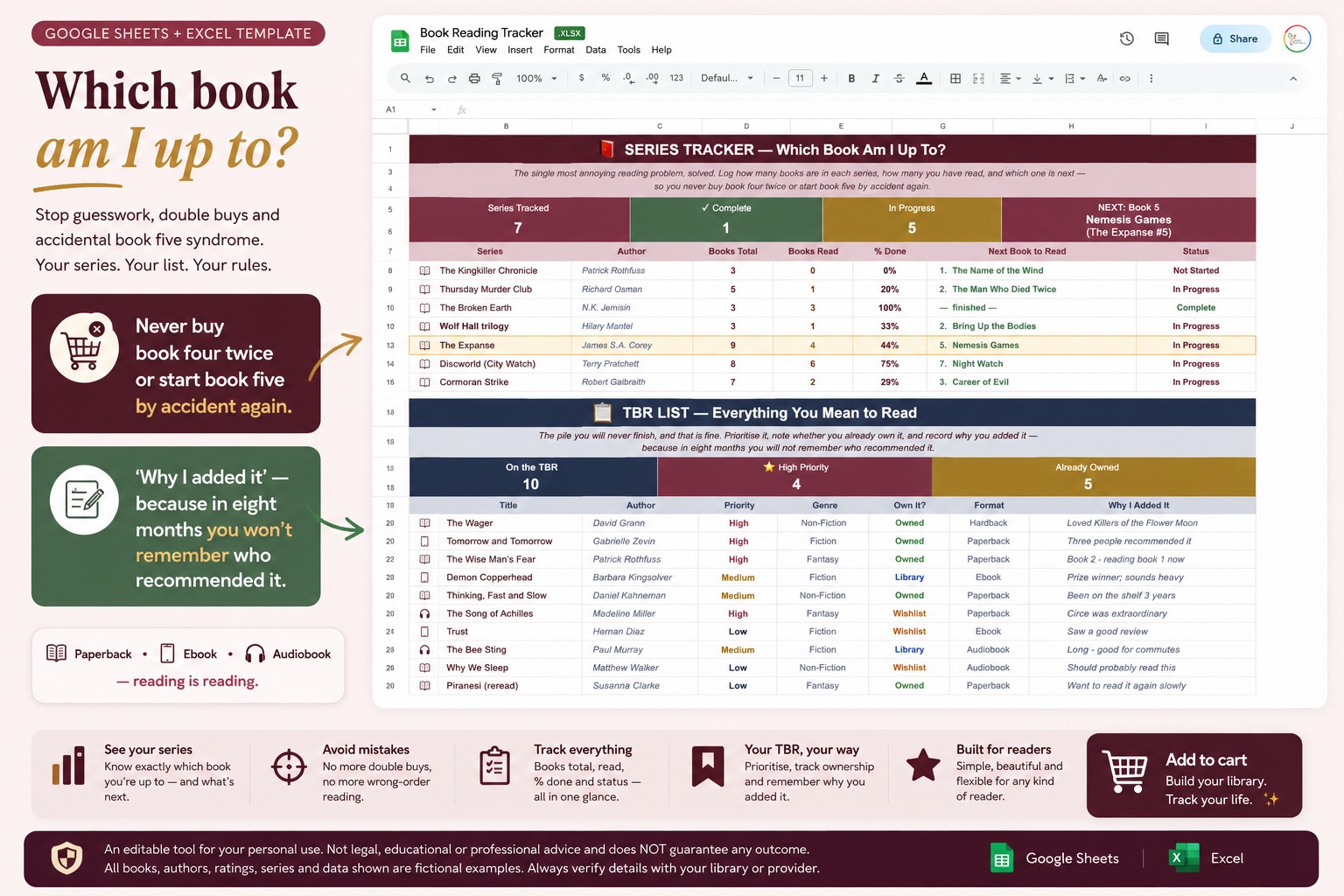
A proper series tracker. For anyone reading fantasy, crime, or anything long-running, the most annoying problem in reading is not remembering where you are. A page listing each series, how many books it contains, how many you’ve read and which one is next, solves it permanently — and stops you buying book four twice.
An “own it?” column on your to-read list. Which quietly prevents the other classic error: buying a book you already have, unread, on a shelf.
None of these is technically impressive. They’re just useful, and they’re the kind of small, specific thing a general-purpose app doesn’t prioritise.
Notes in your own words
One design choice worth arguing for: keep a line of your own thoughts about each book rather than collecting quoted passages.
There’s a practical reason — two years later, your own sentence about what a book did for you is far more useful than a transcribed paragraph you no longer have context for. And there’s a proper reason: extended passages from a book are the author’s and publisher’s work, not yours to reproduce or republish. Keeping short, credited quotations if you share reviews publicly is the right instinct; building a private archive of copied text isn’t.
Your own honest line — “funny, dragged in the middle, the ending stayed with me” — is worth more to future-you anyway. It’s your reaction, which is the thing you actually can’t get anywhere else.
The numbers you’ve never added up
Two more things a personal log surfaces that apps rarely do.
Your monthly pattern. Books, pages and average rating per month, filled in automatically as you log, shows you your own rhythm — the busy months where reading vanished, the holiday where you read four. That’s genuinely interesting, and it’s useful for setting a realistic goal next year rather than an aspirational one.
What books actually cost you. Most readers have never totalled this. It’s not about guilt — books are one of the better things to spend money on — but the number is worth knowing, and it often prompts a healthy rediscovery of the library. Which brings me to library due dates: an alert a few days before something’s due is a small feature that pays for itself the first time it saves you a fine.
An honest note
To be clear: this is a personal logging perspective, not advice of any kind. Any example titles, ratings or prices in a template are illustrative, not endorsements or recommendations, and book prices and library lending terms vary — always check your own. A tracker isn’t affiliated with any author, publisher, bookseller, library service, or reading platform, and nothing here is a criticism of any specific company — plenty of people are perfectly happy with their app, and that’s fine.
If you want one ready to go
I built a reading tracker in Google Sheets that does all of this — automatic days-to-read, honest pace against today with a progress bar, a series tracker, a TBR list with an “own it?” column, monthly stats that fill themselves in, library due-date alerts and a spending total — living entirely in your own Drive:
👉 Reading Tracker for Google Sheets & Excel
Whether you use mine or build your own, consider moving your reading life somewhere you control. It’s a small archive of your own mind, it’s worth keeping, and it deserves better than being a row in a database you can’t export when it matters. Your own private library, with no one else’s opinions in the margins. 📚
This reflects my own perspective and describes a personal logging tool — example titles and prices are illustrative, not recommendations; check current prices and library terms yourself. Not affiliated with any author, publisher, bookseller or reading platform. Where does your reading history live right now — and would you be sad to lose it? Tell me in the comments.