The Moving Costs Nobody Warns You About
Your budget didn’t blow up because the movers were expensive. It blew up because of eleven things nobody mentioned. Here’s how to budget for the real moving costs — and compare quotes properly.
Almost everyone budgets for a move the same way: get a quote from a removal company, add a bit for boxes, and treat that as the cost of moving. Then the final total arrives and it’s dramatically higher, and you can’t quite reconstruct how. It wasn’t one big surprise — it was a series of small, entirely predictable costs that simply weren’t in anyone’s plan. Understanding the real shape of moving costs before you commit is the difference between a move that lands roughly where you expected and one that quietly eats a chunk of savings you needed for the new place. Here’s what’s usually missing.
The mover’s quote is one line, not the budget
The removal quote is the biggest single number, which is exactly why it’s misleading — it feels like the cost, so everything else gets treated as rounding. But the costs that surround a move add up to a lot, and they’re remarkably consistent across people’s experiences:
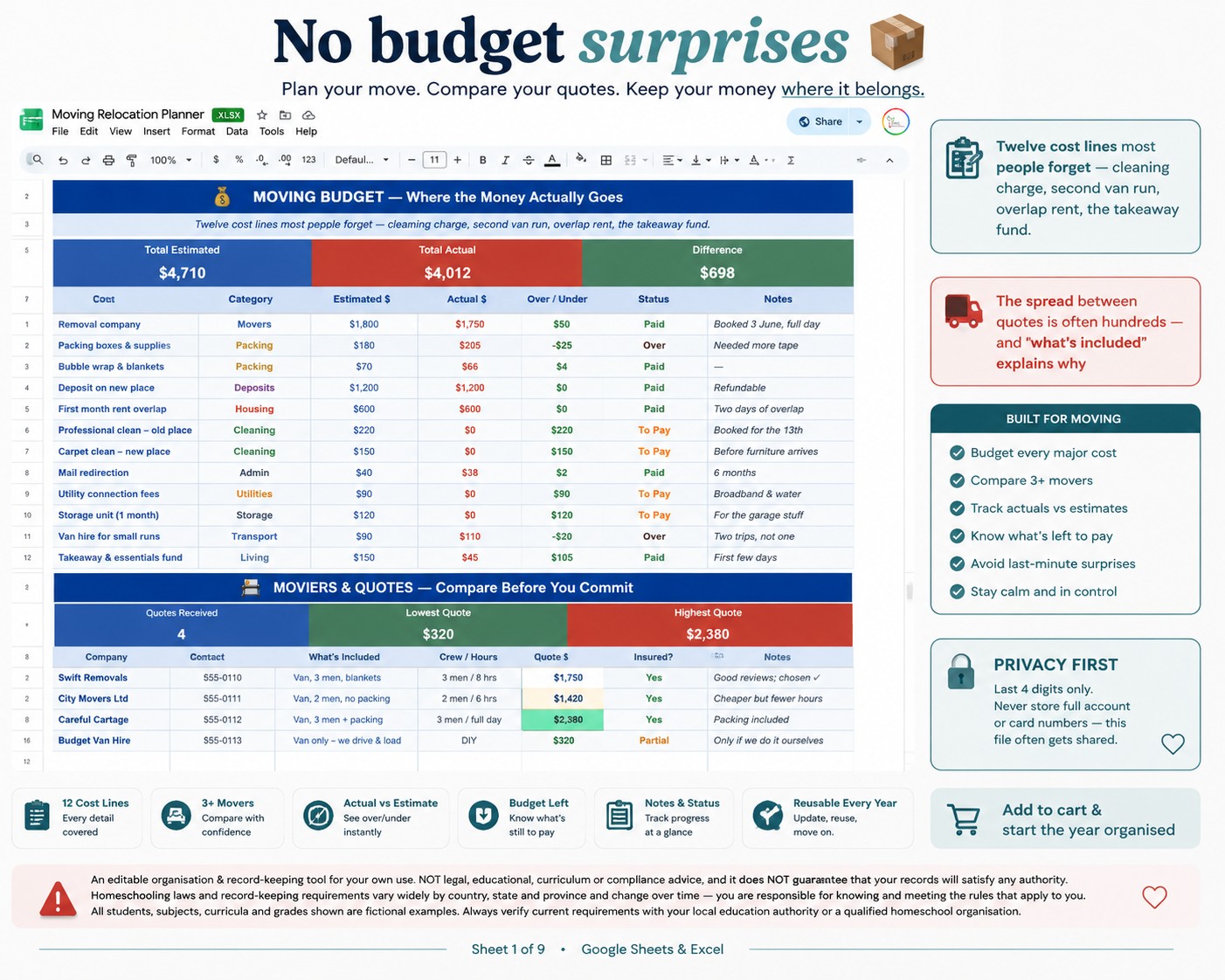
- Packing materials. Boxes, tape, bubble wrap, mattress covers. Individually trivial; collectively not, especially for a whole house.
- Cleaning. End-of-tenancy cleaning is often required, and professional cleans aren’t cheap. Homeowners frequently pay for a clean at one end or both.
- A second van run or extra hours. The estimate was based on an assessment; reality involves more stuff than anyone thought. Overtime and second trips are common.
- Overlap costs. Paying rent or a mortgage on both properties for a period, which is extremely common and often a large number.
- Storage, if there’s a gap between moving out and in.
- Deposits and connection fees for utilities and broadband at the new place.
- Post redirection.
- Time off work, if unpaid.
- Travel and fuel, especially on a long-distance move.
- Immediate purchases for the new home — the curtain rail, the light fittings, the thing that doesn’t fit.
- The takeaway fund. Genuinely worth budgeting: you will not be cooking for several days, and pretending otherwise just makes the number wrong.
None of these is exotic. They’re all foreseeable — which is exactly why listing them explicitly in advance is such high-value, low-effort work. A budget with these lines in it might look alarming, but it’s a real number you can plan around instead of a comfortable fiction you’ll be corrected on later.
Estimate versus actual, tracked as you go
The second half of budgeting is watching it while the move is happening. A moving budget written once and never revisited is just a wish; the value comes from logging what you actually spend against what you estimated, line by line.
Doing that gives you an Over/Under per category and — crucially — a running “budget left” figure. That’s what turns the budget from a document into a steering wheel. If packing materials have already run over by week two, you know to be careful elsewhere while you still can. Discover the same thing at the end and the information is useless; you can only regret it.
The pattern’s the same as any budget: caught early, an overrun costs you a couple of small adjustments. Discovered at the end, it costs you the money and gives you nothing.
Comparing removal quotes: the spread is real
Quotes from removal companies for the same move vary enormously — it’s common for the highest to be hundreds more than the lowest. Faced with that, the temptation is obvious: take the cheapest.
Sometimes that’s right. Often it’s not, because the quotes aren’t for the same thing. What differs underneath:
What’s included. Does the price include packing? Dismantling and reassembling furniture? Materials? Appliance disconnection? A quote that excludes packing is cheaper on paper and identical in reality once you add the packing you now have to do or pay for separately.
Insurance and liability. This is the one people skip and shouldn’t. What happens if something is damaged or lost? The cover offered varies significantly, and a cheap quote with minimal liability is a genuine risk on a van full of everything you own. Damage during a move is one of the most common disputes there is, and the time to understand your cover is before you book, not after something breaks.
Hours and crew. A quote based on fewer hours or a smaller crew than the job needs turns into overtime charges on the day.
So the useful exercise isn’t comparing bottom lines — it’s laying the quotes side by side with what’s included and what the insurance position is, and comparing like for like. Very often the middle quote is the honest one, and the cheapest is the one that becomes most expensive once the extras appear.
Confirm the details in writing, and confirm insurance cover and liability directly with the company. A verbal “we’re fully insured” is not a policy.
Decluttering can genuinely fund part of it
One piece of good news: the cost of a move scales with how much you move. Deciding room by room what to keep, donate, sell, or bin before you pack does two useful things — it reduces the volume (and therefore often the quote), and the selling side can raise a real amount.
Plenty of people find that what they sell before a move meaningfully offsets the cost of it. Tracking what you’ve listed and what’s actually sold turns “we should get rid of some things” into a funded line in the budget rather than a vague intention.
A security note worth taking seriously
One thing specific to moving admin: notifying your utilities, bank, insurers, and the rest usually means gathering account references in one place. Keep that file safe, and don’t store full account or card numbers in it. Moving files get shared — with a partner, a family member, sometimes even a removal company — and anything in the document is visible to everyone with access. The last four digits are enough to identify an account for your own purposes.
An important note
To be clear: this is a planning perspective — it isn’t legal, financial, insurance, tax, or professional removals advice, and it guarantees no outcome. Any cost categories are illustrative; your own figures will differ. Always confirm arrangements, insurance cover, and liability directly with your own removal company, landlord, utility providers, and local authority.
If you want the budget built for you
I built a moving budget into my moving planner in Google Sheets — twelve cost lines most people forget, estimated versus actual with Over/Under per line and a live budget-left figure, plus a mover quote comparison that shows the lowest and highest automatically alongside what’s included and the insurance position:
👉 Moving Planner for Google Sheets & Excel
Whether you use mine or a sheet of paper, write down every cost before you commit — including the cleaning, the overlap and the takeaways. Compare quotes on what’s actually included and what happens if something breaks, not on the bottom line. Moving is expensive enough without being surprised by it. 📦
This reflects my own perspective and is a planning tool — not legal, financial, insurance or professional removals advice, and it guarantees no outcome; confirm cover and liability with your own removal company. What moving cost caught you completely off guard? Tell me in the comments — it’ll save someone else.