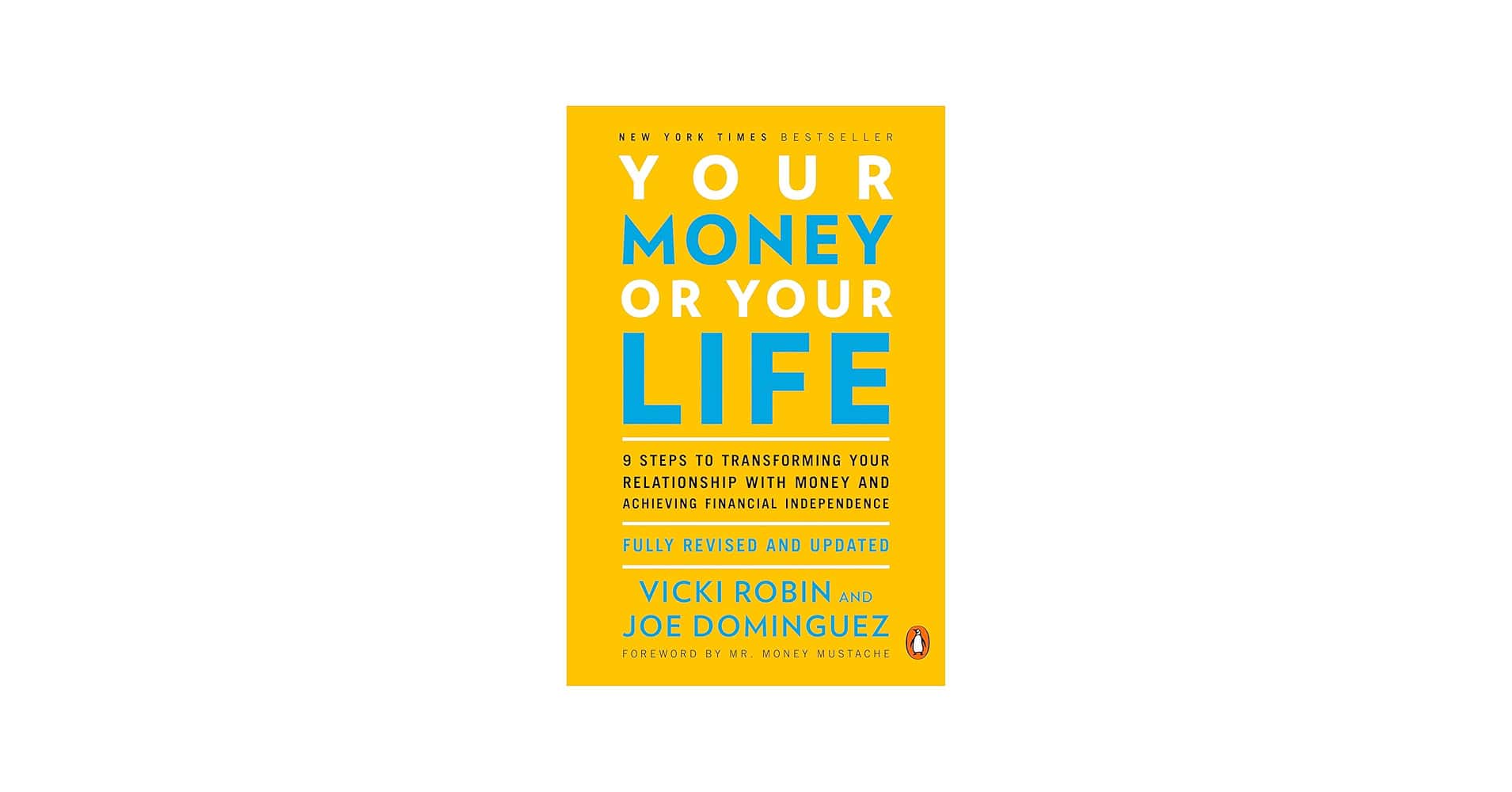
Many of us spend our lives in a state of quiet desperation, trapped in a cycle of earning to spend and spending to recover from the earning. We trade the most precious resource we have—our time—for a paycheck that never seems to buy the freedom we were promised. This Your Money or Your Life summary explores the seminal work of Vicki Robin and Joe Dominguez, a book that serves as the foundation of the Financial Independence, Retire Early (FIRE) movement. It is not merely a book about getting rich; it is a manifest for getting free. By viewing money as a physical representation of your Life Energy, you can begin to bridge the gap between your bank account and your soul, moving away from a life of “making a dying” and toward a life of profound fulfillment.
——————————————————————————–
THE SNAPSHOT: The FIRE Bible at a Glance
Star Rating: 5/5 (The absolute “Gold Standard” for the FIRE movement).
One-Sentence Verdict: This book provides a revolutionary nine-step program to transform your relationship with money by redefining it as the “Life Energy” you exchange for every dollar you earn.
Best For: Burned-out professionals, FIRE aspirants, debt-ridden graduates, and anyone feeling unfulfilled by modern consumerism.
Difficulty: Medium. While the concepts are philosophically accessible, the program requires rigorous, honest participation in its exercises and tracking.
The “So What?” Layer
Why does this book remain the “gold standard” even decades after its release? Unlike typical finance books that focus on aggressive budgeting or complex stock-picking, Your Money or Your Life focuses on mindfulness. It shifts the conversation from “how much can I accumulate?” to “how much is enough?” It treats personal finance as a tool for self-care and environmental stewardship rather than a game of material acquisition. It is the bridge between the analytical “how-to” and the philosophical “why.”
——————————————————————————–
INTRODUCTION: Are You Making a Living or Making a Dying?
Are you making a living or making a dying? This is the fundamental question posed by Vicki Robin and Joe Dominguez. For many in the modern workforce, the “9-to-5 grind” has become a soul-sapping routine where we derive our identities from our job titles and measure our worth by our salaries. This “jobism” creates a culture where we sacrifice our mental health, our time with family, and our passions for a paycheck that is immediately funneled back into a consumerist lifestyle designed to help us “decompress” from the very jobs we hate.
This book is the strategic launchpad for the FIRE movement because it deconstructs the traditional roadmap for money. The authors argue that we are trapped in a “Money Trap”—a cycle of dissatisfaction where material wealth does not equate to true happiness. Research mentioned in the text suggests that despite being a wealthy society, Americans report low happiness levels. We have shifted from being “citizens” to being “consumers,” a move that has left us feeling spiritually hollow and financially stressed.
The core premise is radical: Money is not just currency; it is Life Energy. It is the limited, finite hours of your life that you trade for income. When you spend money, you are spending your life. This fundamental shift in perspective is the prerequisite for financial recovery. To reclaim your soul, you must first acknowledge the true cost of the life you are leading.
——————————————————————————–
THE CORE CONCEPT: Redefining “Life Energy” and the “Real Hourly Wage”
The “Aha!” moment for most readers comes during the exercise of calculating their Real Hourly Wage. We often look at our gross salary and think, “I make $50 an hour.” This is a dangerous illusion. To find your true earnings, you must deconstruct the hidden costs of your employment.
The Four Levels of Money Understanding
To truly grasp the concept of Life Energy, the authors present four levels of understanding money:
- Material: The physical forms—coins, bills, and digital balances.
- Psychological: Your personal feelings and beliefs about money, often inherited from your upbringing.
- Cultural: The societal myths we believe, such as “more is better” or the competitive nature of wealth.
- Life Energy: The ultimate truth—money represents the hours of your life you exchanged to get it.
The Deconstruction of Earnings
The Real Hourly Wage formula is as follows: Real Wage = (Net Salary – Hidden Work-Related Costs) / (Total Work-Related Hours)
This calculation forces an honest evaluation of several “hidden costs” that drain your resources:
- Commuting: Fuel, maintenance, and the unpaid hours spent in traffic.
- Work Clothes: Wardrobes you wouldn’t own if you weren’t “dressing for success.”
- Stress-Relief Spending: Expensive dinners or “retail therapy” required to “unwind.”
- Household Help: Paying for cleaning or lawn care because you are too exhausted to do it.
- The Psychological Toll of Recovery Time: This is the most insidious cost. If you spend your Saturday “recovering” from your job—too tired for hobbies or family—those hours effectively belong to your employer. If you work 40 hours but need 16 hours of “recovery time,” your divisor is now 56 hours, further tanking your Real Hourly Wage.
When you realize that your Real Hourly Wage might be closer to minimum wage once “Life Energy” is factored in, the act of spending becomes an act of self-evaluation: “Is this $100 gadget worth ten hours of my life?”
——————————————————————————–
Read too: Master Your Time: The Strategic Blueprint for Peak Performance (Book Summary)
THE 9 STEPS TO FINANCIAL INDEPENDENCE
Achieving Financial Independence (FI) is not about a “get rich quick” scheme; it is a structured program for reclaiming consciousness.
Step 1: Making Peace with the Past
The first step is a diagnostic tool to calculate two figures:
- Lifetime Earnings: A total of every dollar you have ever earned. This reveals the volume of Life Energy that has passed through your hands.
- Current Net Worth: A “no shame, no blame” assessment of your assets and liabilities. The goal is to face reality without judgment. Consider the case of Ondrea and Kyle. Ondrea had $15,000 in debt and viewed it as normal; Kyle had $40,000 and was averse to it. Their collective net worth of minus $55,000 was a shock, but by adopting the “no shame, no blame” mantra, they turned that realization into a paradigm shift that allowed their relationship—and their finances—to flourish.
Step 2: Tracking Your Life Energy
Here, you track every cent that enters or leaves your life. This isn’t traditional budgeting; it’s building awareness. You are keeping a detailed account of transactions to cultivate a disciplined approach to management. You start to see money not as a vague number, but as the literal hours of your life ticking away.
Step 3: Monthly Tabulation
At the end of each month, you categorize your spending. The key is to create categories that reflect your unique reality rather than standardized norms. Instead of just “Food,” you might have “Essential Groceries” and “Job-Related Stress Snacks.” This tabulation allows you to see exactly where your Life Energy is flowing.
Step 4: Three Questions to Transform Your Life
This is the heart of the program. For every category of spending, you ask:
- Did I receive fulfillment and satisfaction in proportion to the Life Energy spent?
- Is this expenditure in alignment with my values and life purpose?
- How would this expenditure change if I didn’t have to work for money? This process fosters conscious spending. It uses your values as a compass. If a $200 monthly cable bill provides zero fulfillment, you stop spending it—not because you’re “frugal,” but because you value your Life Energy too much to waste it.
Step 5: Mapping Your Life Energy
Create a large wall chart showing your income and expenses over time. This visual feedback loop makes the data real and keeps you accountable.
Step 6: Valuing Your Life Energy (Minimizing Expenses)
This step is about “The American Dream—on a Shoestring.” It’s about discovering how to live well for less. Case studies like Amy and Jim D. show this in action; they embraced frugality to build a family life aligned with their values, eventually achieving community success without the high-cost overhead.
Step 7: Maximizing Income
Value your Life Energy by ensuring you are paid what you are worth. It’s about the “For Love or Money” balance. Wes L. integrated his passion for nature into his career, ensuring his work hours were spent in alignment with his purpose.
Step 8: The Crossover Point
The authors recommend adding a third line to your wall chart: investment income. As you spend consciously (Line A goes down) and save/invest (Line B goes up), you eventually reach the Crossover Point.
Step 9: Managing Your Finances
This step focuses on long-term stability. While the 1992 edition focused on Treasury Bonds, the 2018 update emphasizes low-cost index funds and managing modern revenue streams like side hustles.
——————————————————————————–
THE CROSSOVER POINT: Visualizing the Moment of Freedom
The Crossover Point is the mathematical definition of Financial Independence. Imagine a graph where the line representing your monthly expenses is dipping as you discover what is “Enough.” Simultaneously, the line representing the income from your investments—money earned while you sleep—is climbing.
When the investment income line crosses above the expense line, work becomes optional. “Freedom” is not defined as having millions in the bank; it is the point where your safe investment income covers your monthly cost of living.
This visualization is powerful because it turns “retirement” into a tangible, reachable target. It shifts your focus from the “9-to-5 grind” to a future where your time belongs entirely to you. It is the moment you transition from “making a dying” to truly living. As Grant Sabatier (founder of Millennial Money) noted, this book is the “best book on money. Period.” It allowed him to move from a dire financial state to total wealth creation by defining meaning beyond monetary success.
——————————————————————————–
CRITICAL ANALYSIS: Applying the FIRE Bible in 2026
The original Your Money or Your Life was released decades ago, but the 2018 revision updated the wisdom for the modern era. Applying these principles today requires acknowledging the evolution of the economic landscape.
A common criticism of the original text was its “extreme frugality”—tactics like washing and reusing tea bags. However, a modern Vicki Robin review suggests that the principles of conscious spending are far more important than any specific tactic. In 2026, the “Gig Economy” has replaced the 30-year career. While side hustles can be a path to freedom, they can also be a new form of the “Money Trap” if they simply become more hours of your life traded for more consumer goods.
The investment advice has also modernized. The updated version acknowledges the role of low-cost index funds (per the “Simple Path to Wealth” philosophy) rather than just Treasury Bonds. The book’s psychological depth remains its greatest strength; it understands that until you fix your relationship with money, no amount of income will ever be “enough.”
——————————————————————————–
THE VERDICT: Pros and Cons
No resource is perfect, and it is important to adapt these 9 steps to your personal circumstances.
| Pros | Cons |
| Mindset Transformation: Radical shift from consumerism to life-valuation. | Tedious Tracking: Tracking every cent can be psychologically exhausting. |
| Actionable 9-Step Plan: Provides a clear, mathematical path to freedom. | Outdated Tactics: Some original frugal suggestions (tea bags) are impractical. |
| Values-Based: Prioritizes fulfillment and environmental health over math. | Investment Context: Requires supplementing with modern index fund knowledge. |
——————————————————————————–
CONCLUSION: The Power of “Enough”
The ultimate takeaway of Your Money or Your Life is that Financial Independence is reached at the point of “Enough,” not in the pursuit of “More.” Our culture of endless consumption is not only draining our Life Energy, but it is also devastating the planet. The text highlights “Earth Overshoot Day”—the point each year when our consumption outpaces the Earth’s ability to regenerate—as a sobering reminder of our global impact.
By following these 9 steps, you shift your identity from a “Consumer” to a “Citizen.” You begin to value your Life Energy as the finite and precious resource it truly is. Reclaiming this energy allows you to step off the treadmill and pursue a life of integrity, purpose, and genuine freedom. Whether you are building an eco-village like Kathy and Langdon L. or simply seeking more time with family, the goal is the same: reclaiming your soul.
——————————————————————————–
CALL TO ACTION: Start Your Transformation Today
Stop trading your life for money. Start building your freedom.
- Get the Book: Your Money or Your Life
- Commit to the Process: We highly recommend purchasing a high-quality Notebook or Journal to manually track your 9 Steps. The act of manual tracking has a deeper psychological impact than using a spreadsheet alone.
- Utilize Your Library Card: Follow the lead of the “A Purple Life” blog and use the Libby and Hoopla apps. These tools provide free, immediate access to thousands of books, movies, and audiobooks, allowing you to indulge in hobbies without spending a cent of your Life Energy.
- Find Your Why: Explore the work of other FIRE legends like JL Collins or Thomas Stanley. Your library card is your greatest “anti-consumerist” tool for self-education.
Your life is your own. Don’t spend it all in one place.