The Claim Settles for What You Could Prove
After a fire, a flood or a break-in, someone asks you to list what you owned. Almost nobody can. Here’s why building a home inventory for insurance beforehand is one of the highest-value afternoons you’ll ever spend.
It’s a strange question to be asked on the worst day of your year. You’re standing outside a house you can’t go back into, or looking at a door that’s been kicked in, and someone on the phone asks you to list what was in there. And you find that you genuinely can’t. Not the television. Not the make of the washing machine. Not what was in the attic. And certainly not the value of a wardrobe you’ve been adding to for a decade. So you do what almost everyone does: you underestimate. And the claim settles for what you could prove, not what you actually lost. A home inventory for insurance exists to close that gap — and the only time you can build one is while everything is still there.
Why memory fails at exactly the wrong moment
This isn’t a personal failing. Two things stack against you.
Ordinary possessions are invisible to memory. You can picture the expensive things. What you can’t reliably recall is the accumulated ordinary: the kitchen contents, the linens, the tools, the coats, the things in the cupboard under the stairs. Individually forgettable; collectively a large share of the value.
Stress destroys recall. Even the things you’d normally remember become slippery when you’ve just lost your home or had it broken into. You’re being asked to perform a detailed memory task at the exact moment you’re least able to.
Add the two together and the list you produce under pressure will be shorter and lower than reality. That list becomes the claim. That’s the whole problem in one sentence.
The total is usually the first surprise
Here’s what people find when they actually do it: the number is much bigger than they expected.
An ordinary family home — no collections, nothing extravagant — routinely comes to tens of thousands to replace. A sofa, some appliances, a laptop, clothes, a couple of bikes, garden furniture and the contents of a kitchen add up fast when you price them at what they’d cost to buy today.
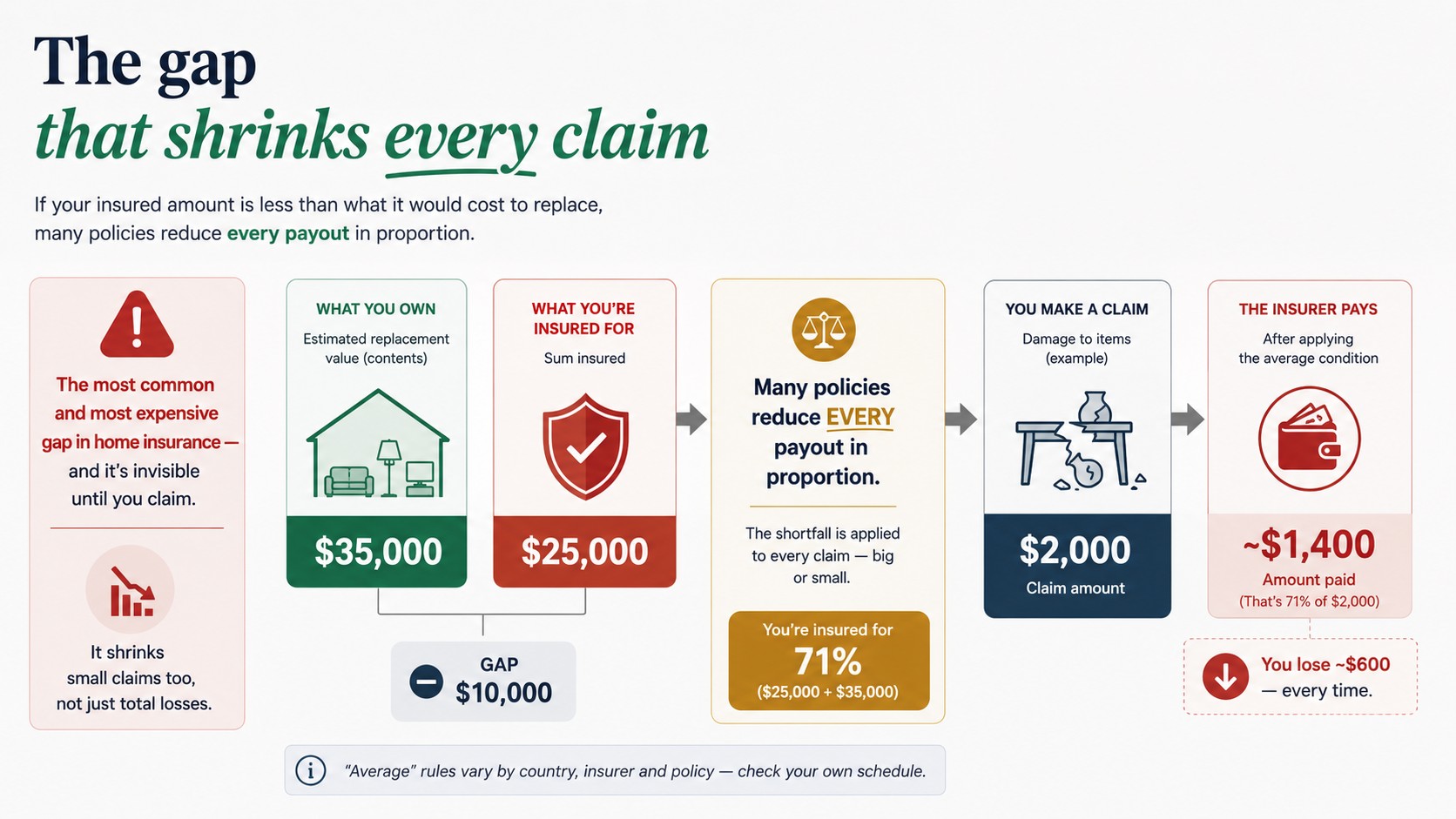
That figure matters for a reason beyond claims: it’s the number you should be comparing against your cover. Most people set a contents sum insured once, based on a guess, and then never revisit it while a decade of purchases quietly accumulates around them. The inventory turns a guess into a figure — and, quite often, reveals a gap.
Value it at today’s replacement cost
One technical point that changes the total significantly: the figure to record usually isn’t what you paid, and isn’t what it’s “worth now” secondhand. It’s what it would cost to buy the same thing today.
Most contents policies replace rather than reimburse, so today’s price is what matters — and on anything bought a few years ago, that’s noticeably more than you paid. Valuing your possessions at their original purchase price is one of the most common ways people quietly underinsure themselves.
(Policies do differ, and some work on an actual-cash-value basis instead. Your own policy schedule is the authority on which applies to you — that’s worth ten minutes of reading before you start.)
Don’t try to list everything
The most common way this project fails is ambition. People start with the intention of listing every single possession, spend an hour on the kitchen drawers, and never open the file again.
Don’t do that. The workable approach:
- List individual items of real value — appliances, electronics, furniture, tools, bikes, jewellery — with a description, the room, replacement cost today, and any serial or model numbers.
- Estimate the rest as groups. “Clothing,” “kitchenware,” “books,” “bedding,” “tools.” A sensible group estimate is far better than nothing, and infinitely better than abandoning the project.
- Back the groups with photographs. A photo of a full wardrobe or an open cupboard is worth more at claim time than an hour spent typing individual entries. Photograph and video every room, including inside cupboards, drawers and the attic.
Serial and model numbers deserve a special mention: for stolen goods, they’re what identifies your property to police and insurers, and they’re impossible to recall afterwards. Capturing them for electronics and tools is a small effort with a specific payoff.
Realistically this is a week of evenings, a room at a time, with the cupboards open. That’s the whole cost.
Store it where a house fire can’t reach it
An inventory that burns with the house has done nothing for you. Whatever form yours takes, keep a copy off the property — cloud storage, or with a family member. Same for the photographs and any receipts or valuation documents.
And a note that matters: this file becomes a complete description of everything valuable in your home, which room it’s in, and what it’s worth. That’s exactly what makes it useful and exactly why it deserves care. Keep policy references partial rather than complete, never store bank details or passwords alongside it, don’t email it around casually, and be deliberate about who it’s shared with. Sensible handling makes this far safer than having no record at all — but it isn’t a file to leave lying about.
Know the steps before you need them
The other half of preparation is knowing what to do in the first hours of a claim, because that’s when mistakes happen — throwing away damaged items before they’re seen, missing a notification deadline, not reporting a theft to the police promptly enough for the policy’s requirements, or not keeping receipts for emergency expenses.
Your insurer’s own instructions and your policy schedule are the authority here, and requirements differ enormously between countries, insurers and policies. But reading them before something happens, and keeping a dated log of every call, name and promise once a claim starts, is the difference between a process you can follow and one that happens to you.
An important note
To be clear: this is about record-keeping only. It is not insurance, financial, legal, or professional advice; it is not an insurance policy or a valuation; it doesn’t create or alter any cover; and it guarantees no claim outcome. Policy terms, single-item limits, underinsurance rules, claim notification deadlines and evidence requirements differ enormously by country, insurer and individual policy — nothing here describes your cover. Values you record are your own estimates, not professional valuations; high-value items usually need a formal valuation from a qualified valuer. Always read your own policy schedule and take advice from your insurer, a regulated broker, or a qualified professional.
If you want a structure to work through
I built a home inventory spreadsheet in Google Sheets for exactly this — 500 item rows with room, replacement cost today, serial numbers and a “where proof is kept” column, photo and receipt tracking with a percentage complete, value by room and category, plus a 12-step evidence checklist and a 12-step claim procedure, all built to be privacy-conscious (partial policy references only, no fields for bank details or passwords):
👉 Home Inventory Spreadsheet for Google Sheets & Excel
Whether you use mine or a notebook and your phone’s camera, spend the week of evenings. Walk each room with the cupboards open, price things at what they’d cost today, photograph everything, and keep a copy somewhere the house can’t reach. Build it once, calmly — and then hope you never need it. 🏠
This reflects my own perspective and describes a record-keeping tool — NOT insurance, financial or legal advice, not a valuation, and it guarantees no claim outcome; policy terms differ enormously, so always read your own schedule and speak to your insurer or a regulated broker. Have you ever tried to list your possessions from memory? Tell me how far you got in the comments.