

Fees Hide Bad Rates
A project can come in on budget, on time, with a delighted client — and still quietly pay you two-thirds of what you think you charge. Here’s the number that tells you, and why almost no freelancer looks at it.
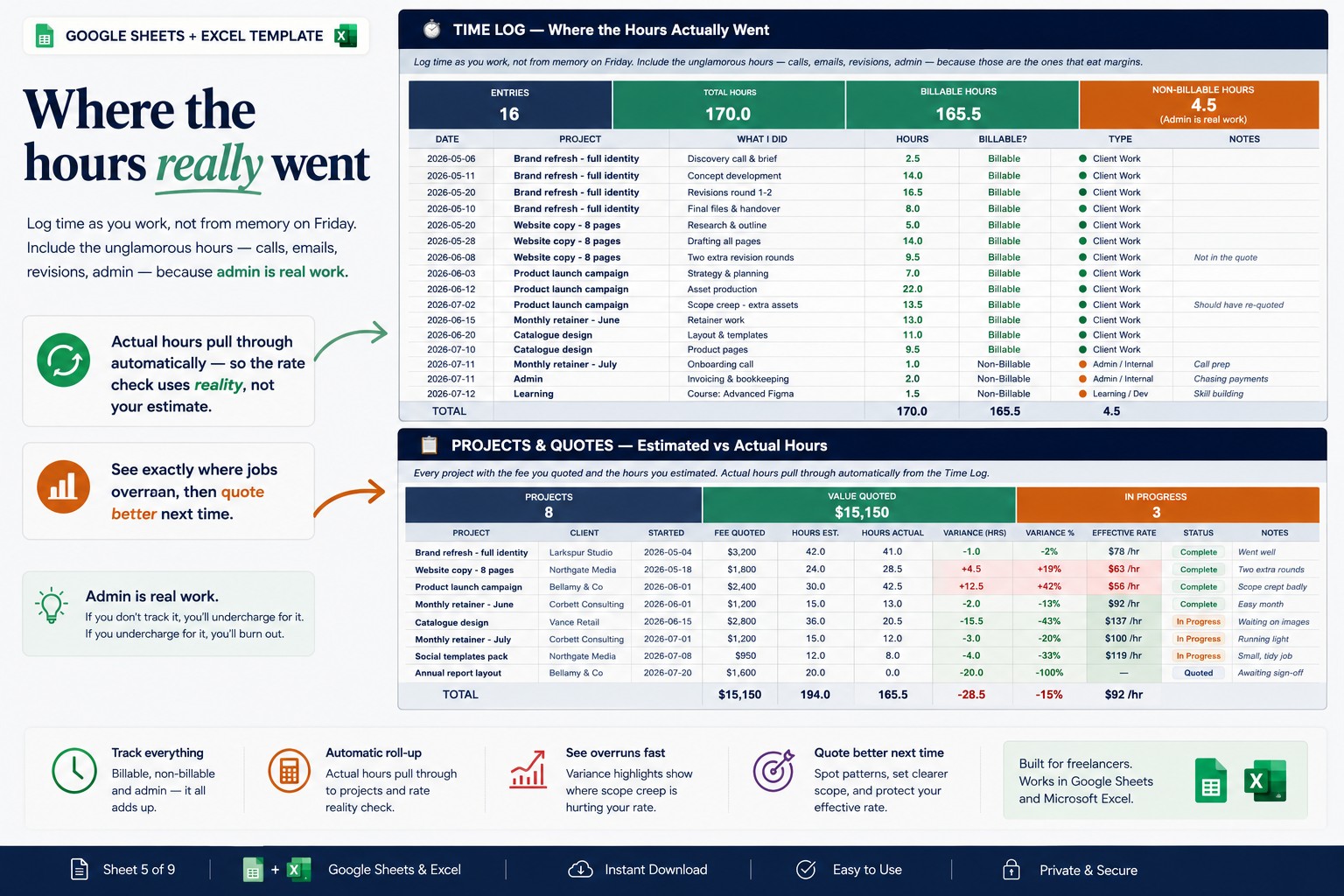
You quote $2,400 for a project. The client agrees. The work goes well. They’re happy, you’re happy, the invoice gets paid. By every visible measure that was a good job — and you’ll quote roughly the same thing for the same work next month. But somewhere in the middle there were two rounds of revisions nobody re-quoted, a longer-than-expected kickoff call, and an afternoon of exports. When you divide the fee by the hours you actually spent, that “good job” paid you $56 an hour against the $65 you believe you charge. Nothing told you. Nothing ever will, unless you calculate it. Your effective hourly rate is the single most useful number a freelancer can track, and almost nobody does.
Why the fee conceals the rate
The mechanism is simple and it catches everyone. A fee is agreed before the work, based on an estimate of the effort. The hours are spent during the work, and they don’t stay inside the estimate — they never quite do. But the fee doesn’t move. So every hour beyond your estimate is an hour you worked for free, and it’s invisible because the money side of the transaction looks exactly the same as planned.
This is worse for fixed-fee work, which is most freelance work. On an hourly contract, overrun at least shows up as more hours billed. On a fixed fee, overrun shows up as nothing at all — it just quietly reduces what you earned per hour, and the only person who absorbs it is you.
And the causes are mundane, not dramatic: scope that expanded slightly without anyone calling it a change, revisions beyond what you’d assumed, meetings that weren’t in the estimate, admin and file wrangling at the end. Each one small. Together, frequently a third of your rate.
Log the hours, even when you don’t bill them
The obvious objection: “I do fixed-fee work, I don’t track hours.” That’s exactly the situation where you most need to.
If you bill hourly, your hours are already visible — you’re being paid for them. If you bill fixed fees, your hours are the hidden variable, the only thing that determines whether a fee was good or terrible, and it’s the one thing you’re not measuring. Logging time on fixed-fee work isn’t about billing; it’s about learning what your work actually pays.
It also needs to include the unglamorous parts. The kickoff call. The email thread clarifying the brief. The revisions. The exporting, packaging and handover. The invoice itself. None of that is billable, and all of it is time the project consumed. A rate calculated only on “the creative hours” flatters itself and teaches you nothing.
You don’t need heroic precision — rough but honest beats meticulous but selective. What matters is that the total reflects reality.
What the number does to your quoting
Once you have effective rates across several projects, three things change quickly.
You find out which work actually pays. Almost every freelancer discovers a surprise here — a type of project that felt fine and consistently underpays, or an unglamorous one that turns out to be their best hourly earner. Neither is visible from the fees alone.
You quote better, without agonising. The hardest part of pricing is having no anchor. “What should I charge for this?” becomes far easier when you can look at three similar past projects and see what they really paid. If similar work has consistently landed below your target rate, the answer isn’t to hope this one goes better — it’s to quote higher or scope tighter.
You spot the specific leak. Because the overrun usually has a cause you can name. If revisions are what’s eating your rate, that’s a scope conversation and a “two rounds included, further rounds quoted separately” line in your terms. If it’s meetings, that’s a structure problem. Knowing where the hours went turns a vague sense of being underpaid into a fixable thing.
That’s the real payoff: not a number to feel bad about, but a specific adjustment to make. Most people who do this for two or three projects start quoting noticeably better — not by inflating prices, but by pricing the work that actually happens rather than the work they imagined.
Compare against a target you chose
The effective rate is only meaningful against something. Set a target rate — what you need to earn per hour for this to work — and compare each project to it. Then every job gets a plain verdict: on target, or below.
Choose the target based on what you need, not what you think clients will accept. Those are different questions, and blending them is how freelancers end up gradually working for less while feeling vaguely anxious about their prices.
And retainers deserve the same treatment, since they’re where this hides best. A retainer that feels comfortable because the money is predictable can be your worst-paying work once you count the hours — or your best. Log each period as its own project and find out. “It feels fine” is not a rate.
Tax: separate it at the moment money arrives
One adjacent habit worth pairing with this, because it’s the other thing freelancers reliably regret: set aside a portion of every payment for tax as it lands, in a separate account.
The percentage isn’t something an article or a spreadsheet can tell you — income tax, social contributions, VAT/GST, allowable expenses and filing rules differ enormously by country and by your own situation. Ask an accountant what’s right for you. But whatever the figure, the mechanism matters: separating it per payment rather than hoping there’s enough later is what turns tax from an annual crisis into a non-event.
It also makes your income picture honest. The money in your account isn’t all yours, and knowing what’s genuinely spendable — after the reserve — is a much better basis for planning than the raw balance.
An important note
To be clear: this is a general perspective on organising your own figures. It is not accounting, tax, legal, or professional advice, and it guarantees no outcome. Figures mentioned are illustrative examples. Any tax set-aside percentage should come from a qualified accountant who knows your circumstances, not from a rule of thumb. Rules on payment terms, late-payment interest and debt recovery vary by jurisdiction and contract.
If you want it calculated for you
I built a rate reality check into my freelance invoice tracker in Google Sheets — each project’s fee divided by the hours you actually logged, compared to your target rate with an on-target or BELOW verdict, plus estimated versus actual hours so you can see exactly where jobs overran, and a tax reserve applied to each payment at a percentage you choose:
👉 Freelance Invoice Tracker for Google Sheets & Excel
Whether you use mine or a calculator, do the sum for your last three projects. Fee divided by hours actually spent, including the unglamorous ones. It’s an uncomfortable ten minutes and it’s probably the highest-value ten minutes available to you — because fees hide bad rates, and you can’t fix a rate you’ve never seen. 💼
This reflects my own perspective and describes an organising tool — NOT accounting, tax or legal advice, and it guarantees no outcome; consult a qualified accountant about your tax position. Freelancers: what’s the project type that turned out to pay far worse than it felt? Tell me in the comments.

