The Cheapest Car on the Forecourt Is Often the Most Expensive
Sticker price is the one cost that’s advertised and one of the smaller ones that matters. Here’s how the true cost of car ownership can make a “cheaper” car thousands worse off.
Two cars sit side by side. One is a little over a thousand cheaper, and that’s the number on the windscreen, so that’s the number people decide on. Five years later, the “cheaper” one has cost several thousand more — because it lost value faster, cost more to insure, drank more fuel, and needed more work. Nothing on the windscreen told you any of that, and nobody on the forecourt is going to volunteer it. This isn’t an exotic edge case; it’s an ordinary outcome, and it’s why true cost of car ownership is the only sensible basis for choosing between cars. Here’s how to work it out.
The costs that actually decide it
Buying a car isn’t a purchase, it’s the start of a spending commitment. Over a few years of ownership, these are the pieces:
Depreciation. The value the car loses while you own it. For most cars this is the single largest cost of ownership — and it’s completely invisible, because you never write a cheque for it. You only meet it once, at the end, when the car is worth far less than you remember paying. Two cars bought at similar prices can differ enormously here, and that difference alone frequently dwarfs a sticker-price gap.
Insurance. Varies dramatically between cars that seem comparable — insurance group, repair costs, theft rates and the model’s history all feed in. It’s also the cost that surprises buyers most, precisely because they don’t check until after they’ve decided.
Fuel. Economy differences that look small per tank become large over several years of your actual annual mileage.
Servicing, parts and repairs. Some cars are simply cheaper to keep running. Parts availability, service intervals and known weak points vary a lot, and owners’ forums usually know exactly which ones.
Tax, tyres and the rest. Individually modest, collectively not.
Add those to the purchase price, subtract what you’d expect to sell it for, and you have the real number: what this car costs you to own over the period you’ll own it. That’s the figure worth comparing — and it routinely reorders a shortlist.
Why depreciation deserves top billing
If you only add one thing to how you compare cars, make it depreciation, for two reasons.
It’s usually the biggest number. Larger than fuel, often larger than everything else combined on a newer car. Ignoring the biggest cost while carefully comparing the smaller ones is a strange way to make a decision — but it’s what most buyers do, because depreciation never appears as a transaction.
It varies hugely and predictably. Some models hold value notably better than others, for reasons that are reasonably well known — reliability reputation, demand, supply. You can estimate it before you buy by looking at what the same car, a few years older, sells for today. That’s not a forecast, but it’s a far better guide than assuming all cars depreciate similarly, which they don’t.
A car that holds its value is quietly refunding you a chunk of its purchase price at the end. One that doesn’t is charging you for the privilege of having owned it.
Get the insurance quote before you commit
The single most valuable practical step in this whole process takes ten minutes: get an actual insurance quote for the specific car you’re considering, before you agree to buy it.
Not an estimate, not an average, not “insurance is usually about…”. A real quote, for that model, at your age, postcode and history. The variation between superficially similar cars can be startling, and it’s a cost you’ll pay every year for as long as you own it.
People skip this because it feels like a step for after the decision. It isn’t — it’s an input to the decision, and it’s occasionally the thing that changes it entirely.
Similarly, look up servicing costs and common faults for the specific model and year before buying. Owners’ forums are unusually honest about which cars are expensive to keep, and an hour there can save a great deal.
Compare on total, not on price
Once you have estimates for each car on your shortlist — purchase, insurance, fuel, tax, servicing, tyres, and expected resale — you can compare them properly, and the useful output is a cost per month, all in. That’s the figure to hold against your actual budget, because it’s what motoring will really take out of your life each month.
This is also where the finance and the ownership sides finally meet. A loan payment you can afford on a car whose running costs you can’t is the classic mistake, and it’s only visible when you look at both together. Comparing all-in monthly cost across your shortlist puts everything in one number that can’t be gamed by adjusting a term or ignoring a category.
Two honest caveats. These are estimates — depreciation especially, since resale values depend on the market at the time you sell. And the numbers aren’t everything: safety, practicality, how a car actually suits your life, and simply liking it are legitimate reasons to pay more. The point isn’t that the cheapest-to-own car always wins. It’s that you should know what you’re paying for the one you choose.
Before the money changes hands
Whatever the numbers say, sequence matters at the end. The safeguards belong before payment, not after:
- An official vehicle history check — for outstanding finance, write-off records, mileage discrepancies and theft. Cheap, fast, and occasionally saves you from disaster.
- An independent mechanical inspection, especially on a used car and especially from a private seller. A mechanic who doesn’t work for the seller and doesn’t want the sale is worth every penny.
- Everything in writing — price, what’s included, and any promises made.
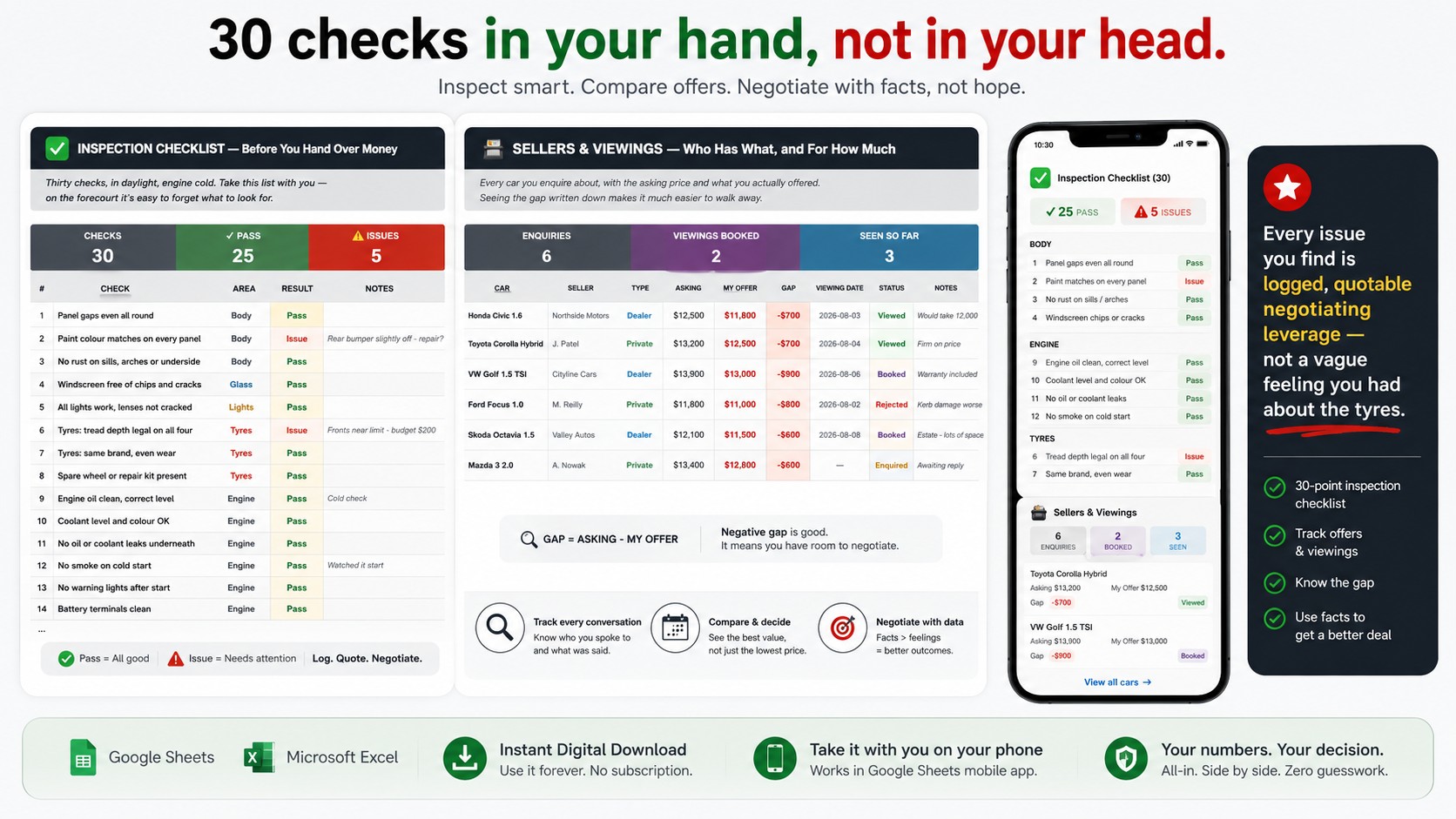
Anything you find in an inspection is also negotiating leverage, incidentally: a documented, quotable issue is worth far more in a price conversation than a vague sense that something wasn’t quite right.
An important note
To be clear: this is a general explanation and a way of organising your own estimates. It is not financial, credit, insurance, legal, tax, or professional motoring advice, and it guarantees no outcome. All figures are illustrative — your real costs depend on the specific vehicle, your insurer, your credit, your mileage and where you live, and resale values are estimates that can change. Registration and change-of-keeper rules vary by country and state. Always obtain written quotes, an official vehicle history check and an independent mechanical inspection, and consult a qualified adviser before committing.
If you want it calculated for you
I built a true-cost-of-ownership page into my car buying spreadsheet in Google Sheets — enter each car’s purchase price, insurance, fuel, tax, servicing, tyres and expected resale, and it works out the full cost of ownership and an all-in monthly figure, then ranks your shortlist and picks the best value on total cost rather than sticker price:
👉 Car Buying Spreadsheet for Google Sheets & Excel
Whether you use mine or a calculator, don’t let a windscreen price make a five-year decision. Estimate what each car will actually cost you to own, get the insurance quote before you commit, and compare on the total. The cheapest car on the forecourt is often the most expensive one in the driveway — and the only way to know is to add it up. 🚗
This reflects my own perspective and describes an estimation tool — not financial, insurance or professional motoring advice, and it guarantees no outcome; figures are illustrative and depend on your own circumstances. Always get a history check and an independent inspection before buying. Has a car ever cost you far more to run than you expected? Tell me in the comments.