


The most uncomfortable audit I ever ran: A few years ago I spent a week tracking where my professional results actually came from. Not where I spent my time — where my results came from. The finding was deeply uncomfortable: roughly 20% of my activities were generating roughly 80% of everything that mattered. The other 80% of my time was producing roughly 20% of value — and consuming the energy I needed for the vital 20%. This is what I did about it.
The Italian economist and the pea pods
The 80/20 principle takes its name from Vilfredo Pareto, an Italian economist who made an observation in his garden in 1896: approximately 20% of his pea pods were producing approximately 80% of the peas. Curious about whether this distribution appeared elsewhere, he examined land ownership data in Italy and found that approximately 20% of the population owned approximately 80% of the land. He looked further and found the same distribution repeating in wealth, tax receipts, and economic output across countries.
The specific numbers — 80 and 20 — are not the point. What Pareto had identified was a recurring pattern of unequal distribution: in many complex systems, a small minority of inputs, causes, or participants produces a large majority of the outputs, effects, or results. The ratio varies, but the asymmetry is consistent enough across enough domains to constitute a genuine principle rather than a coincidence.
“The majority of results come from a minority of causes.”— Richard Koch, The 80/20 Principle
What the 80/20 principle actually says — and what it doesn’t
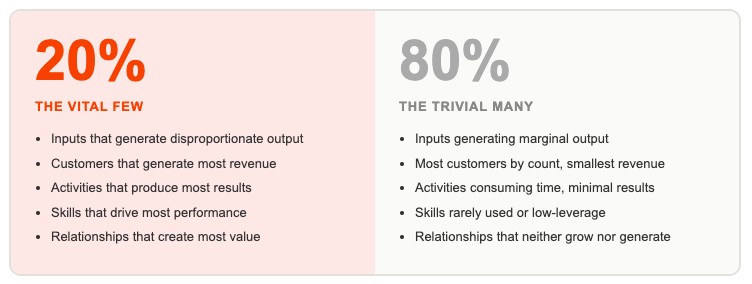
The 80/20 principle does not say that 20% of inputs always produce exactly 80% of outputs. The exact ratio varies — sometimes it’s 90/10, sometimes 70/30. What it says is that the distribution is typically far more unequal than people intuitively assume. We tend to think effort and results scale proportionally. They almost never do.
It also does not say that the 80% majority is worthless or should be eliminated. Some activities in the 80% are necessary infrastructure, genuine obligations, or investments in future value that hasn’t materialized yet. The principle is an invitation to look at the distribution honestly — not a mandate to ruthlessly eliminate everything below a threshold.
Read also: How Jeff Bezos Made the Biggest Decision of His Life — And How I Use It for Mine
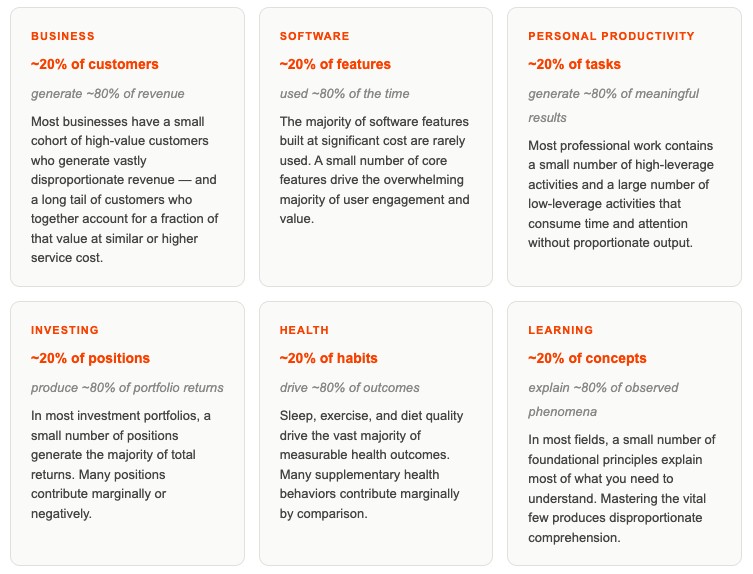
Where the distribution shows up across domains
My results audit — and what I found
The uncomfortable practice I referenced in the introduction involved tracking not time but results. For one week, I logged every activity and noted whether it produced outcomes that actually mattered: client work that moved a relationship forward, writing that led to a meaningful response, decisions that generated real impact, conversations that produced concrete next steps.
The finding was startling in its clarity. Two client relationships were generating the vast majority of my consulting revenue. Three writing topics consistently produced the traffic and engagement that drove everything else. One skill — the ability to take a complex situation and produce a clear, structured analysis of it — was being invoked in nearly every high-value outcome I could identify. One relationship network cluster was the source of most meaningful professional opportunities.
The flip side: roughly 60% of my recorded activities had no traceable connection to any meaningful outcome I could identify. Some were genuine obligations. Some were low-value habits dressed up as productive behavior. Some were activities I enjoyed but that weren’t generating what I actually wanted to generate.
The audit produced a clear agenda: more of the two clients, more of the three topics, deeper development of the one core skill. Less of most everything else.
How to apply the 80/20 principle — step by step
- Define “results” precisely before running the analysis The 80/20 audit is only as good as the definition of output you’re working with. Revenue generated. Content that drove meaningful engagement. Decisions that changed outcomes. Relationships that created opportunity. Vague definitions of “valuable” produce vague audit results. Be specific.
- Track activities and their results for at least one representative week Log what you actually do — not what you plan to do or intend to do. Include the full range: email, meetings, creative work, administrative tasks, learning, relationship maintenance. For each activity block, note whether it produced a result you defined in Step 1.
- Identify the vital 20% — the activities with disproportionate output Which activities appear repeatedly in connection with meaningful outcomes? Which client relationships, content types, skills, or focus areas show up in the high-output column? These are your vital few. The analysis should produce a short list — three to six items — not a comprehensive taxonomy.
- Examine the 80% honestly — what can be reduced, delegated, or eliminated? Not everything in the 80% can or should be eliminated. Some is necessary infrastructure. But some is there through inertia, habit, or misplaced busyness. Separate the necessary from the optional, and identify what can be reduced without meaningful loss of output.
- Redesign your default week around the vital 20% Schedule the high-leverage activities first, in your best cognitive hours, with protection from interruption. Schedule or delegate the necessary 80%. Eliminate what can be eliminated. Then monitor whether results improve with the reallocation.
Read also: How Stoicism Changed My Approach to Adversity — And 5 Practices I Still Use Every Day
The 80/20 rule at work — what I eliminated and what happened
After running my audit, I made several specific changes that I want to describe concretely because general advice about “doing less” is not useful without examples of what “less” looks like in practice.
I reduced my client base by 40%. I identified the two relationships generating the vast majority of value and made them substantially deeper. I concluded relationships that were consuming equal time for a fraction of the revenue and impact. Revenue did not drop proportionally — it held at roughly 85% of the previous total while my workload dropped by a third.
I stopped writing on four topic areas. The topics I had been covering comprehensively were not what my audience was engaging with most. Three specific topic areas were generating the overwhelming majority of meaningful responses. I stopped the others and focused there. Traffic improved within two months.
I eliminated three standing meetings. These were weekly commitments that produced almost no traceable outcomes but consumed roughly four hours per week. Removing them returned roughly 200 hours per year to high-leverage work.
None of these decisions were comfortable in the short term. All of them produced better outcomes within six months. The audit made the choices obvious — the discomfort was entirely in executing them.
The dangers of over-applying this principle
⚠️ Where the 80/20 principle can mislead
Relationships are not revenue streams. The 80/20 analysis applies well to activities and outputs. It applies poorly to human relationships, which have dimensions — loyalty, care, reciprocity — that cannot be reduced to current output contribution without moral and personal costs that the analysis doesn’t capture.
The 80% contains future vital few. Some of what appears in the low-output 80% today is investment in future capabilities, relationships, or opportunities that haven’t yet matured. Eliminating all of the 80% can starve the pipeline that produces next year’s vital 20%.
Not everything valuable is measurable. An analysis based on traceable results will systematically underweight activities whose value is real but difficult to attribute: learning, relationship maintenance, creative exploration, rest. The audit captures what is visible — not everything that matters.
Conclusion: the goal is not doing less — it is doing the right things more
The misreading of the 80/20 principle as a permission slip for laziness misses its actual power. The principle is not an argument for doing less. It is an argument for doing the right things — the vital few that generate disproportionate value — with more of the time, energy, and focus that are currently being spread thin across the trivial many.
Done well, applying the 80/20 principle produces not less output but more: because the high-leverage 20% receives the focused attention it deserves rather than competing with the diffuse demands of the remaining 80%.
The 80/20 audit — start this week
For the next five working days, log every activity block and note whether it produced a result that you would describe as genuinely meaningful — not just completed, but meaningful.
At the end of the week, add up the meaningful-outcome activities. They will almost certainly be a minority of your time. That minority is where your leverage lives. The question is what you do with that information.

