

Cost Per Use: The Number That Finally Makes You Cancel
A subscription’s real price isn’t what it costs per month — it’s what it costs each time you actually use it. Here’s why cost per use ends the “should I cancel?” debate.
We’re all bad at judging whether a subscription is worth it. We look at the monthly price, decide it’s “not much,” and keep paying. The gym at $45 a month? Reasonable. The streaming service at $15? Fine. But the monthly price is the wrong number to judge by, and it’s precisely why we keep subscriptions we shouldn’t. The right number — the one that instantly settles whether something is worth keeping — is cost per use. Once I started calculating it, my “should I cancel this?” debates ended in about ten seconds each. Here’s why it’s so powerful.
The monthly price hides the truth
Here’s the problem with judging a subscription by its monthly cost. The price tells you what you pay, but not what you get. Two people paying the same $45 for a gym are having completely different financial experiences: one goes twelve times a month, the other goes twice. Same price, wildly different value. The monthly number can’t see that difference, so it can’t tell you whether you are getting your money’s worth.
This is why the “it’s only $X a month” logic keeps us subscribed to things we barely use. The price sounds small and reasonable in isolation, so we never question it. What we’re missing is the other half of the equation: how much we actually use the thing. Value isn’t cost alone — it’s cost relative to use. And most of us only ever look at the cost.
The math that changes everything
Cost per use is simple: take what you pay, and divide it by how many times you actually use it.
That gym at $45 a month, visited twice? That’s $22.50 per visit. Suddenly it’s not “$45 a month, seems fine” — it’s “I’m paying twenty-two fifty every time I walk in there.” That reframe is devastating in the best way, because it makes the true cost of your underuse impossible to ignore. You could pay for a drop-in class for less.
The streaming service you watch once a month? Its cost per use might be the entire monthly price, for one film you could have rented. The app you open twice a year? The cost per use is genuinely absurd once you look at it. Cost per use takes a subscription that felt harmless and reveals exactly how much each actual use is costing you — and for the things you barely touch, the number is shocking.
Why this number ends the debate
The reason cost per use is so effective is psychological. “Should I cancel my gym membership?” is a hard, fuzzy question tangled up with guilt, good intentions, and the vague sense you should go more. It’s easy to keep deferring.
“Am I happy paying $22.50 every single time I go?” is a completely different question. It’s concrete, it’s specific, and it usually has an obvious answer. Cost per use converts a wishy-washy, emotional decision into a clear, factual one. It cuts through the “but I might use it more next month” self-deception, because it’s based on what you actually do, not what you intend to do.
That’s why it works when nothing else does. We’re brilliant at rationalizing keeping subscriptions (“I’ll use it more,” “it’s not that much,” “I’d feel bad cancelling”). Cost per use doesn’t argue with the rationalizations — it just shows you a number so stark that the rationalizations quietly give up.
Use it to keep the good ones, too
Cost per use isn’t only for cancelling — it’s for clarity, and it cuts both ways. It can also confirm that a subscription you felt guilty about is actually great value. The streaming service you watch constantly might cost pennies per use — genuinely excellent value, keep it happily. The tool you use every day for work more than earns its price.
That’s important, because good financial decisions aren’t about cutting everything; they’re about knowing what’s worth it. Cost per use lets you keep the subscriptions that genuinely earn their place with zero guilt, and cut the ones that don’t with zero hesitation. It replaces vague guilt about “having too many subscriptions” with clear, per-item facts.
A quick, honest caveat
Two sensible notes. First, this is about money value; some things you underuse still matter for other reasons (a gym membership that keeps you going even occasionally may be worth it for your health — only you can weigh that). Cost per use informs the decision; it doesn’t make it for you. Second, before you actually cancel anything, check the subscription’s terms and your real statements — cancellation timing, commitments, and what you’d lose. This is a way of thinking about value, not financial advice.
If you want it calculated for you
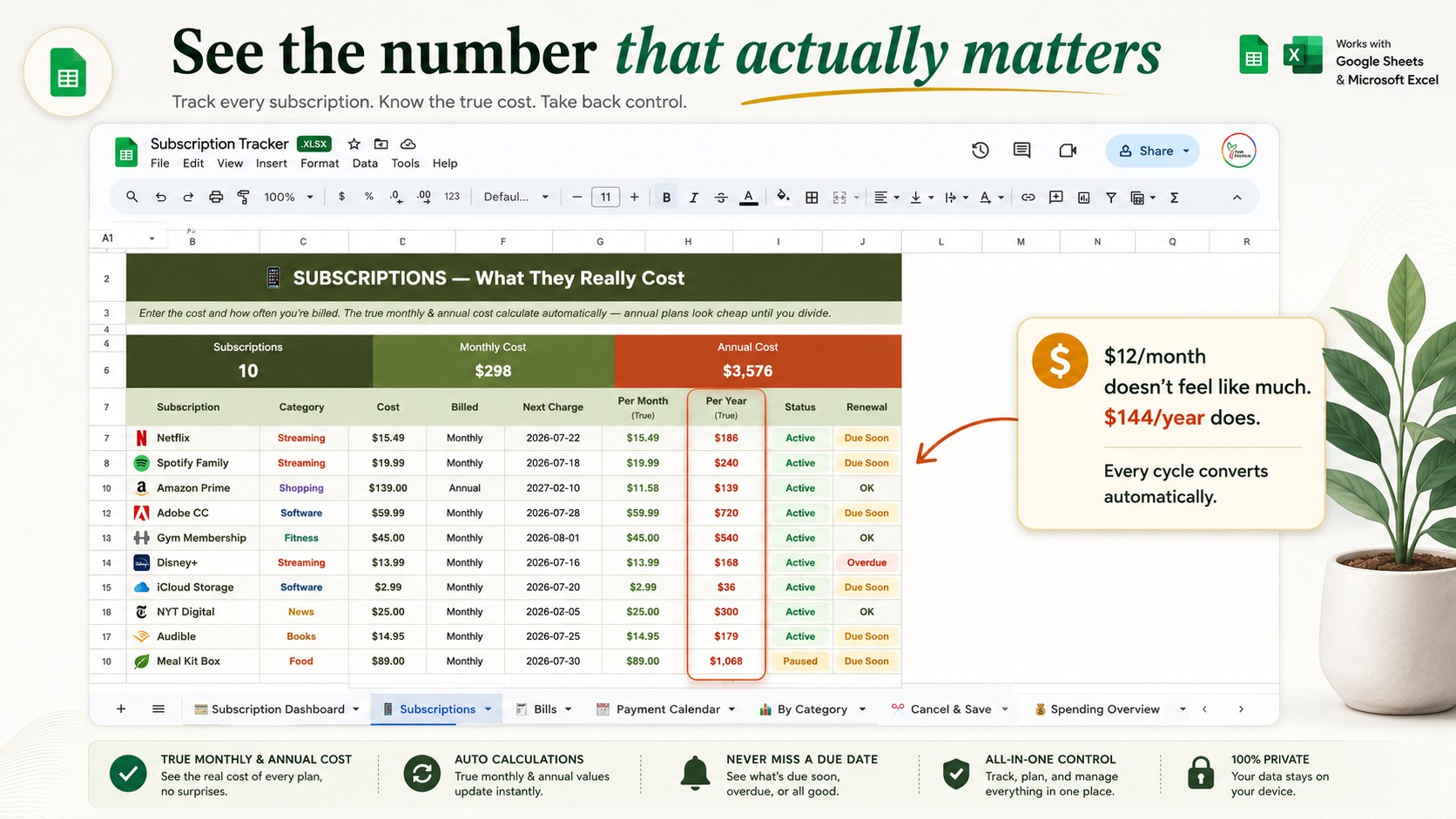
I built cost per use into my subscription tracker in Google Sheets — enter what you pay and roughly how often you use each subscription, and it shows the cost per use automatically, alongside the true annual cost and a cancel-and-save calculator:
👉 Subscription Tracker for Google Sheets & Excel
Whether you use a tool or a calculator, stop judging subscriptions by their monthly price and start judging them by cost per use. It’s the single most persuasive number in personal finance for a reason: it shows you, in plain dollars, exactly what your underused subscriptions are really costing you — and it makes the decision almost make itself.
This is a personal-finance perspective and organizing tool — not financial advice. Always check each subscription’s terms and your actual statements before cancelling. What’s the worst cost-per-use you’ve ever calculated? Confess it in the comments — I’ll start.

