When Three Interviewers Have a Gut Feeling, the Loudest Voice Wins
Hiring debrief meetings are where good candidates get lost and bad decisions get made. Here’s how to turn a hiring panel decision from a debate into evidence.
You know the meeting. Three or four people who interviewed the same candidate sit down to decide. Everyone shares their impression. Someone says they “really liked” the candidate. Someone else has “a slight concern” but can’t quite articulate it. The most senior person in the room says what they think, and — funny how this works — the group gradually converges on that view. Twenty minutes later you have a decision that feels collective but was mostly determined by whoever spoke with the most conviction. That’s how most hiring panel decisions actually get made, and it’s a genuinely bad way to choose who joins your team. Here’s the fix.
Why panel debriefs go wrong
The debrief meeting has some well-known failure modes, and they’re all about social dynamics overwhelming evidence:
- The loudest voice wins. The person who speaks with the most confidence and force disproportionately shapes the group’s view — regardless of whether their assessment is the most accurate.
- Seniority anchors everyone. When the most senior person shares their opinion first, everyone else’s assessment quietly bends toward it. Junior interviewers, who may have spotted something important, soften or swallow their concerns.
- Vague impressions can’t be debated. “I just wasn’t sure about them” is impossible to argue with or examine, because there’s nothing concrete in it. So it either sways the room unexamined, or gets dismissed unexamined — neither is good.
- The charming candidate benefits again. Absent structure, the debrief re-runs the same charisma contest as the interview, now amplified by group dynamics.
The result is decisions driven by whoever’s most confident and senior, not by who’s actually best for the job. And nobody in the room quite realizes it happened.
Collect scores BEFORE the discussion
The single most powerful fix: have every interviewer record their evaluation before the group discusses. Independently, in writing, scored against the agreed criteria.
This one change neutralizes the biggest problem — anchoring. When each person has committed to their assessment before hearing anyone else’s, the senior person’s opinion can’t quietly reshape everyone else’s memory of the interview. You get genuinely independent data points, which is the whole reason you had multiple interviewers in the first place. If everyone just converges on the loudest opinion, why did you bother with a panel?
Independent scoring also surfaces genuine disagreement rather than burying it. If three interviewers scored a candidate very differently, that’s valuable information — it means something interesting is going on, and it’s worth exploring. In an anchored debrief, that disagreement would have been smoothed over and lost.
Give every voice a place on the record
Beyond scores, capturing each interviewer’s specific strengths, concerns, and recommendation — in writing — ensures that everyone’s input is on the record, not just the people comfortable speaking up in a room. The junior interviewer with a well-founded concern, who wouldn’t have pushed back against a senior colleague verbally, has their view captured and visible.
This is a fairness issue and a quality issue at once. Panels exist to bring multiple perspectives; if the process silently filters those perspectives down to whoever’s most assertive, you’ve wasted the panel and possibly lost the most important insight in the room.
Make the discussion about evidence, not vibes
With independent scores and written feedback in hand, the debrief transforms. Instead of “what did everyone think?” (which invites the loudest voice to lead), you can start from the evidence: here are the scores, here’s where we agree, here’s where we diverge — let’s dig into the divergence.
Now disagreement becomes productive rather than political. “I scored them low on this criterion because of this specific answer” is something the group can actually examine. Someone else may have evidence that changes your view — or you may change theirs. That’s a real discussion, grounded in what candidates actually demonstrated, rather than a contest of confidence.
Document the decision
The final piece: record the decision and the reasoning behind it. This matters for a few reasons. It creates a clear record of why you hired (or didn’t hire) someone, which supports a fair, consistent, and defensible process. It helps you learn over time — you can look back and see whether your evaluations predicted actual performance. And it holds the panel accountable for making a decision based on the evidence they gathered, rather than a vibe they can’t reconstruct later.
A hiring process you can explain is a hiring process you can improve, and one you can stand behind.
An important note on fairness and the law
To be clear: structuring a panel decision helps reduce the influence of bias and social dynamics — but it doesn’t eliminate bias, and a tool is not a guarantee of a fair or lawful process. This is not legal, HR, or employment advice. The fairness and legal compliance of your hiring are your responsibility: keep your criteria genuinely job-related, follow the employment and equal-opportunity laws that apply to you, and consult a qualified professional where needed.
If you want a system for panel scoring
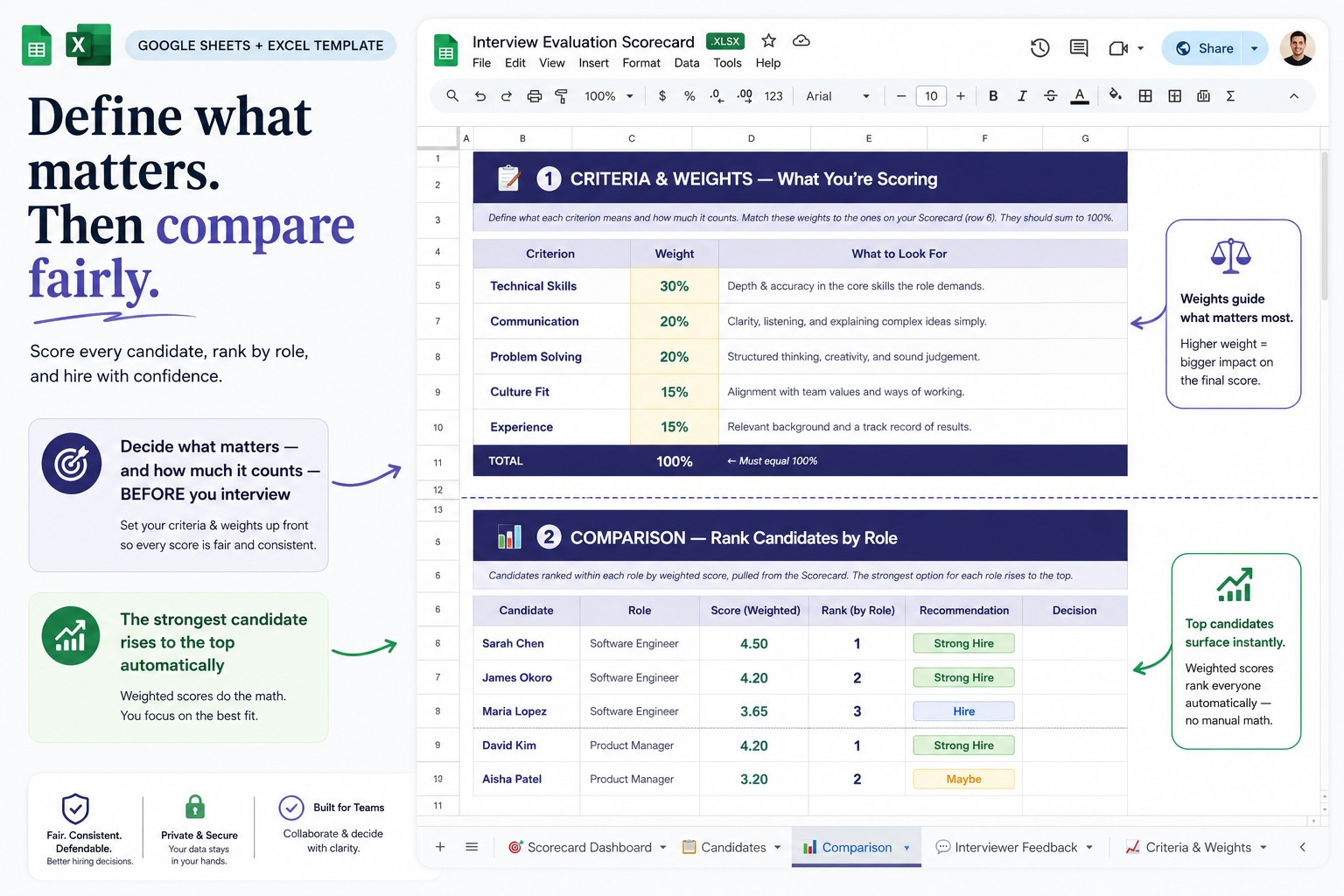
I built multi-interviewer feedback into my interview scorecard in Google Sheets — every interviewer records their own scores, strengths, concerns and recommendation, candidates are ranked by weighted score, and the final decision is logged with the evidence behind it:
👉 Interview Evaluation Scorecard for Google Sheets & Excel
Whether you use mine or build your own, stop letting the loudest voice pick your team. Score independently before you discuss, capture every interviewer’s view, and make the debrief about evidence rather than confidence. The best candidate deserves a process where the strongest argument wins — not the strongest personality in the room.
This reflects my own experience and is a structuring tool — not legal, HR or employment advice. The fairness and legal compliance of your hiring process are your responsibility; consult a qualified professional. How does your team run its hiring debriefs? Tell me in the comments.