

Introduction: Framing the Long-Term Consequences of Impatience
Financial success is often discussed in terms of intelligence, discipline, or access to capital. Yet across generations and economic systems, a more consistent explanatory variable emerges: time horizon. Individuals and institutions that align decisions with long-term compounding processes tend to outperform those that optimize for immediacy. The tension between short-term incentives and long-term outcomes is not incidental. It is structural.
Impatience is not merely a personality trait. It is a systematic distortion in decision-making under uncertainty. It arises when immediate feedback is weighted more heavily than delayed but larger consequences. In financial contexts, this distortion frequently manifests as the misinterpretation of volatility as risk. Temporary fluctuations are treated as permanent threats. Short-term discomfort triggers action, even when inaction would yield superior outcomes over extended horizons.
The consequences are cumulative. Small deviations from long-term reasoning compound into material differences in wealth, career trajectory, and institutional resilience. To understand why impatience undermines financial success—and why this pattern persists despite widespread awareness of compounding—it is necessary to examine underlying mechanisms: time horizon mismatch, incentive structures, feedback loops, and cognitive biases embedded in social and institutional systems.
This is not a moral argument for patience. It is an analytical inquiry into why misaligned time horizons systematically erode outcomes across domains.
The Core Problem: Time Horizon Misalignment
Time horizon misalignment occurs when the evaluation period of a decision does not match the payoff period of the underlying system. In financial markets, for example, assets may fluctuate daily, but their productive capacity unfolds over years or decades. When individuals evaluate long-term assets using short-term metrics, they distort risk assessment.
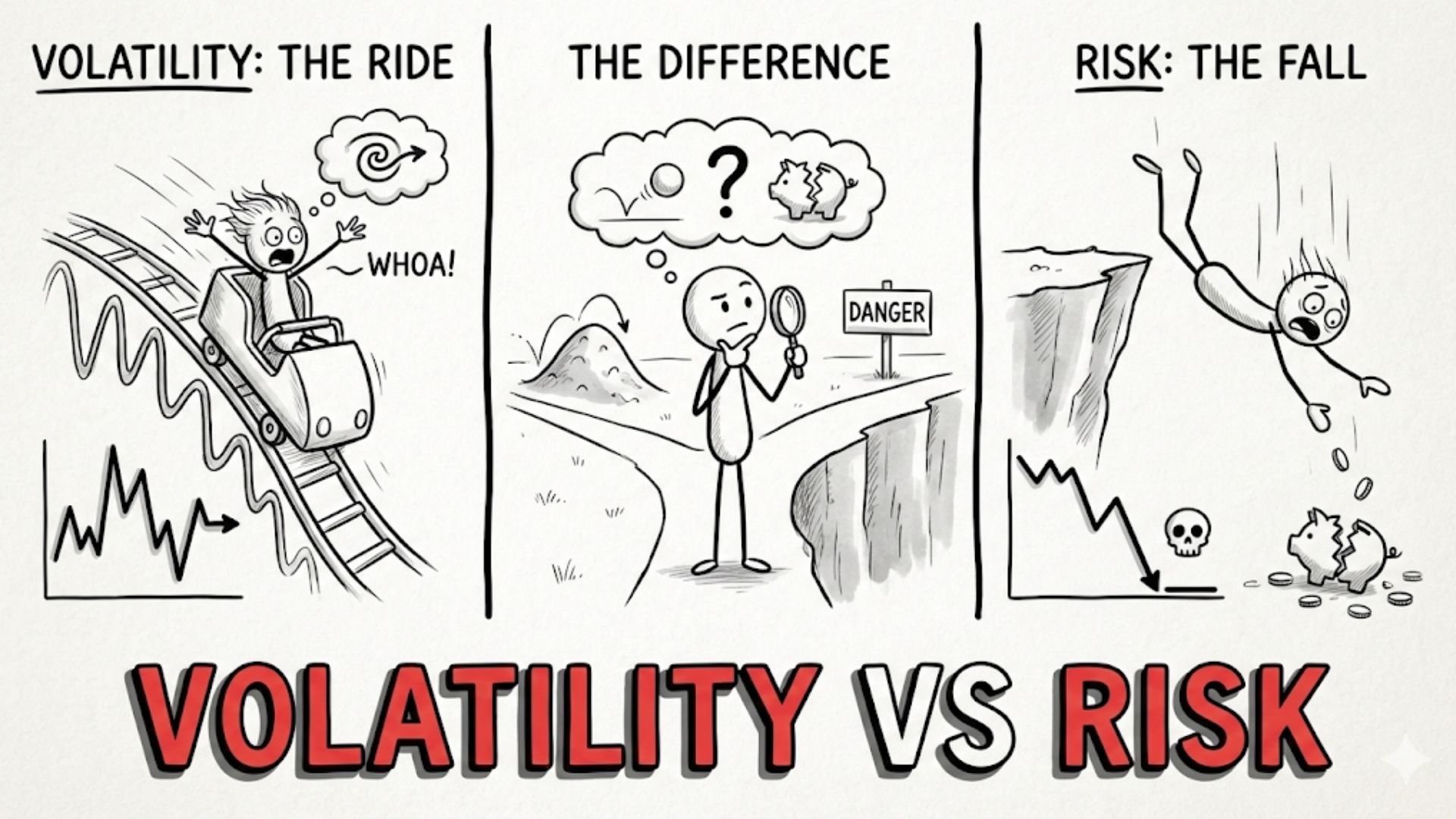
Volatility refers to short-term price variability. Risk, in a structural sense, refers to the probability of permanent capital impairment. These are not equivalent. A long-term productive asset may exhibit high short-term volatility while presenting low long-term risk. Conversely, an apparently stable system may conceal structural fragility.
When time horizons are compressed, volatility is misclassified as danger. This classification triggers reactive behavior: selling during downturns, abandoning strategies prematurely, shifting focus before compounding mechanisms have time to operate. The core error is not market timing; it is temporal miscalibration.
Time horizon misalignment extends beyond investing:
- In careers, skill accumulation may require years before visible payoff.
- In business strategy, customer trust and brand equity compound slowly.
- In savings behavior, modest but consistent contributions create exponential outcomes only after extended durations.
In each case, the evaluation window must match the system’s natural maturation cycle. When individuals judge long-gestation processes using short-term performance metrics, they systematically underinvest in compounding systems.
The problem is structural because modern economic life amplifies short-term signals while obscuring long-term payoffs.
Read also: How Fear and Greed Drive Market Cycles
Why the Problem Persists Despite Experience
If the benefits of long-term thinking are widely documented, why does impatience remain pervasive? The persistence of this decision-making error can be explained through three reinforcing mechanisms: delayed feedback, incentive design, and behavioral bias.
1. Feedback Delay and Signal Distortion
Compounding systems exhibit non-linear growth. Early stages appear flat. Progress is difficult to detect. The absence of visible reinforcement weakens commitment. Humans evolved in environments where feedback was immediate and survival-relevant. Modern financial systems often operate on timelines that exceed intuitive perception.
When outcomes are delayed, learning is impaired. Behavioral adaptation relies on tight feedback loops. In long-term investing or skill development, the loop may span years. During that interval, individuals receive noisy signals—price fluctuations, peer comparisons, short-term underperformance—that distort perception.
The result is premature abandonment of strategies that would have succeeded given sufficient time.
2. Incentive Structures Reward Immediacy
Institutions frequently embed short-term evaluation periods:
- Corporate earnings are reported quarterly.
- Professional performance is reviewed annually.
- Fund managers are judged on near-term returns.
- Media narratives prioritize daily fluctuations.
These structures reward visible short-term performance even when long-term optimization requires temporary underperformance. Agents operating within such systems face career risk for pursuing long-term strategies that may not align with short-term benchmarks.
The rational response to short-term evaluation is short-term optimization. Thus, impatience becomes institutionally reinforced rather than individually chosen.
3. Behavioral Bias: Present Bias and Temporal Discounting
Behavioral economics identifies present bias—the tendency to overweight immediate outcomes relative to future ones. Temporal discounting causes individuals to value future rewards less steeply than rational compounding models would imply.
This bias is not eliminated by awareness. Knowing that compounding exists does not neutralize the psychological discomfort of short-term loss or uncertainty. Emotional responses to volatility are immediate and visceral; long-term benefits are abstract.
Moreover, social comparison amplifies present bias. When peers display visible markers of short-term success, long-term strategies feel comparatively stagnant. Cultural narratives emphasizing rapid achievement reinforce the perception that delayed payoff signals failure rather than incubation.
These mechanisms create a self-reinforcing loop: short-term feedback shapes behavior; behavior reinforces short-term incentives; incentives validate short-term evaluation frameworks.
Read also: A Masterclass on Graham and Dodd’s “Security Analysis”
Real-World Consequences Across Domains
Time horizon misalignment produces distinct but structurally similar consequences across multiple domains.
Investing
In financial markets, volatility is visible; long-term productivity is abstract. Daily price changes are observable; decades of earnings growth are conceptual. When investors react to short-term price movements, they convert temporary volatility into permanent loss through transaction costs, tax friction, and suboptimal timing.
Frequent portfolio adjustments often reflect discomfort with uncertainty rather than improved information. Empirical evidence consistently shows that excessive trading correlates with lower returns, largely due to behavioral responses to short-term noise.
The structural error lies in evaluating multi-decade wealth-building mechanisms on quarterly timescales.
Career Development
Skill accumulation operates as a delayed payoff system. Early investment in complex capabilities—technical expertise, communication skills, network building—may not yield immediate compensation. Returns materialize after competence compounds and optionality expands.
Impatience leads individuals to chase visible short-term salary increases at the expense of long-term skill depth. This trade-off can produce flatter trajectories over time. The compounding advantage of rare expertise becomes visible only after years of deliberate investment.
Time horizon compression causes misallocation of effort toward immediate recognition rather than durable capability.
Entrepreneurship and Business Strategy
Businesses often require extended periods of reinvestment before profitability stabilizes. Brand equity, customer trust, operational efficiency, and network effects compound gradually.
Pressure for immediate profitability can constrain strategic investment. Companies that optimize for quarterly metrics may underinvest in research, customer experience, or infrastructure that would enhance long-term resilience.
Conversely, excessive tolerance for losses without structural path to sustainability represents a different form of misaligned horizon—one that confuses delayed payoff with absent payoff. The critical variable is alignment between time horizon and economic reality of the business model.
Savings Behavior
Savings and retirement planning illustrate compounding clearly. Early contributions generate disproportionate long-term effects. Yet the psychological reward for saving is minimal relative to immediate consumption.
Structural forces—advertising, consumer credit availability, cultural emphasis on lifestyle signaling—encourage immediate expenditure. The cost of impatience accumulates invisibly over decades, only becoming salient when reversal is difficult.
Across these domains, the pattern is consistent: short-term evaluation produces long-term underperformance.
Read also: Passive Income From $2.26 to $1.25 Million in 5 Years
A Core Mental Model: Compounding and Delayed Feedback Systems
To understand why patience matters structurally, consider compounding as a system governed by exponential rather than linear dynamics.
In linear systems, inputs and outputs scale proportionally. Effort today produces immediate, predictable results. In compounding systems, early outputs appear negligible. Growth accelerates only after a threshold period. The curve remains flat before inflecting upward.
This structure creates a paradox. The period when commitment is most critical is precisely when visible payoff is smallest.
Delayed feedback systems amplify this effect. Because reinforcement is postponed, agents must rely on probabilistic reasoning rather than immediate evidence. The absence of short-term reward does not imply absence of long-term benefit. However, human cognition is optimized for environments where cause and effect are tightly coupled.
When compounding interacts with delayed feedback, impatience becomes structurally likely. Individuals perceive stagnation, underestimate exponential growth, and terminate processes before inflection occurs.
Importantly, compounding operates not only in finance but also in knowledge accumulation, reputation building, and network expansion. Each domain features nonlinear growth curves and extended gestation periods.
Understanding this mental model clarifies why volatility—short-term deviation from trend—should not automatically be interpreted as risk. In a compounding system, temporary regressions may be statistically inevitable while long-term direction remains intact.
Applying Better Thinking in Practice (Principles, Not Tactics)
Improving long-term reasoning does not require specific financial strategies. It requires structural realignment between evaluation periods and payoff cycles.
Several principles emerge from the analysis:
Match evaluation intervals to system dynamics.
Assess multi-decade processes over multi-decade horizons. Short-term measurement may provide information but should not dominate decision criteria.
Design incentives consistent with long-term objectives.
Where possible, align compensation, performance metrics, and organizational benchmarks with durable outcomes rather than immediate outputs.
Distinguish volatility from structural impairment.
Temporary fluctuation is not equivalent to irreversible loss. Analytical focus should center on fundamental drivers rather than surface-level variability.
Account for opportunity cost across time.
Short-term gains often displace long-term accumulation. Evaluating trade-offs requires projecting alternative trajectories, not merely comparing immediate outcomes.
These principles do not eliminate uncertainty. They reframe evaluation criteria to better reflect the time-based nature of compounding systems.
Common Misunderstandings About Patience
Patience is frequently mischaracterized in two opposing ways: as passive endurance or as guaranteed success.
Patience Is Not Passivity
Long-term thinking does not imply inaction. It requires active monitoring of structural integrity. If the underlying assumptions of a system deteriorate, persistence becomes negligence rather than discipline.
Distinguishing between volatility and structural decay demands analytical rigor. Patience applies to temporary fluctuation within intact systems, not to failing models.
Long-Term Thinking Does Not Guarantee Positive Outcomes
Extending a time horizon does not eliminate risk. Businesses fail. Industries decline. Assets lose relevance. Compounding magnifies both gains and losses.
The advantage of long-term alignment lies not in certainty but in probability. Over extended periods, productive assets and skill accumulation have historically exhibited upward drift. However, this statistical tendency does not negate variability.
Misunderstanding patience as inevitability creates complacency. The relevant concept is disciplined probabilistic reasoning under uncertainty.
Read also: How an Insignificant Ape Conquered the World
Connections to Broader Thinking Frameworks
Time horizon alignment intersects with several foundational decision-making concepts.
Second-Order Effects
Short-term optimization often ignores second-order consequences. For example, liquidating an investment during volatility may reduce immediate discomfort but forgo future compounding. The second-order effect—lost exponential growth—dominates the first-order relief.
Incentive Design
Systems produce behavior consistent with their reward structures. When incentives prioritize quarterly metrics, participants rationally respond with short-term focus. Designing for durability requires embedding long-term metrics within evaluation frameworks.
Opportunity Cost
Every allocation of attention or capital excludes alternative trajectories. Immediate consumption carries the opportunity cost of foregone compounding. Frequent career switching may sacrifice depth accumulation. Evaluating opportunity cost across extended horizons alters perceived trade-offs.
Path Dependency
Early decisions constrain future options. Consistent reinvestment builds optionality; early liquidation reduces it. Because compounding magnifies initial conditions, small early choices exert disproportionate influence over long-term outcomes.
These frameworks reinforce a central insight: financial success is not solely a function of intelligence or information. It is strongly influenced by structural alignment between decisions and temporal dynamics.
Conclusion: Reframing Financial Success as a Time-Based System
Impatience undermines financial success not because markets punish emotion, but because compounding systems reward temporal alignment. When evaluation windows are shorter than payoff cycles, individuals misclassify volatility as risk, abandon productive processes prematurely, and prioritize immediate signals over durable trajectories.
The persistence of this error arises from delayed feedback, incentive structures, cultural reinforcement of immediacy, and inherent cognitive bias toward present outcomes. These forces are embedded in modern institutions and media environments. They are not easily neutralized by awareness alone.
Understanding the distinction between volatility and risk clarifies a broader principle: financial success is fundamentally time-based. Wealth accumulation, skill development, business resilience, and reputation formation operate through nonlinear systems that require sustained exposure to produce meaningful outcomes.
Aligning decision horizons with system dynamics does not eliminate uncertainty or guarantee success. It does, however, reduce the probability of self-inflicted error caused by premature reaction to short-term fluctuation.
In a world saturated with immediate feedback, the capacity to reason across extended timeframes becomes a structural advantage. Financial outcomes, in this view, are less a function of prediction and more a function of temporal discipline—of allowing compounding systems to operate long enough for their underlying logic to assert itself.

