

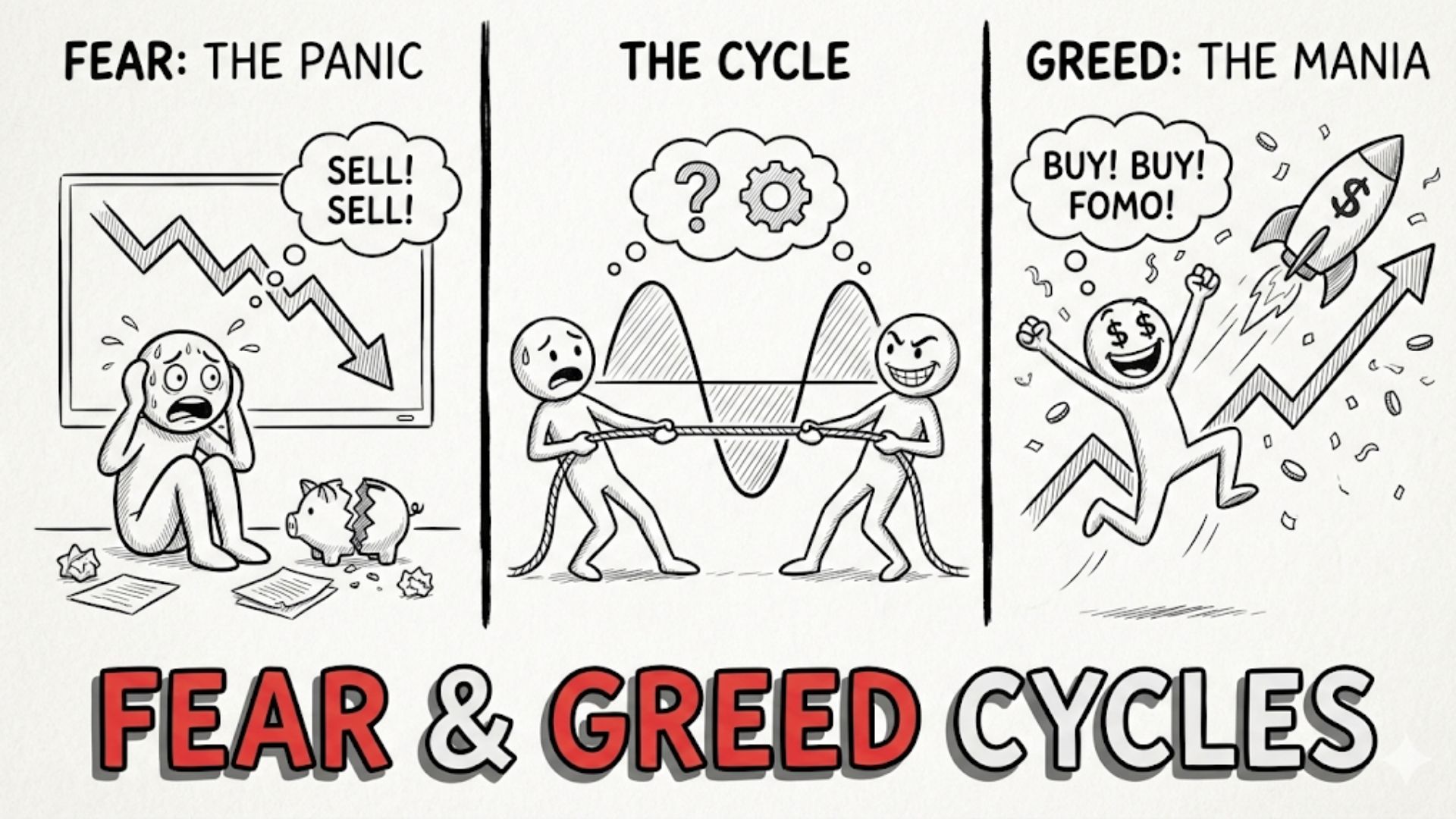
Financial market cycles are frequently characterized as external, quasi-mechanical phenomena—tectonic shifts in capital driven by interest rates, geopolitics, or industrial output. However, a more rigorous analysis through the lens of behavioral economics and decision theory suggests that these cycles are, in essence, the aggregate manifestation of human time-horizon volatility. The oscillations between market peaks and troughs are the physical footprints of a recurring cognitive error: the systemic collapse of long-term reasoning in the face of immediate emotional stimuli.
This article examines why impatience and the attendant emotional states of fear and greed systematically undermine financial success. It explores the causal mechanisms that allow these decision-making errors to persist across generations, even in the presence of overwhelming contrary evidence. By deconstructing the structural forces that favor immediacy over compounding, we can understand why market cycles are not merely economic events, but psychological feedback loops that reward structural patience and punish temporal myopia.
The Core Problem: Time Horizon Misalignment
The fundamental driver of sub-optimal financial outcomes is a structural misalignment between the duration of an asset and the evaluation window of the participant. Most productive assets—be they equities, corporate ventures, or specialized skill sets—require extended periods of time to realize their intrinsic value through the geometric process of compounding. Conversely, the human cognitive apparatus is evolutionarily optimized for a much shorter duration.
Hyperbolic Discounting and Temporal Myopia
In behavioral economics, “hyperbolic discounting” describes the tendency for individuals to prefer smaller, immediate rewards over larger, delayed rewards, with the preference for the immediate growing disproportionately as the delay nears “now.” This creates a state of temporal myopia. When the market rises, the immediate gratification of potential wealth triggers a “greedy” response—an urge to accelerate gains through increased leverage or concentrated positions. When the market falls, the immediate pain of notional loss triggers “fear”—an urge to terminate the exposure to stop the immediate stimulus.
The error lies in treating a long-term system as a series of short-term events. By evaluating a ten-year compounding process through a daily or weekly lens, the participant introduces “noise” into a “signal” environment. This misalignment ensures that the participant reacts to volatility (the random variance around a trend) rather than the trend itself. Consequently, capital is frequently deployed at the height of greed (cycle peaks) and withdrawn at the depth of fear (cycle troughs), precisely the opposite of a rational allocation strategy.
Read also: Financial Freedom From $2.26 to $1.25 Million in 5 Years
Why the Problem Persists Despite Experience
It is a central paradox of finance that despite centuries of market data and personal experience, the cycles of fear-driven panic and greed-driven euphoria repeat with remarkable consistency. This persistence is not the result of a lack of information, but of three primary structural reinforcement mechanisms.
Feedback Loop Distortion
In many high-stakes domains, such as surgical medicine or structural engineering, bad decisions yield rapid, unambiguous negative feedback. In financial markets, the feedback loop is “noisy” and often decoupled from the quality of the decision. A participant may make a fundamentally flawed decision—such as speculative “timing”—and receive a positive reward due to simple randomness. This intermittent reinforcement strengthens the bad mental model. Conversely, a structurally sound, long-term decision may yield negative notional results for several years before compounding takes hold. This delay between the “correct” action and the “positive” outcome makes it difficult for experience to calibrate the mind toward patience.
Incentive Structures and the Principal-Agent Problem
Impatience is often structurally mandated by institutional design. Professional fund managers, for instance, are measured on quarterly and annual benchmarks. Even if a manager possesses the intellectual clarity to maintain a ten-year horizon, their incentive structure—bonuses, career longevity, and client retention—is tied to the short term. This creates a “Principal-Agent” problem where the agent is forced to be impatient to satisfy the institutional requirement for immediate results. This institutional behavior then trickles down to individual participants, who use these short-term benchmarks as proxies for their own success.
Cultural and Technological Reinforcement
Modern information environments are designed to maximize engagement by amplifying urgency. Real-time notifications, 24-hour news cycles, and social media platforms create a “culture of the immediate.” This environment reinforces “Present Bias”—the tendency to over-weight information that is happening now. In a world where every minor price fluctuation is presented as a significant event, the cognitive cost of maintaining a long-term perspective rises significantly.
Real-World Consequences Across Domains
While most visible in equity markets, the collapse of time horizons has profound consequences across all domains of capital and human development.
Financial Markets: The Behavioral Gap
The “behavioral gap” refers to the difference between the return of an investment and the return actually realized by the investor. Studies consistently show that the average investor underperforms the very funds they own because they enter and exit positions based on recent performance. Fear and greed cause participants to “churn” their portfolios, incurring transaction costs and taxes, and—most importantly—missing the few high-impact days that account for the vast majority of long-term market gains.+1
Career Development and the Expertise Gap
In professional life, impatience manifests as “job-hopping” or the premature abandonment of a specialization. Mastery requires a prolonged “plateau” phase where effort is high but market reward is stagnant. Impatient actors, seeking immediate salary increases or status titles, often reset their compounding clock by switching industries or roles before reaching the “seniority” phase where their expertise would yield non-linear returns.
Business Strategy: The R&D Sacrifice
At the corporate level, greed for quarterly earnings often leads to the cannibalization of long-term growth. Firms may cut Research and Development (R&D) or capital expenditures to “beat” immediate earnings expectations. While this satisfies the immediate demand of the market (greed), it introduces long-term fragility, leaving the firm vulnerable to disruption by competitors with longer investment horizons.
Read also: Why One Index Fund Can Buy Your Freedom
A Core Mental Model: Compounding and the “Valley of Disappointment”
To navigate market cycles, one must internalize the mental model of Compounding and Delayed Feedback Systems. Wealth, in any form, does not grow linearly; it grows geometrically.
The Mathematics of the End-Load
The power of compounding is heavily “back-loaded.” In a doubling system ($1, 2, 4, 8, 16…$), the growth in the final step is greater than all previous steps combined. This creates a “Valley of Disappointment” in the early stages of a long-term plan. During this phase, the participant’s effort or capital input feels disconnected from the results.
[Image comparing a linear growth line with an exponential compounding curve, highlighting the gap where progress feels slow]
Impatience is the failure to cross this valley. Greed makes the early, slow growth feel inadequate, leading the participant to seek “faster” alternatives. Fear, during a drawdown, makes the “valley” feel like a permanent state of loss. The mechanics of patience require understanding that time is the most powerful variable in the compounding equation. By truncating the duration ($t$), the participant effectively destroys the exponential power of the system, regardless of the initial capital or the rate of return.
Applying Better Thinking in Practice (Principles, Not Tactics)
Improving decision-making quality requires a shift from a “reaction-based” framework to a “structure-based” framework. The objective is to design systems that protect the actor from their own biological impulses toward fear and greed.
- Decouple Evaluation Frequency from Asset Duration: If an asset has a ten-year horizon, it should not be evaluated on a daily frequency. Better thinking involves matching the sampling rate of information to the lifecycle of the investment.
- Focus on Process Integrity Over Outcome Variance: Because short-term outcomes are noisy, they are poor indicators of success. A sound decision-making process—one that accounts for margin of safety and long-term trends—is a success even if the immediate result is negative.
- The “Inverse” Signaling Principle: In a market cycle, the aggregate level of “Greed” (high valuations, speculative fervor) is a structural signal of future low returns. Conversely, aggregate “Fear” (capitulation, low valuations) is a structural signal of future high returns. A rational participant views these emotional states as contrarian indicators rather than directives for action.
Common Misunderstandings About Patience
Patience is frequently misinterpreted as a passive or “unthinking” state. This oversimplification leads to two significant errors in reasoning:
Patience is Not Passivity
Active patience involves the continuous monitoring of the structural thesis behind a decision. It is not “set it and forget it.” If the fundamental reason for an investment or a career path disappears (e.g., a technological shift renders a skill obsolete), “patience” becomes a “sunk cost fallacy.” True patience is the refusal to act on price or emotion while remaining vigilant regarding value and logic.
The Fallacy of the Infinite Horizon
Patience does not guarantee success. A long time horizon allows compounding to work, but only if the underlying asset is productive. Being patient with a failing business or a declining industry is merely a delay of the inevitable. Patience is a multiplier of quality; it cannot create value from a zero-sum or negative-sum system.
Read also: Why Modern America Feels Lost Despite Having Everything
Connections to Broader Thinking Frameworks
The tension between impatience and long-term success connects to several foundational decision-making frameworks:
- Second-Order Thinking: Impatience is a first-order response. Fear and greed focus on the immediate effect of a price change. Second-order thinking asks: “What happens to the terminal value of my capital in 20 years if I act on this fear today?”
- Incentive Alignment: Many “greed-driven” market bubbles are caused by misaligned incentives. When market participants are rewarded for volume rather than value, the system becomes biased toward short-term speculative cycles.
- Opportunity Cost: The cost of impatience is not just the lost capital, but the lost time. Because time cannot be recouped, the opportunity cost of resetting a compounding cycle at age 40 is vastly higher than it is at age 20.
Conclusion: Reframing Financial Success as a Time-Based System
Market cycles of fear and greed are the external evidence of an internal struggle: the human attempt to navigate non-linear, compounding environments with a linear, reactive brain. The systemic underperformance of most participants is not a failure of intelligence, but a failure of duration.
Wealth building, career mastery, and strategic business growth are all time-based systems. They reward those who can maintain a stable time horizon while the rest of the market collapses into the immediate. Reframing financial success as a function of structural patience rather than tactical timing allows the individual to stop being a victim of market cycles and start being a beneficiary of them. In the final analysis, the most significant strategic advantage is not more information or faster technology, but the intellectual clarity to remain consistent when the environment demands a reaction.
Next Step: Would you like me to develop a “Temporal Audit” framework—a series of diagnostic questions to help you determine if your current professional and financial evaluation windows are correctly aligned with your actual time horizons?