

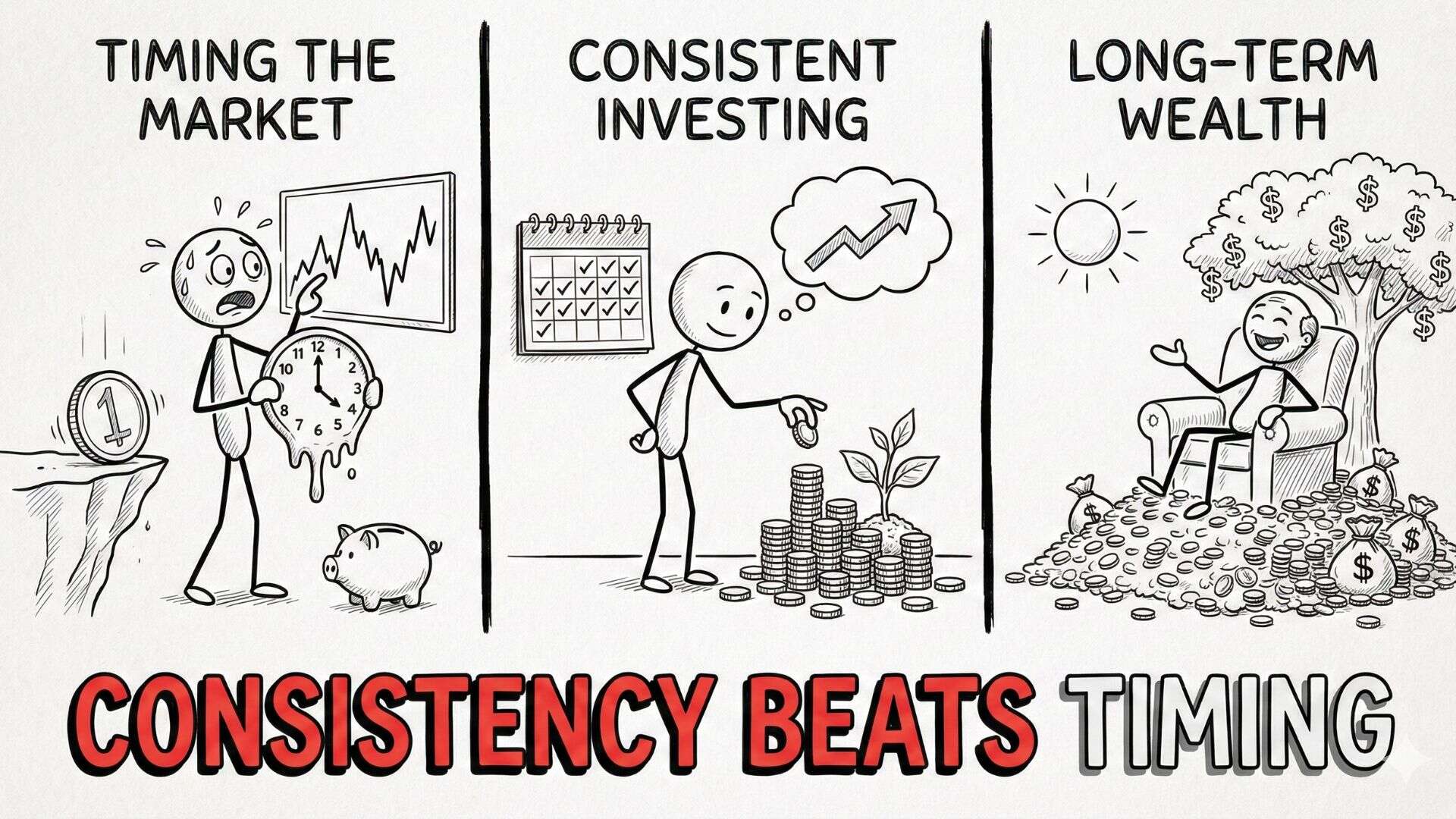
In the analytical study of long-term capital formation—whether manifested as financial wealth, professional reputation, or organizational capability—there exists a persistent tension between two fundamental strategies: tactical timing and structural consistency. The former, tactical timing, is characterized by the attempt to identify and exploit specific windows of opportunity through predictive action. The latter, structural consistency, emphasizes the maintenance of a stable, long-horizon exposure to a productive system, regardless of short-term environmental fluctuations.
Statistically, in nearly all complex, non-linear systems, consistency dominates timing as a predictor of terminal outcomes. Yet, the human cognitive apparatus, reinforced by modern institutional incentives, remains deeply biased toward timing. This article examines the causal mechanisms behind this decision-making failure, the psychological and structural drivers that sustain it, and the mathematical reality of how long-term compounding rewards persistence over precision.
1. The Core Problem: The Illusion of Control Over Timing
The drive to “time” a system—be it an entry point into a market, a career pivot, or a business launch—stems from a fundamental desire for agency in the face of uncertainty. Timing is intellectually attractive because it presents as a high-agency, skill-based activity.
The Misinterpretation of Variance as Signal
One of the primary reasoning errors in timing-based strategies is the conflation of short-term variance with meaningful signal. In complex systems, such as global markets or labor economies, the noise-to-signal ratio is exceptionally high over short durations. When an individual successfully times a decision—for example, exiting an asset before a downturn—there is a powerful tendency to attribute the outcome to predictive skill rather than statistical probability. This “hindsight bias” creates a false sense of control, leading the actor to believe they can replicate the outcome in the future.
Overconfidence and the Predictive Fallacy
Human cognition is evolutionarily optimized for linear environments with immediate feedback. In the ancestral environment, timing a physical movement to catch prey was a high-frequency, replicable skill. Modern economic systems, however, are non-linear and governed by “reflexivity,” where the actions of participants change the system itself. Attempting to time such a system requires not only an accurate model of the future but also an accurate model of how everyone else’s model of the future will change. The computational complexity of this task makes consistent timing virtually impossible, yet overconfidence heuristics lead individuals to believe they possess a unique informational edge.
Read also: The Psychology Behind Lifestyle Inflation
2. Why the Problem Persists Despite Experience
If timing is statistically inferior to consistency, one might expect that experience would eventually correct this behavior. However, several structural reinforcement mechanisms ensure the persistence of the “timing trap.”
Intermittent Reinforcement and the Casino Effect
Behavioral psychology demonstrates that intermittent rewards are the most difficult to extinguish. Because timing occasionally works due to sheer randomness, the occasional “big win” provides a powerful neurological dopamine spike. This reinforces the behavior more effectively than a steady, consistent gain. The individual remembers the one time they “called the bottom” and forgets the numerous instances where they missed the subsequent recovery, leading to a distorted self-assessment of their timing capabilities.
Institutional Incentives and Media Amplification
The modern information environment is structurally biased against consistency. Media outlets, financial commentators, and institutional analysts are incentivized to provide “news,” which by definition focuses on the immediate, the volatile, and the actionable. Consistency is intellectually “quiet” and offers little in the way of clickable content or advisory fees. Consequently, the prevailing cultural narrative is one of constant tactical maneuvering. Institutional incentives often favor timing as well; a fund manager who remains consistent during a downturn may face “career risk,” whereas a manager who attempts to time the market—even if they fail—can often justify their actions as “active management.”
Survivorship Bias in Public Narratives
Public discourse is dominated by “survivors”—individuals who successfully timed a single, massive opportunity and achieved outsized rewards. These outliers are held up as models of success, while the millions of individuals who attempted similar timing strategies and failed are rendered invisible. This creates a skewed data set for the observer, making the “timing” path appear more viable than it is in reality.
3. Real-World Effects Across Domains
The failure to maintain consistency has asymmetric consequences across multiple areas of human endeavor.
Financial Markets and the Cost of “Missed Days”
In financial capital allocation, the cost of inconsistency is mathematically severe. Historical analysis of equity markets shows that the vast majority of long-term returns are concentrated in a very small number of trading days. An individual attempting to time the market by moving to cash during periods of volatility frequently misses the sharpest recovery days. Because compounding is a geometric process, missing these few high-impact windows can result in a terminal portfolio value that is significantly lower than a “buy and hold” strategy, despite the individual being “right” about the existence of volatility.
Career Development and the Resetting of Compounding
Reputation and skill acquisition are also compounding systems. Consistency in a single domain allows for the accumulation of “career capital.” When an individual repeatedly switches paths—driven by the desire to “time” the next “hot” industry—they effectively reset their compounding clock. While tactical pivots are sometimes necessary, chronic “pivot-itis” prevents the individual from reaching the “knee of the curve” where their expertise and network begin to yield non-linear returns.
Business and Operational Fragility
In the context of business building, consistency in execution creates operational reliability. Organizations that constantly “pivot” their strategy in response to short-term market noise often fail to build a core competency. The friction costs of constant tactical shifts—employee burnout, loss of brand clarity, and resource misallocation—often outweigh the perceived benefits of “timing” the market perfectly.
Read also: How to Stop Losing Money
4. A Core Mental Model: The Ergodicity Problem
To understand why consistency is a superior strategy, one must engage with the mental model of Ergodicity. In many scientific fields, an “ergodic” system is one where the average of a group (the ensemble average) is the same as the average of a single person over time (the time average).
Ensemble vs. Time Averages
Most financial models and career advice are based on ensemble averages: “On average, people who invest in X earn Y.” However, as an individual, you do not live through the ensemble average; you live through a single, continuous time series. If a strategy has a 1% chance of “ruin” (total loss) at any given time, the ensemble average looks great because 99% of people are fine. But if you follow that strategy consistently over a long enough period, your probability of ruin eventually approaches 100%.
The Absorbing Barrier
Timing strategies frequently involve taking on “tail risk”—the risk of a rare, catastrophic event—in exchange for short-term precision. Consistency-based strategies, conversely, are designed to avoid “absorbing barriers” (points of no return). By maintaining a consistent, diversified exposure and avoiding the urge to “bet it all” on a specific timing window, an individual ensures they stay in the game long enough for the positive-sum nature of the system to work in their favor. In non-ergodic systems, “survival” is the most important variable for long-term success. Consistency is, at its core, a strategy for survival.
5. Applying Better Thinking: Principles of Structural Consistency
Moving from a timing-based framework to a consistency-based framework requires a shift in how one evaluates decisions.
Aligning Strategy with the True Time Horizon
A common error is the mismatch between the decision-maker’s actual time horizon and their evaluation window. If an individual’s goal is wealth at age 65, but they evaluate their strategy based on monthly fluctuations, they are virtually guaranteed to succumb to the urge to “time” the market. Aligning the evaluation window with the objective time horizon reduces the perceived need for tactical intervention.
Measuring Process, Not Outcomes
Because outcomes in complex systems are noisy, one must focus on the quality of the process. A consistent process that yields a temporary negative outcome is often superior to a flawed timing strategy that yields a temporary positive outcome. By focusing on “process hygiene”—the adherence to a predetermined, long-term strategy—the decision-maker reduces the influence of emotional volatility.
Designing for “Low-Friction” Persistence
Consistency is easier to maintain when the system is designed to minimize the need for willpower. Automated capital allocation, “lock-in” career commitments, and pre-defined exit/pivot criteria are structural tools that help individuals resist the siren song of timing. The goal is to make “staying the course” the path of least resistance.
6. Common Misunderstandings
The advocacy for consistency over timing is often oversimplified, leading to its own set of reasoning errors.
The Nuance of “Strategic Rebalancing”
Consistency does not mean rigidity. It is not an argument for ignoring structural shifts in the environment. Legitimate strategic timing exists—for example, responding to a fundamental change in a business model or an industry-wide technological disruption. The distinction lies in the frequency and motivation of the action. Strategic rebalancing is based on long-term structural changes; tactical timing is based on short-term price or sentiment noise.
Consistency is Not a Guarantee of Success
It is possible to be consistently wrong. If an individual is consistently invested in a declining asset or a dying industry, persistence will only accelerate their loss. Consistency is a “multiplier” of a system’s underlying return. It requires that the underlying system (e.g., the global economy, a valuable skill set) has a positive expected return over the long term.
The “Cost of Admission”
Maintaining consistency often requires enduring periods of significant “notional” loss or professional stagnation. This is the “cost of admission” for long-term compounding. Many individuals mistake these periods as signals that their strategy has failed, when in fact they are simply the statistical price paid for eventual non-linear gains.
Read also: The 13 Principles of Success
7. Connections to Broader Frameworks
Consistency as a strategy is deeply rooted in several diverse intellectual frameworks.
Systems Thinking and Delay
In systems thinking, there is often a significant “delay” between a cause and its effect. Timing is an attempt to shorten this delay, which often introduces “oscillation” and instability into the system. Consistency allows the system to reach a “steady state,” where the reinforcing feedback loops of compounding can take over.
Game Theory and Repeated Games
In game theory, a “one-shot” game has different optimal strategies than a “repeated” game. Timing is often treated as a one-shot game (e.g., “I need to get this right now”). However, wealth building and career growth are repeated games. In repeated games, the most successful strategy is often “Tit-for-Tat” with a long memory—a form of consistency that rewards cooperation and persistence over aggressive, short-term tactical maneuvers.
Signal vs. Noise
This framework, popularized in information theory, reminds us that the more frequently we look at data, the more noise we see. If you check your portfolio every minute, the ratio of noise to signal is over 1000-to-1. If you check it once every year, the ratio flips. Consistency is the act of ignoring the high-frequency noise to capture the low-frequency signal.
8. Conclusion: The Time Horizon Advantage
The structural advantage of consistency lies in its rarity. Because human psychology and modern institutions are so heavily tilted toward tactical timing, the competitive field for long-term consistency is remarkably thin. While millions of participants compete in the “red ocean” of short-term timing, attempting to out-predict one another over days or months, the “blue ocean” of long-term consistency is occupied by those with the structural patience to wait.
The asymmetry of compounding means that the rewards of consistency are back-loaded. The first decade of persistence may yield results that appear linear and unremarkable, but it is this very period that builds the base for the vertical growth that follows. By rejecting the illusion of control over timing and embracing the probabilistic certainty of consistency, the decision-maker moves from a state of reactive fragility to one of structural strength. In the final analysis, wealth is not “made” by the brilliance of a single timed entry; it is “grown” through the relentless, quiet, and consistent application of a productive process over time.

