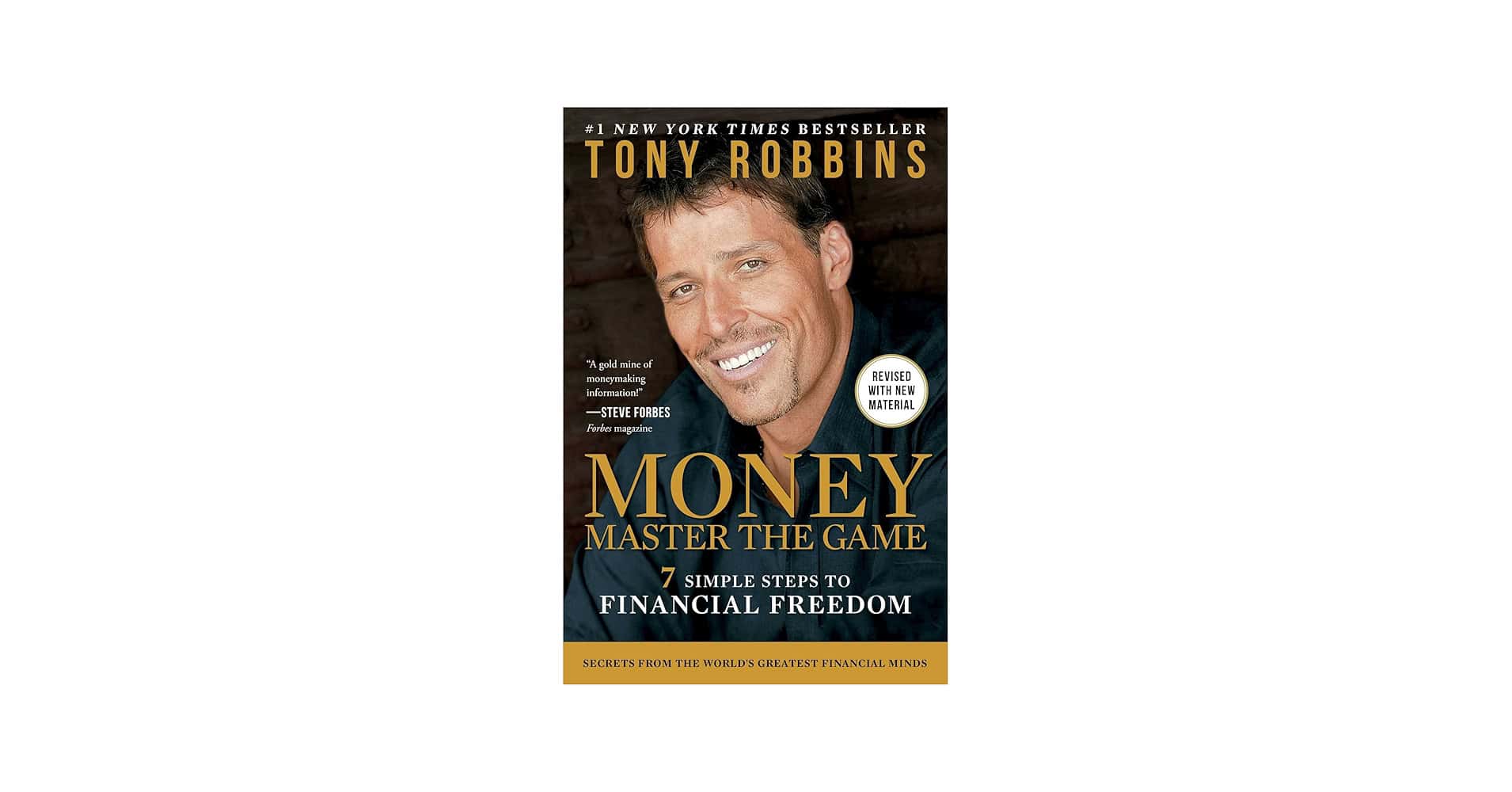
This is not just a book summary; it is a tactical manual for the most important battle of your life. Tony Robbins’ MONEY Master the Game is the result of a monumental four-year quest, distilling the wisdom of 50 of the world’s most legendary financial minds—icons like Ray Dalio, Warren Buffett, Paul Tudor Jones, and Mary Callahan Erdoes—into a cohesive, 7-step blueprint. Robbins has “democratized” high-level institutional finance, taking the strategies usually reserved for the .001% and handing them to you.
To master the game of money, you must first realize that you are currently being played. The financial system is a jungle—an uncharted wilderness filled with things designed to kill your bank account: hidden fees, predatory brokers, and the “marketing myths” of Wall Street. This summary is your guide through that jungle.
Star Rating: 4.5/5
One-Sentence Verdict: A high-octane, comprehensive roadmap that exposes the “rigged” financial system and provides billionaire-tested strategies to help the average person achieve lifetime income.
Best For: Beginners, Wall Street skeptics, and anyone looking to build a “pension-style” income they can never outlive.
Difficulty: Easy to understand, translating complex institutional finance into punchy, actionable prose.
——————————————————————————–
INTRODUCTION: The Hook—The System is Rigged
In an era of disappearing social safety nets and 30-year retirements, financial literacy is no longer a luxury; it is a survival skill. The traditional “pension” is a relic of the past, and Social Security was never intended to be your primary retirement source. We live in a 401(k) world where the responsibility of your future has been shifted entirely onto your shoulders.
Robbins’ research reveals a harsh reality: the current system is designed to separate you from your wealth. Think of it like playing a video game against a child. Why do they always win? Is it reflexes? No. It’s because they’ve played the game before and they can anticipate every move.
Anticipation is the ultimate power. Losers react to market crashes; leaders anticipate the moves of the “bad guys” (fees, taxes, and inflation) and build systems to thrive regardless. To win, you must move from being a spectator to a player by making one foundational decision.
——————————————————————————–
THE 7 SIMPLE STEPS TO FINANCIAL FREEDOM
Achieving financial freedom is not a lucky break; it is a mountain climb. You begin at the base camp of accumulation (putting money away) and work your way to the summit of decumulation (where your money pays you a lifetime income).
Step 1: Make the Decision (The Power of Compounding)
The journey begins with a foundational shift in identity: You must stop being a consumer and start being an owner. This means deciding on a specific percentage of your income to save and invest—your “Freedom Fund”—before you pay a single bill. This is the “wealth tax” you pay to yourself.
Robbins illustrates the “magic” of compound interest using a staggering example. Imagine doubling $1 every year for 20 years. In a tax-free world, that 1 grows to **1,048,576**. However, Robbins warns of the devastating “tax drag.” If you lose 33% to taxes every year—especially in high-tax states like California or New York—that same 1 only grows to roughly **28,000**. That is a $1 million difference! This proves that tax efficiency is the secret weapon of the wealthy. You must automate this savings process so you never even see the money.
Read too: Your Money or Your Life Summary: 9 Steps to Financial Freedom (FIRE Guide)
Step 2: Become the Insider (Fees & The Fiduciary)
Wall Street is built on marketing myths designed to capture your capital. The mutual fund industry often advertises “average returns” while hiding the fact that transaction costs, cash drag, and management fees eat up to 60% of an investor’s potential returns over their lifetime. A seemingly small 1% fee can actually cost you 10 years of retirement income.
To win, you must know who is sitting on your side of the table. Most “advisors” are actually brokers—salespeople who have no legal obligation to put your interests first.
| Feature | Broker (Salesperson) | Fiduciary (Advisor) |
| Legal Standard | Suitability (Can sell “okay” products) | Legal obligation to put your interests first |
| Duty of Care | Owes duty to the firm/employer | Owes duty 100% to the client |
| Compensation | Commissions and kickbacks | Flat fee or percentage of assets |
| Transparency | Often hidden in fine print | Transparent disclosure of all fees |
Massive Action: Only work with a Registered Investment Advisor (RIA) who acts as a fiduciary 100% of the time.
Step 3: Make the Game Winnable (The Freedom Number)
“Clarity is Power.” Most people have a vague dream of “being a billionaire,” which is so intimidating it leads to paralysis. Robbins breaks financial freedom into five manageable “base camps”:
- Financial Security: Your investment income covers housing, utilities, food, transport, and insurance.
- Financial Vitality: Security plus half of your small “indulgences” (new clothes, dining out, etc.).
- Financial Independence: Your current lifestyle is fully supported by your investment income. You never have to work again.
- Financial Freedom: Independence plus 2–3 significant luxuries (a vacation home, travel).
- Absolute Financial Freedom: You can do anything you want, anytime you want, with anyone you want.
The Calculation: To find your “Independence Number,” take your annual expenses and multiply by 20. If you need $50,000/year to live, your number is $1,000,000. Realizing your goal is a specific number—not an infinite pile of gold—creates the psychological breakthrough needed to start the climb.
Step 4: The Most Important Investment Decision (Asset Allocation)
Asset allocation is the “only free lunch” in investing. It’s not about what you buy, but in what proportions you own them. Robbins uses the Three-Bucket System to manage risk and psychology:
- The Security Bucket: Assets that provide peace of mind. This includes cash, US Treasuries, and TIPS (Treasury Inflation-Protected Securities). As David Swensen (Yale’s $23B man) told Tony, you need Treasuries for deflation and TIPS for inflation.
- The Risk/Growth Bucket: Assets with high upside but high volatility. This includes REITs (Real Estate Investment Trusts), Emerging Markets, and broad-based Stock Index Funds.
- The Dream Bucket: This is the “juice.” When you hit a win in your Growth Bucket, you move a portion of the profits here for “strategic splurges” (a new car, a trip to Fiji). This prevents burnout and rewards your discipline.
Step 5: Create a Lifetime Income Plan (The All-Weather Portfolio)
The goal isn’t just to build a pile of money; it’s to create a “pension” you can’t outlive. Robbins emphasizes that “income is the outcome.” This requires a portfolio designed to thrive regardless of the “economic season.” This leads to the Ray Dalio “All-Weather” concept—a strategy meant to provide upside without the 50% drawdowns that kill retirement dreams.
Step 6: Invest Like the .001% (Billionaire Strategies)
Robbins distills the principles of the masters into four key rules:
- Don’t Lose: Billionaires like Warren Buffett are obsessed with protecting the downside.
- Seek Asymmetric Risk/Reward: This is the “Holy Grail.” Paul Tudor Jones seeks to risk $1 to make $5. This allows him to be wrong 4 out of 5 times and still be profitable.
- Tax Efficiency: It’s not what you earn; it’s what you keep. Use Roth IRAs and tax-harvesting to stop the bleeding.
- Never Stop Learning: Knowledge is the ultimate asset in the financial jungle.
Step 7: Just Do It, Enjoy It, and Share It (The Psychology of Wealth)
Wealth is 20% mechanics and 80% psychology. Robbins argues that “the secret to living is giving.” True wealth is an abundance mindset. According to the book Happy Money, there are three scientific ways to buy happiness:
- Investing in Experiences: Travel and skills over “things.”
- Buying Time: Paying to eliminate tasks you dread (hiring a cleaner or assistant).
- Investing in Others: Giving creates the feeling of abundance, which ironically attracts more wealth.
——————————————————————————–
DEEP DIVE: THE RAY DALIO ALL-WEATHER PORTFOLIO
The most famous technical contribution of the book is the Ray Dalio All-Weather Portfolio. Dalio, founder of Bridgewater Associates, shared this strategy as a way for the average investor to achieve Risk Parity.
Traditional 60/40 portfolios (60% stocks, 40% bonds) are actually dangerous because stocks are three times as volatile as bonds. In a 60/40 split, stocks account for 90% of your risk. Dalio’s approach balances the risk, not just the dollar amounts.
The All-Weather Asset Allocation:
- 30% US Stocks: For growth and capital appreciation.
- 40% Long-Term Treasuries: (20+ year bonds) To protect against deflation and falling growth.
- 15% Intermediate-Term Treasuries: (7–10 year bonds) For stability.
- 7.5% Gold: An inflation hedge and protection against currency devaluation.
- 7.5% Commodities: Diversification for periods of rising inflation.
The Four Economic Seasons
Dalio’s logic is that only two things drive asset prices: Economic Growth and Inflation. This creates four “seasons.”
| Economic Environment | Assets that Thrive |
| Rising Growth | Stocks, Commodities, Corporate Bonds |
| Falling Growth | Long-term Treasuries, TIPS |
| Rising Inflation | Gold, Commodities, TIPS |
| Falling Inflation | Stocks, Treasuries |
By holding assets that thrive in each quadrant, the All-Weather Portfolio is designed to be “unsinkable.” Back-testing results (1984–2013) showed an average annual return of 9.72% (net of fees) with a maximum drawdown of only -3.93% during the 2008 crash. Most importantly, it made money in 86% of the years tested.
——————————————————————————–
CRITICAL ANALYSIS: THE CONTROVERSIAL PARTS
Robbins heavily promotes Annuities as a tool for “Step 5: Lifetime Income.” While this creates a “pension” you can’t outlive, it is a nuanced recommendation that requires caution.
- The Pros: Guaranteed lifetime income and 100% principal protection. For an investor who is terrified of market volatility, this “insurance” provides immense psychological peace.
- The Cons: Annuities can have high fees, surrender charges (locking up your money), and they rely entirely on the claims-paying ability of the insurer.
- Strategic Advice: Robbins suggests diversifying your annuities across multiple highly-rated insurance companies to mitigate the risk of any single insurer failing. Treat annuities as a risk-management tool, not a high-growth investment.
——————————————————————————–
THE FINAL VERDICT: PROS AND CONS
Tony Robbins has achieved a monumental task by synthesizing complex institutional strategies into a coherent plan for the “little guy.”
| PROS | CONS |
| Democratizes Billionaire Wisdom: Makes the strategies of Dalio and Paul Tudor Jones accessible to everyone. | Massive Length: At over 600 pages, the book is incredibly long and frequently repetitive. |
| Fee Reduction Focus: Provides a practical guide to saving hundreds of thousands in “hidden” fees. | “Sales Pitch” Feel: At times, it feels like a funnel for Robbins’ partner firms (Stronghold/Creative Planning). |
| Psychological Mastery: Bridges the gap between “knowing what to do” and “doing what you know.” | US-Centric: Heavy focus on US tax laws (Roth IRAs) and US-based bonds. |
——————————————————————————–
CONCLUSION & CALL TO ACTION
Wealth is not a matter of luck; it is a matter of having a mindset and a system. Most people spend their lives reacting to the “bad guys” of finance—high fees, predatory brokers, and market volatility. By following these 7 Steps, you move from the “spectator” stands onto the playing field as a leader.
The most critical step is the very first one: Make the Decision. Decide today what percentage of your income will be automated into your “Freedom Fund.” If you don’t make the decision to be an owner, you will remain a consumer for the rest of your life. Leaders anticipate; losers react. Which one will you be?
Your Immediate Next Steps:
- Master the game before the game plays you. Get the full book Money: Master the Game to read the deep-dive interviews with the billionaires.
- STOP THE BLEEDING: Use a tool like Empower to audit your current 401(k) or mutual funds for hidden fees. See exactly how much your “1% fee” is actually costing you.
- Calculate Your Number: Multiply your annual expenses by 20. That is your finish line. Write it down. Clarity is power.
- Adopt the All-Weather Mindset: Rebalance your portfolio to ensure you aren’t 90% at risk in the stock market. Balance your risk, not just your dollars.
Take Massive Action now. Your future self is counting on you.