You Can Sell Out Every Day and Still Lose Money
A line down the street feels like success. But most food truck owners never calculate the one number that decides whether all that selling actually makes money: food cost percentage.
Here’s the brutal truth nobody tells you before you buy the truck: you can have a line down the street, sell out every single service, and still barely break even. It sounds impossible — surely selling everything means you’re winning? — but it happens constantly in the food business, and it happens for one reason. In food, it’s not what you sell that matters, it’s what you keep. And what you keep is decided by a single number that most truck owners never actually calculate: their food cost percentage. Understanding this one number is the difference between a food truck that’s a business and one that’s a very stressful way to feed people for free. Here’s how it works.
What food cost percentage actually is
Food cost percentage is simple to calculate and enormous in consequence. It’s the cost of the ingredients in a dish divided by the price you sell it for. If a plate costs you $3 in ingredients and you sell it for $10, your food cost is 30%. That’s it.
But that innocuous percentage is the master metric of any food business, because it determines how much of every sale you actually keep to cover everything else — your fuel, your permits, your commissary, your staff, your own wages — and, eventually, to profit. A dish with a 30% food cost leaves 70% to cover all of that. A dish with a 45% food cost leaves only 55%. That gap, multiplied across everything you sell, is the difference between a healthy business and a treadmill.
Why “sold out” and “profitable” aren’t the same
Now the paradox makes sense. Imagine you sell out every service, but your food cost percentage is too high — your dishes cost too much to make relative to what you charge. You’re moving huge volume, feeling successful, and keeping too little of each sale to cover your costs. You can be busy and broke, because volume doesn’t fix a broken margin; it just multiplies it.
This is the trap that catches enthusiastic food truck owners. They focus entirely on sales — get the line longer, sell more plates — when the more important lever is often the margin on each plate. Selling twice as much at a bad food cost percentage can still leave you with nothing, while a healthy food cost percentage makes every sale actually count. As the saying in the trade goes, you can’t out-sell a bad food cost. The number has to work at the level of a single dish, or no amount of volume saves you.
The maths that should scare you (in a useful way)
Here’s a concrete illustration of why this number is so powerful. Suppose you’re running a 40% food cost when you could be running 30%. To make the same actual profit at 40% as you would at 30%, you’d have to sell dramatically more — in many cases close to twice as much. Think about that: fixing your food cost percentage can do more for your bottom line than doubling your sales, and it’s usually far easier than doubling your sales.
This is why experienced operators obsess over food cost percentage rather than just revenue. A few percentage points of food cost is worth an enormous amount of extra selling. It’s the highest-leverage number in the whole business, and it’s completely invisible unless you calculate it.
Calculate it per dish, and get a verdict
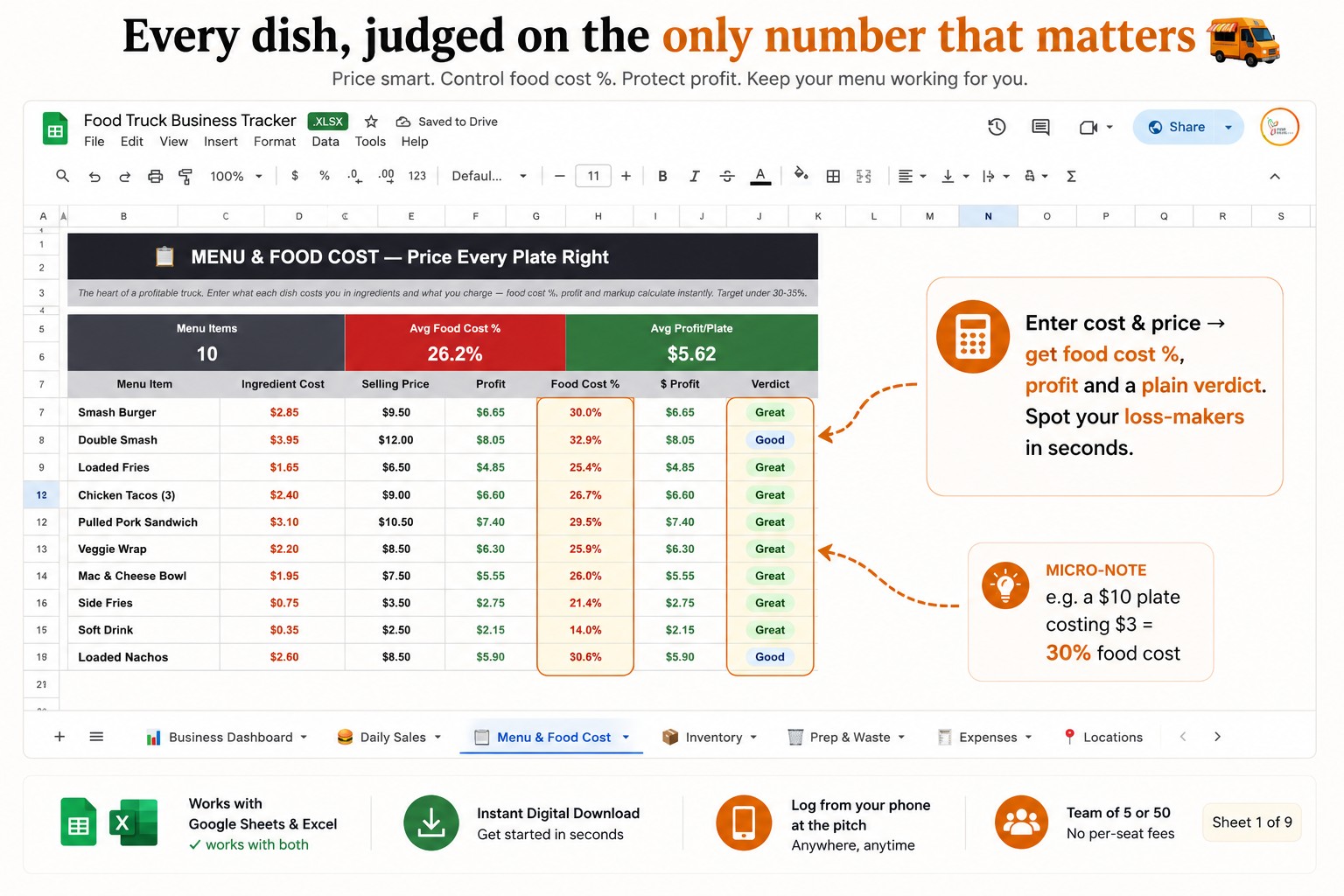
The practical move is to cost every dish on your menu: work out exactly what the ingredients cost to make it, compare that to your price, and get its food cost percentage. Do this and something powerful happens — you discover that your menu is not uniformly profitable. Some dishes are great earners. Others, often ones you’d never suspect, are quietly losing you money or barely breaking even on every single sale.
That per-dish clarity is what lets you act. A dish running too hot on food cost can be repriced, resized, reformulated with cheaper (or less wasteful) ingredients, or dropped. A dish with a great food cost percentage can be promoted and pushed. Without costing each dish, you’re flying blind — pricing by gut, copying competitors, or guessing, any of which can leave loss-makers hiding on your menu indefinitely. A clear verdict on each item (is this great, fine, or does it need repricing?) turns a vague worry into a concrete to-do list.
Track it daily, too
Beyond individual dishes, your overall food cost percentage — across everything you sold on a given day or month — is your business’s vital sign. Tracked over time, it tells you whether your margins are healthy or slipping. A creeping food cost percentage is an early warning that something’s wrong: ingredient prices rising, portions drifting bigger, or waste climbing (more on that in another piece). Catching that trend early, from the number, lets you fix it before it quietly erodes a season of profit.
An important note
To be clear, because this is a real, regulated business: this is about organising and understanding your own numbers — it is not financial, tax, accounting, legal, food-safety, or business advice, and it guarantees no result. Any figures or percentages here are general examples, not promises; your real numbers depend on your ingredients, prices, and situation. Food businesses are heavily regulated — you must follow the licensing, commissary, food-safety, and insurance requirements that apply where you operate, and those are your responsibility. Consult a qualified professional for tax and accounting decisions.
If you want food cost calculated for you
I built food cost percentage into my food truck business tracker in Google Sheets — enter each dish’s ingredient cost and price and get its food cost %, profit, and a plain Great/Good/Watch/Reprice verdict automatically, plus your daily and monthly food cost % across the whole business:
👉 Food Truck Business Tracker for Google Sheets & Excel
Whether you use mine or a calculator, stop judging your truck by how long the line is and start watching your food cost percentage. It’s the number that decides whether all that selling turns into money you keep — and most owners never calculate it. The line loves your food. Your food cost percentage decides whether you get to keep cooking it.
This reflects my own perspective and is an organising tool — not financial, tax, accounting, legal, food-safety or business advice, and it guarantees no result; figures are examples, and licensing/commissary/food-safety/insurance requirements are your responsibility. Food truck owners: were you surprised by your food cost % when you first calculated it? Tell me in the comments.