Running an Employee Survey and Doing Nothing Is Worse Than Never Asking
Surveys don’t build trust. Acting on them does. Here’s why a mishandled employee engagement survey damages culture — and how to actually close the loop.
There’s a well-meaning ritual that plays out in companies everywhere: leadership runs an employee survey, the results come back, everyone nods thoughtfully in a meeting, and then… nothing changes. A few months later, they run another survey and wonder why the response rate dropped and the scores got worse. The uncomfortable truth is that a badly handled employee engagement survey doesn’t just fail to help — it actively damages trust. Asking your team how they feel and then doing nothing about it is one of the fastest ways to make things worse. Here’s why, and how to do it right.
Why doing nothing is actively harmful
At first glance, running a survey and not acting seems neutral — you didn’t help, but surely you didn’t hurt? That’s wrong, and understanding why is crucial.
When you ask employees for honest feedback, you make an implicit promise: we’re asking because we care and intend to do something. People take a risk to answer honestly — it takes effort, and sometimes courage, to voice a concern. When they then see nothing change, the message they receive is loud and clear: leadership asked, heard, and didn’t care enough to act. That’s far more damaging than never asking, because it confirms a cynical story — “management doesn’t really listen” — with hard evidence. You didn’t stay neutral; you proved the pessimists right.
The practical result is predictable. Next survey, fewer people respond (why bother?), and those who do are more guarded or more negative. You’ve trained your team that feedback is theatre. Trust, once burned this way, takes a long time to rebuild. The kindest thing you can do is either commit to acting on a survey, or not run one at all.
The whole point is the action, not the data
Here’s the reframe that changes everything: the purpose of a survey isn’t to collect data. It’s to drive action. The data is just the means; the improvements are the end. Too many organizations treat the survey as the deliverable — “we ran it, we have the scores, done.” But the scores are worthless unless they lead to change.
This flips how you should think about the whole exercise. Before you even send a survey, you should be planning what happens after: how you’ll analyze the results, decide what to act on, assign responsibility, and follow through. If you’re not prepared to do that, you’re not ready to run the survey. The action plan isn’t an afterthought — it’s the actual product of the entire effort.
Closing the loop: what “acting” really means
Acting on feedback doesn’t mean fixing everything — that’s impossible, and employees don’t expect it. It means visibly responding. Closing the loop looks like this:
- Share what you heard. Tell the team the results, honestly, including the uncomfortable bits. This alone signals you take it seriously.
- Pick a few things to act on. You can’t fix everything, so choose the most important issues and be clear about them. A few real changes beat a dozen vague promises.
- Assign owners and dates. Every action needs a specific person responsible and a deadline. “We’ll work on culture” is not an action; “Priya will run X by end of Q2” is. Without an owner and a date, nothing happens.
- Follow up and report back. Show progress. Even partial progress, communicated, proves the loop is closed.
Notice that even acknowledging an issue you can’t immediately fix — “we heard this, here’s why it’s hard, here’s what we can do” — builds trust, because it shows you listened. What destroys trust is silence.
Owners and dates are where good intentions go to live or die
Of all of these, the owner-and-date discipline matters most, because it’s where survey follow-through usually dies. After a survey, there’s often genuine goodwill and a list of things people agree should improve. Then everyone gets busy, no one specific is responsible, and the list quietly evaporates. Six months later, nothing happened, not out of bad faith but out of diffusion — everyone’s responsibility became no one’s.
Attaching a named owner and a due date to each action is the simple mechanism that prevents this. It converts “we should improve recognition” into an actual commitment someone is accountable for. This is the difference between a survey that changes things and a survey that becomes evidence, next time, that nothing ever changes.
A crucial note on trust and anonymity
One essential point, because it underpins everything: if you promise anonymity, you must protect it absolutely. The moment employees suspect their individual answers can be traced back to them, honest feedback dies and trust is broken — possibly worse than by inaction. This means being genuinely careful with how you handle the data: don’t store identifying information alongside individual responses, and be very cautious about reporting on small groups where individuals could be identified (a common guideline is never breaking out results for a team with fewer than a handful of responses). Protecting anonymity isn’t a technicality; it’s the foundation that makes honest answers possible.
An important note
To be clear: this is general guidance on running surveys well — not HR, legal, or employment advice. You’re responsible for how you collect, store, and handle employee data, including anonymity and any privacy laws that apply to you (such as GDPR). Handle people’s feedback and data with care, and consult a qualified professional where needed.
If you want a system built around acting
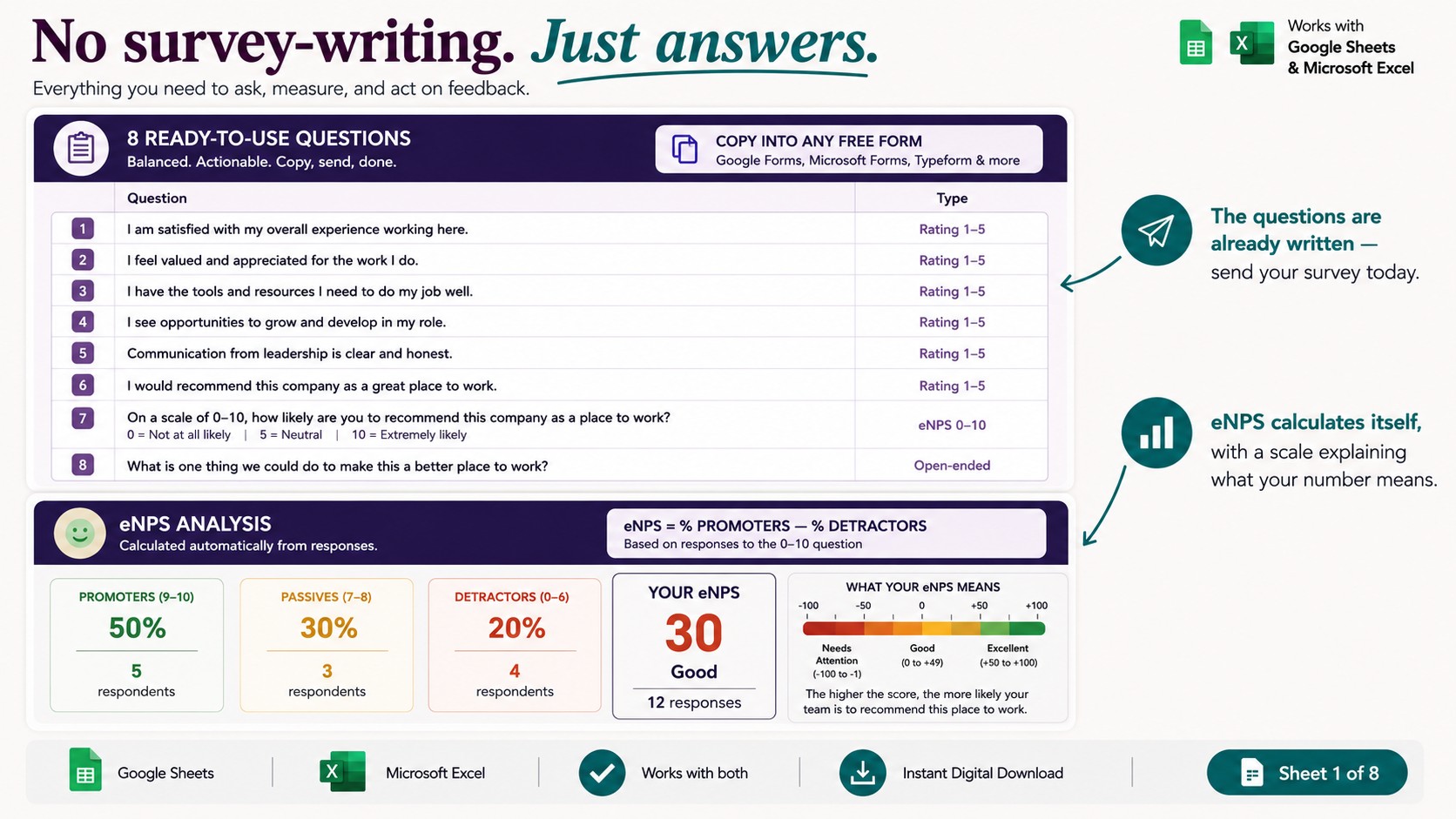
I built an employee satisfaction survey dashboard in Google Sheets designed around the action, not just the data — ready-written questions, automatic scoring and eNPS, department breakdowns, and an action plan where every issue gets an owner and a due date, plus built-in anonymity guardrails:
👉 Employee Satisfaction Survey Dashboard for Google Sheets & Excel
Whether you use mine or build your own, decide before you send a single question: are you prepared to act on the answers? If yes, a survey is one of the most powerful trust-building tools you have. If no, don’t run it — because asking and doing nothing will cost you more than the silence ever would. Asking is easy. Acting on the answers is what actually builds trust.
This reflects my own perspective and is an organizing tool — not HR, legal or employment advice; you’re responsible for anonymity and data handling, including any privacy laws that apply to you. What’s the best example you’ve seen of a company actually acting on feedback? Tell me in the comments.