The reframe that changed everything: For years I treated procrastination as a time management problem. I built schedules, set timers, tried accountability partners, downloaded apps. Nothing worked for long. Then I learned that procrastination is not a time management problem at all — it is an emotion regulation problem. That single reframe dismantled the way I had been approaching it and replaced it with something that actually works.
The myth I believed about procrastination for years
For most of my adult life, I understood procrastination as a discipline problem. I delayed tasks because I wasn’t disciplined enough to start them on time. The solution, therefore, was more discipline — better schedules, stricter deadlines, productivity systems, and accountability structures that forced compliance.
I tried most of them. They worked briefly and failed gradually. The schedule would hold for three weeks before an emotionally difficult period disrupted it and never quite recovered. The accountability partner helped until the stakes felt too low to maintain the motivation. The productivity apps accumulated notifications that became easy to dismiss.
What I eventually realized — through a combination of research and honest self-examination — was that the premise was wrong. Procrastination is not primarily a discipline problem. It is not a personality flaw, a character weakness, or a symptom of laziness. It is a specific, well-understood psychological phenomenon — and understanding it correctly is the prerequisite for addressing it effectively.
Read also: What I Learned About Leading Without Having All the Answers
What procrastination actually is — the psychology
The research on procrastination has shifted significantly in the past two decades. The field’s most productive current framing — developed extensively by Dr. Piers Steel and more recently by Dr. Fuschia Sirois — treats procrastination not as a time management failure but as an emotion regulation strategy.
“Procrastination is an emotion regulation problem, not a time management problem. People procrastinate to escape negative feelings in the short term — and pay a higher price in the long term.”— Dr. Fuschia Sirois, University of Sheffield
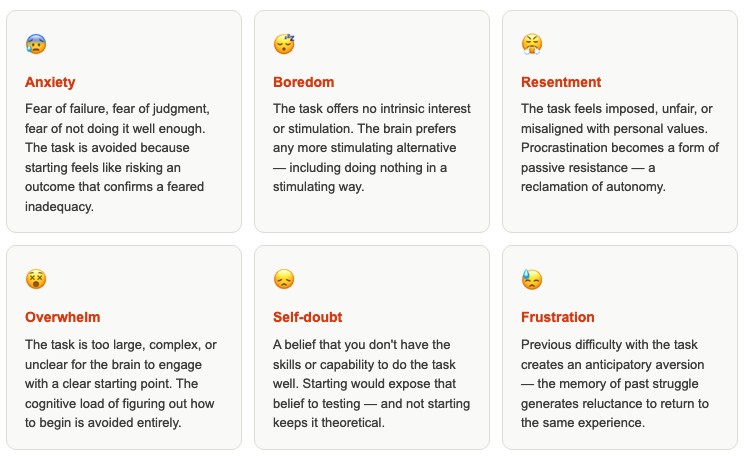
The logic is simple but important: procrastination is not random avoidance. It is a predictable response to tasks that generate specific negative emotional states — anxiety, boredom, self-doubt, resentment, frustration, or a sense of overwhelming complexity. The delay provides immediate relief from those emotions, which reinforces the delay as a coping strategy.
This is why willpower-based interventions fail. Willpower attacks the behavioral symptom — the delay — without addressing the emotional cause. The emotion remains, and at the next opportunity to avoid the task, the same relief is available and the same choice gets made.
The effective intervention targets the emotional trigger, not the schedule.
The six emotions that most reliably trigger procrastination
The diagnostic question I now ask first
When I notice I’m procrastinating on something, the first question I ask is: “What emotion am I avoiding by not starting this?”
The answer almost always identifies the specific intervention needed — because different emotions require different responses. Anxiety is addressed differently from boredom. Overwhelm is addressed differently from resentment. The generic “just do it” addresses none of them.
My specific pattern — and what I discovered about it
My personal procrastination pattern, once I examined it honestly, was almost entirely anxiety-driven. The tasks I delayed longest were not boring tasks or imposed tasks — they were tasks that mattered most to me and where the fear of doing them inadequately was highest.
This is a counterintuitive but well-documented pattern: we often procrastinate most on the things we care most about. The higher the stakes, the stronger the anxiety, and the stronger the pull toward delay. Tasks that are low-stakes and personally irrelevant rarely trigger the same avoidance, because there’s nothing significant at risk in them.
Understanding this changed my interpretation of my own procrastination. It wasn’t evidence that I didn’t care about something. In many cases, it was evidence that I cared about it intensely — enough to be afraid of doing it badly.
Read also: Structural Mechanisms of Asymmetric Discovery
The system I built — what works and what doesn’t
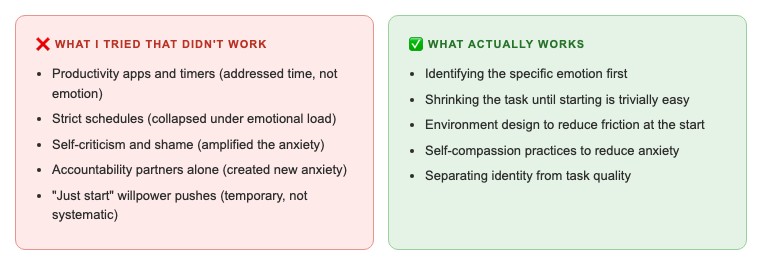
Specific tools and techniques I actually use
- The Two-Minute Start — shrink the task until resistance disappears For any task I’m avoiding, I reduce my commitment to starting it to two minutes of engagement. Not two minutes of the full task — two minutes of any version of beginning. Open the document and write one sentence. Review the first page of the report. Write the subject line of the email. The point is not to do the task in two minutes; it is to discover that starting is almost always easier than not starting. Most two-minute starts extend well beyond two minutes once the initial resistance dissolves.
- Name the emotion before opening any distraction When I notice I’m about to check my phone, open a browser tab, or otherwise redirect from a task, I pause and name the emotion I’m feeling. “I’m avoiding this because I’m anxious about how it will turn out.” Naming the emotion reduces its automatic influence and creates a moment of deliberate choice between the avoidance and the task.
- Reduce the definition of “done” until it’s achievable today Overwhelm-driven procrastination is almost always a function of a task definition that’s too large. I break tasks into the smallest possible completable unit — not “write the report” but “write the introduction section.” Not “learn Spanish” but “complete one lesson.” The goal is a version of the task that produces a genuine sense of completion within the session, which reinforces the behavior for the next session.
- Design the environment to make starting automatic Borrowing from the Atomic Habits framework: I arrange my workspace so the first thing visible when I sit down is whatever I’m supposed to be working on. Document open. Materials visible. The task in my sight line before any distraction has a chance to pull my attention. This is not willpower — it is architecture working instead of willpower.
- Time-box instead of open-endedly scheduling Open-ended scheduling — “I’ll work on this until it’s done” — creates anxiety about the uncertain duration. Time-boxing — “I’ll work on this for 45 minutes” — creates a finite, manageable commitment. The knowledge that the discomfort has a defined endpoint makes starting significantly easier, particularly for anxiety-triggering tasks.
Why self-compassion outperforms self-criticism — consistently
The most counterintuitive finding in procrastination research is that self-criticism makes procrastination worse, not better. People who respond to procrastination episodes with harsh self-judgment — “I’m so lazy, what’s wrong with me” — are more likely to procrastinate again in the near future, not less. The shame and self-criticism amplify the negative emotional state that caused the procrastination in the first place.
Self-compassion — treating yourself with the same understanding you’d extend to a friend who was struggling — has the opposite effect. Research by Dr. Kristin Neff and others has found that self-compassion after a failure or setback is associated with higher motivation to try again, not lower. It reduces the anxiety and shame that fuel avoidance, making the next engagement with the task less emotionally costly.
This is not an excuse for poor performance. It is an empirically supported recognition that shame is not a useful motivational tool — and that treating yourself with understanding when you fail to start is, paradoxically, the response most likely to produce starting next time.
The internal script that replaced self-criticism
“I avoided that task because it felt threatening/overwhelming/boring. That’s a normal response. What can I change about how I’m approaching it to make starting easier next time?”
That question produces better outcomes than “I’m so lazy” because it targets the mechanism rather than the character — and because it generates actionable responses rather than shame spirals that make the next start harder.
Conclusion: the task isn’t the problem — the feeling is
The shift from treating procrastination as a time management problem to treating it as an emotion regulation problem changed everything in my relationship with it. Not because the tasks became easier or more appealing — they didn’t. But because I stopped fighting the wrong thing.
When I built schedules and timers to fight procrastination, I was trying to force behavior change without addressing the emotional state that was generating the behavior. When I started identifying and addressing the specific emotion — anxiety, overwhelm, boredom — the behavioral change became considerably more natural and more durable.
The two-minute start still feels awkward sometimes. The emotion-naming still occasionally feels performative. But the tasks get started, which is more than the schedules and the timers reliably produced.
If you’re a persistent procrastinator who has tried the productivity systems and found them insufficient, try the diagnostic question first: what emotion am I avoiding by not starting this? The answer is more useful than any timer.