


A different kind of question: I used to ask “How do I build a successful career?” and get nowhere. The day I flipped it — “How would I guarantee destroying my career?” — I suddenly had a list of thirty specific, actionable answers. That reversal is called inversion. It is one of the most underused mental models available to anyone willing to think backwards for five minutes.
The moment a backwards question unlocked a year of progress
For almost eighteen months, I had been trying to grow a writing habit. I set goals. I created schedules. I read articles about consistency and discipline and the psychology of motivation. I tried accountability partners, streak trackers, and morning pages. I made progress in short bursts and fell apart repeatedly.
The forward question — “How do I become a consistent writer?” — had produced nothing but good intentions and disappointing results.
Then, almost by accident, I flipped it.
I was reading a collection of Charlie Munger’s speeches when I came across a passage about the power of inverting problems. That evening, instead of asking how to build the habit, I asked the opposite question:
“What would guarantee that I never write consistently?”
The answers came immediately. Keep my writing environment noisy and cluttered. Never start writing before checking social media. Set vague goals with no concrete output requirement. Use inspiration as a prerequisite rather than beginning without it. Wait until I feel like it. Have no designated time or place for writing.
I had been doing almost all of those things.
Within a week of eliminating the conditions I had identified, I had written more than in the previous three months combined. Not because I found new motivation. Because I had finally stopped doing the things that were actively preventing the behavior I wanted.
That experience turned me into a dedicated student of the inversion mental model — a tool that, once you understand it properly, reveals itself as one of the most practical thinking frameworks in existence.
Read also: The Hidden Bias That Quietly Sabotaged My Investment Portfolio for Years
What the inversion mental model actually is
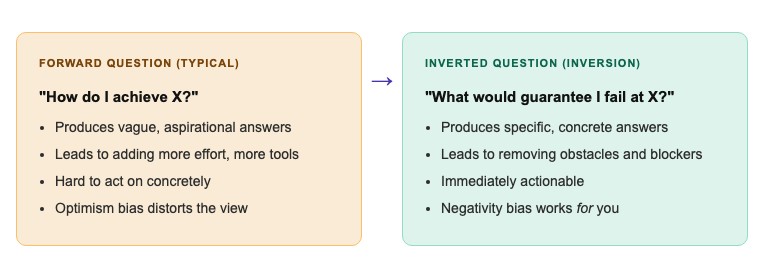
Inversion is exactly what it sounds like: instead of approaching a problem in the forward direction — asking how to achieve a goal — you approach it in reverse, asking how to cause the opposite of your goal, or how to guarantee failure.
Then you avoid what you find.
At its core, the model rests on an insight that is both obvious in hindsight and underutilized in practice: it is often easier to identify what causes failure than what causes success. Failure leaves clearer tracks. The conditions that produce bad outcomes are frequently more concrete and observable than the conditions that produce good ones.
By cataloguing the causes of failure with precision, you get something practically useful: a map of what not to do. And removing obstacles is frequently more effective than adding effort.
Charlie Munger and the ancient roots of thinking backwards
The modern articulation of inversion as a mental model is most closely associated with Charlie Munger — the legendary investor, polymath, and longtime partner of Warren Buffett at Berkshire Hathaway. Munger spoke about inversion repeatedly throughout his career, most famously in a 1986 commencement address at Harvard that has since become something of a cult document among thinkers who care about mental models.
“Invert, always invert. Turn a situation or problem upside down. Look at it backwards. What happens if all our plans go wrong? Where don’t we want to go, and how do you get there? Instead of looking for success, make a list of how to fail instead.”— Charlie Munger, paraphrasing the German mathematician Carl Jacobi
Munger was himself drawing on Carl Jacobi, a 19th-century German mathematician who regularly solved hard mathematical problems by reversing them. Jacobi’s famous instruction to himself was: “Man muss immer umkehren” — “One must always invert.” He found that many problems which resisted direct solution collapsed quickly when approached from the opposite direction.
But the roots run even deeper. The Stoic philosophers of ancient Greece and Rome — Marcus Aurelius, Seneca, Epictetus — practiced a discipline they called premeditatio malorum: the premeditation of evils. Rather than visualizing success, they deliberately imagined failure, loss, and catastrophe. Not to cultivate pessimism, but to prepare for it — and to clarify what was truly in their control.
Inversion, in other words, is not a modern productivity hack. It is a technology of thought that has been independently rediscovered by mathematicians, investors, and philosophers across centuries. That kind of convergence is usually a signal worth paying attention to.
Read also: Stop Following Advice, Start Reasoning
Why inversion works when forward thinking fails
Understanding why this technique is effective changed how I use it. There are three distinct mechanisms at work.
It bypasses optimism bias
When we think forward — toward goals, toward success — our brains engage the imagination in a way that is inherently optimistic. We picture the outcome we want. We underweight the obstacles, the failure modes, the things that go wrong. This is sometimes called the planning fallacy: our consistent tendency to underestimate how difficult and time-consuming a task will be.
Inversion sidesteps this entirely. When you ask “how would I fail?” you are no longer generating optimistic projections. You are engaging a different cognitive mode — one that is much better at identifying concrete, specific hazards.
It leverages our negativity bias productively
We already explored loss aversion and negativity bias in a previous article — the human tendency to weight negative information more heavily than positive information. In most domains, this bias works against us. Inversion is one of the few techniques that turns this bias into a feature.
Because the brain is naturally more alert and precise when cataloguing threats and failures than when imagining successes, asking the negative question produces better, more specific, more actionable answers than asking the positive one. You are using the brain’s negativity machinery for a productive purpose.
It reveals hidden constraints
Perhaps most valuably, inversion frequently surfaces constraints and blockers that are completely invisible when you’re looking forward. I could have spent months trying new writing techniques without ever noticing that the reason I wasn’t writing was because I always opened Twitter first. The blocker was obvious once I asked the inverse question — invisible when I was focused on the forward one.
The core insight
Forward thinking optimizes for adding things — more effort, more systems, more tools, more motivation. Inversion optimizes for removing things — obstacles, bad habits, destructive conditions, self-sabotage.
In most areas of life, removal is more powerful than addition. We are not failing because we need more. We are failing because we have not identified and eliminated what is actively working against us.
Read also: The Day I Walked Away from Three Years of Work — And Why It Was the Best Decision I Ever Made
How I apply inversion across work, money, and relationships
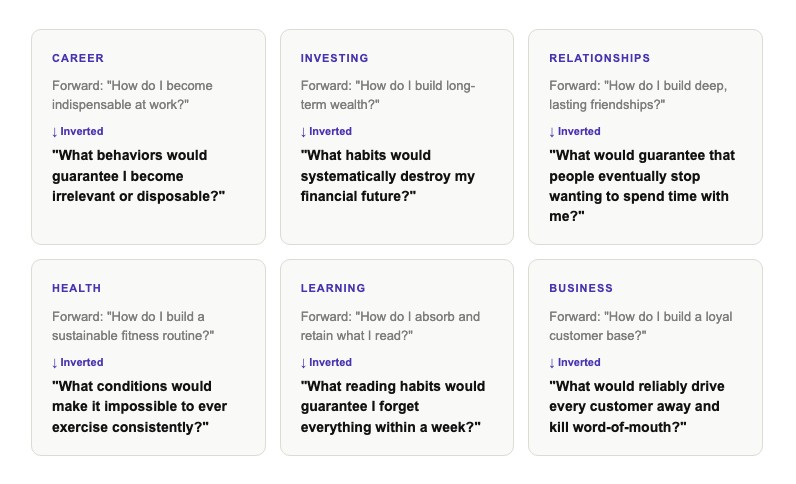
Since adopting inversion as a consistent practice, I have applied it across domains where forward thinking kept producing vague, unhelpful answers. Here are the specific inversions that have made the most difference.
The premortem: inversion applied to every major decision
One of the most structured applications of inversion is a technique called the premortem, developed by psychologist Gary Klein and subsequently popularized by Daniel Kahneman in his work on decision-making.
A postmortem is what organizations do after a project fails — they analyze what went wrong. A premortem does the same thing, but in advance, before the decision is made or the project begins.
The exercise works like this: imagine it is twelve months into the future. The project, decision, or initiative you are about to launch has failed — completely and catastrophically. Not a partial failure, not a minor setback. A full, unambiguous disaster. Now write down every specific reason you can think of for why it failed.
I run a premortem before every significant decision I make now. Before signing a contract. Before starting a major project. Before making a large investment. Before any commitment that is difficult to reverse.
The results are consistently surprising. In the optimistic, forward-facing mode of planning, I reliably miss three or four critical failure modes that appear immediately the moment I force myself to imagine total failure. Those failure modes are almost always real — real risks, real dependencies, real assumptions I was making without acknowledging them.
How to run a premortem in 10 minutes
Step 1. Clearly state the decision, project, or plan you are about to commit to.
Step 2. Write this sentence at the top of a blank page: “It is 12 months from now. This has failed completely. What happened?”
Step 3. Set a timer for 8 minutes. Write every plausible reason for failure you can think of — no filtering, no optimism. Include things that feel embarrassing or unlikely.
Step 4. Review the list. Any item that appears there is a risk that deserves a mitigation plan before you begin.
Read also: Cracking the Sales Management Code for Predictable Revenue
A step-by-step framework to invert any problem today
Here is the exact process I use when applying inversion to any meaningful problem or goal. The whole exercise takes fifteen to twenty minutes and consistently produces more useful output than hours of conventional planning.
- State your goal in one clear sentence Vague goals produce vague inversions. Get specific. Not “I want to be healthier” but “I want to exercise four times per week consistently for six months.” The more precise the goal, the more precise the inversion.
- Write the inverse question Take your goal statement and flip it. “What behaviors, conditions, or habits would guarantee I completely fail to [goal]?” Write this at the top of a fresh page. Read it out loud if it helps. Commit fully to the inverted frame.
- Brainstorm failure conditions without filtering Set a timer for 10 minutes and write every answer you can think of. Include the obvious ones, the embarrassing ones, the ones that feel too simple. Aim for at least 15 items. Quantity over quality at this stage — you are surfacing everything, not curating.
- Identify which failure conditions are currently present in your life Go through your list and mark every item that is, in some form, already true right now. These are active blockers — things that are already working against your goal even if you haven’t named them.
- Prioritize and eliminate the top three Pick the three marked items that would have the greatest negative impact on your goal. These become your immediate focus — not what to add, but what to remove. Design your environment, schedule, or behavior specifically to eliminate these three conditions.
- Use the remaining list as an ongoing risk register Keep the full list somewhere visible. As you make progress, the failure conditions that are most relevant to your current phase will shift. Review it monthly and re-prioritize. Inversion is not a one-time exercise — it is a habit of looking backwards regularly to check what is creeping into your blind spots.
Read also: What “Mastering Private Equity” Taught Me About How Capital Really Moves
When inversion goes wrong — and how to avoid it
I want to be honest about the failure modes of this technique itself — which is, fittingly, its own kind of inversion.
Using it to justify inaction
The most common misuse I have seen — and committed — is treating the output of an inversion exercise as a reason not to act. You identify thirty ways a business could fail and conclude: “See, this is too risky.” But that is not what the exercise is for. The failure conditions are not a verdict; they are a map. The appropriate response is not abandonment, it is mitigation.
Inversion answers the question: “What do I need to address before I proceed?” not “Should I proceed at all?”
Generating failure modes without acting on them
There is a version of this exercise that is pure intellectual entertainment — you generate a beautifully comprehensive list of failure conditions, feel smart for having thought of them, and then proceed exactly as you would have anyway. The value of inversion lives entirely in the actions that follow the list. A risk you have identified but not mitigated is still a risk.
Inverting the wrong problem
Inversion is most powerful when applied to goals and decisions. It is less useful — and can be actively misleading — when applied to beliefs or identity. Asking “how would I guarantee I’m wrong about this belief?” is valuable; asking “how would I guarantee I’m a bad person?” is not an inversion exercise, it is a cognitive spiral. Use the tool on problems, not on yourself.
The rule I follow
Every inversion exercise must end with at least one concrete, scheduled action — something I will do differently based on what I found. If I close the notebook without that, the exercise was philosophy, not problem solving.
Thinking backwards is only powerful if it changes what you do moving forward.
Conclusion: the most useful question has a minus sign in front of it
There is a peculiar kind of intellectual freedom in asking how to fail. It feels transgressive — counterintuitive in a world that endlessly tells us to visualize success, set positive intentions, and focus on what we want.
But I have found, repeatedly, that the negative question is the more honest one. It bypasses the optimism that obscures real obstacles. It engages the brain’s threat-detection machinery in a productive direction. It produces specific, actionable answers where the forward question produces vague inspiration.
Charlie Munger built one of the greatest investment track records in history, in part, by obsessively asking what made businesses fail and then systematically avoiding those companies. He was not pessimistic about the world — he was precise about risk. Inversion was how he stayed precise.
You do not have to be building a billion-dollar portfolio to use this. The writing habit I unlocked. The project risks I caught before they materialized. The failure conditions I named and removed — none of those required a sophisticated framework or an advanced degree.
They required one question, asked in the wrong direction, at the right time.
Take one goal you are currently stuck on. Write the inverse question at the top of a blank page. Set a timer for ten minutes.
See what you have been doing to yourself without knowing it.

