After decades of observing the mechanics of capital allocation, career trajectories, and institutional behavior, I have come to a conclusion that deviates from common cultural wisdom. Patience is frequently framed as a moral virtue—a testament to one’s character or emotional discipline. In the domestic sphere, we are taught that “patience is a virtue”; in the professional sphere, we are urged to be “patient” as a form of social compliance. However, when we strip away the veneer of morality, a more rigorous truth emerges.
Patience is not merely a personality trait. It is a mathematical advantage.
In systems governed by compounding, delayed payoffs, and non-linear growth, patience is the structural prerequisite for capturing asymmetric returns. Most participants in modern markets and professional hierarchies are optimized for the short term—driven by quarterly metrics, instant digital feedback, and the biological urge for immediate gratification. This systemic short-termism creates a massive “arbitrage” opportunity for those who can extend their time horizon. To understand the mathematics of patience is to understand that the most profound rewards in complex systems are back-loaded, and that the “cost” of impatience is not just a lack of speed, but the total destruction of the compounding engine itself.
The Difference Between Linear Thinking and Exponential Systems
The primary obstacle to practicing strategic patience is the fundamental mismatch between human intuition and the behavior of complex systems. Evolution has optimized the human brain for linear environments. If our ancestors walked for ten hours, they covered ten times the distance of one hour. If they gathered fruit for a day, the yield was proportional to the labor. In these settings, the relationship between input and output is 1:1.
However, the most significant systems in the modern world—finance, intellectual capital, reputation, and network effects—do not function linearly. They are exponential.
In an exponential system, the rate of growth is proportional to the current value. This means that the “r” (rate) stays the same, but the “A” (amount) grows increasingly fast as the base expands. Because our brains default to linear projections, we consistently underestimate how much a system can grow over a long duration and consistently overestimate how much it should grow in the short term. This cognitive gap is where impatience is born. When a professional or an investor doesn’t see “proportional” progress in the first six months, they assume the strategy is failing. In reality, they are simply in the early, flat phase of an exponential curve where the “mathematics of patience” hasn’t yet reached the tipping point.
Read also: Why the Traditional Accounting Formula Is Killing Your Business
The Hidden Curve of Compounding
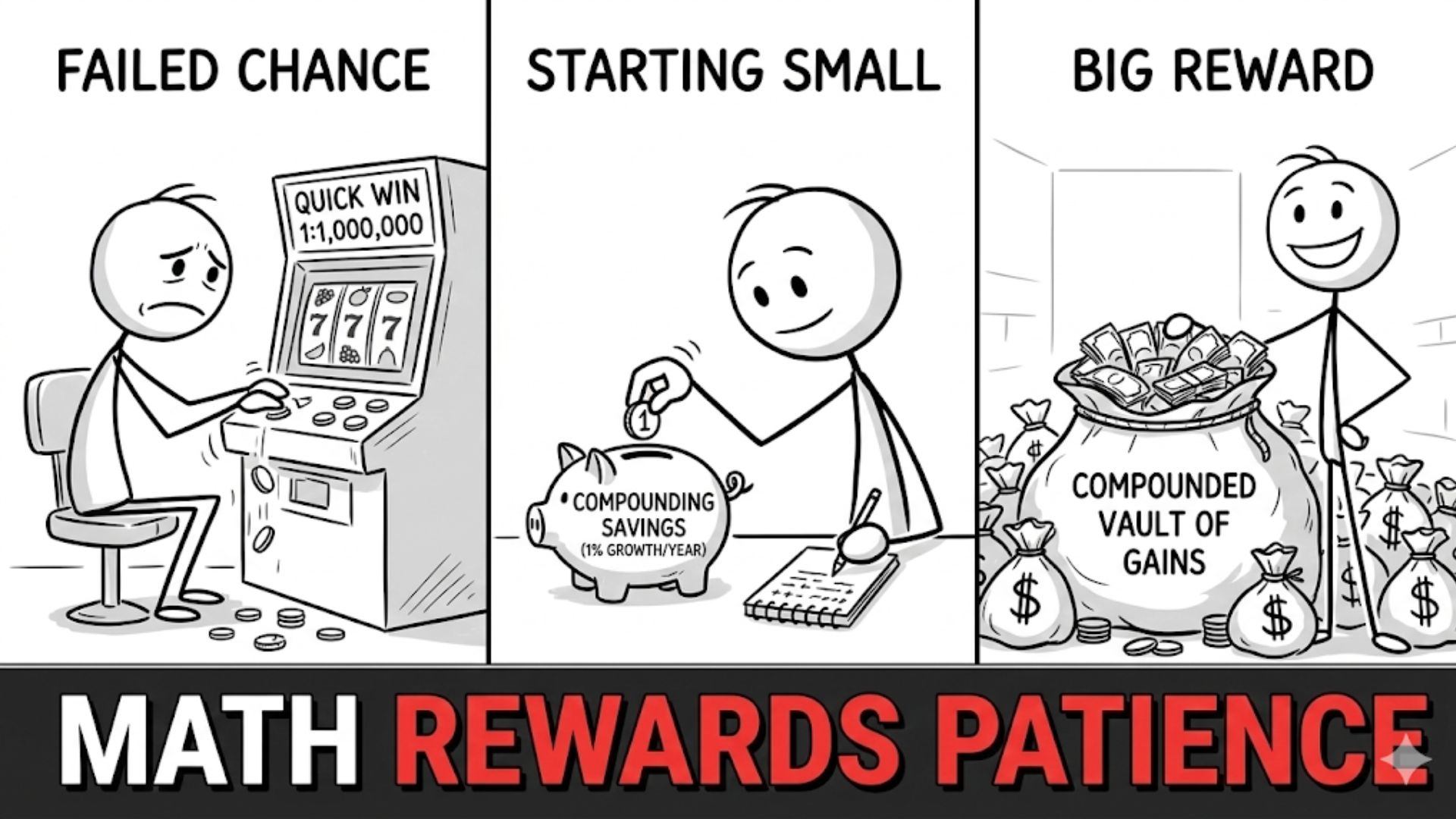
Compounding is the process where the gains from an asset are reinvested to generate their own gains. The mathematical formula, $A = P(1+r)^t$, reveals a critical truth: the exponent ($t$) is the most powerful variable.
The early phase of any compounding system is characterized by a “plateau of latent potential.” During this period, the results of one’s efforts are nearly invisible. If you improve a skill by 1% every week, the difference between week 1 and week 10 is imperceptible. This is the danger zone. Most individuals and organizations quit during this flat part of the curve because the feedback loop is “quiet.” They mistake a lack of visible results for a lack of progress.
Patience is the structural capacity to cross this threshold. Crossing it requires an intellectual conviction that the “work” is being done in the background, building the base upon which vertical growth will eventually occur. The mathematics of patience dictates that the final 20% of the time horizon often generates 80% of the total results. To be impatient in the first 80% of the journey is to forfeit the entirety of the terminal gain.
Time Horizon as a Strategic Advantage
In any competitive environment, the most effective way to reduce competition is to lengthen your time horizon. In the world of high-frequency trading, participants compete in milliseconds; in quarterly earnings cycles, they compete in ninety-day blocks. The competition in these windows is ferocious, and the margins for error are razor-thin.
However, as the time horizon extends to five, ten, or twenty years, the number of competitors drops precipitously. Very few individuals—and even fewer institutions—have the structural permission or the psychological independence to think in decades.
Investing and Career Development
In investing, a long time horizon allows an individual to ignore “volatility” (short-term noise) and focus on “terminal value.” In career development, it allows for the accumulation of “sovereign expertise”—the kind of deep, rare knowledge that takes a decade to build but makes one uncopyable once achieved. By the time the short-term competitors realize they are being outperformed, the patient actor has already moved into the vertical phase of compounding, creating a “moat” that no amount of short-term intensity can bridge.
Read also: The Power of Small Financial Advantages Over Time
The Opportunity Cost of Impatience
We often think of impatience as “moving faster.” In complex systems, however, impatience is a form of structural friction. Every time an investor churns their portfolio, they incur taxes, fees, and the risk of “missing the best days.” Every time a professional switches industries because they aren’t promoted within a year, they reset their “reputational compounding.”
Impatience carries a massive, often invisible, opportunity cost. It is the cost of resetting the clock. If compounding is a geometric progression, then interrupting it—even briefly—forces you to start back at the linear base.
Impatience is essentially a tax on future outcomes. When we optimize for a small gain today, we are often liquidating a much larger, non-linear gain tomorrow. In this sense, impatience is not a personality flaw; it is a profound capital allocation error. It is the choice to trade a “Type 1” asset (long-term geometric growth) for a “Type 2” asset (short-term linear utility).
Delayed Payoff Systems
Many of the most valuable activities in human society operate within delayed payoff systems. Research and development, the pursuit of a PhD, the building of a brand, and the raising of a child are all systems where the input and the reward are separated by years or decades.
The individuals who thrive in these systems are those who have internalized the “Mathematics of Patience.” They understand that the delay is not an obstacle; it is a filter. The delay ensures that the reward is only accessible to those who can maintain a consistent allocation of effort in the absence of immediate reinforcement.
In a world of instant gratification—where every “like,” “view,” or “transaction” provides a dopamine hit—the ability to operate in a delayed payoff system is a superpower. It allows for the pursuit of “grand-scale” projects that are physically impossible to execute in a short-term framework. Intellectual development, in particular, requires this. One cannot “cram” for a decade of pattern recognition. It must be layered, year by year, through patient observation.
Read also: The Math of Scaling Without Burning Out
Cumulative Advantage and Patience
In sociology and economics, the “Matthew Effect” (or cumulative advantage) states that “to those who have, more will be given.” Patience is the mechanism that allows this effect to trigger.
Small advantages in reputation, skill, or capital do not stay small. They act as “attractors.” A slightly better reputation leads to a slightly better opportunity, which leads to a more significant success, which further enhances the reputation. Over time, these small “deltas” compound into massive gaps between the top performers and the mean.
Patience allows you to stay in the system long enough for these small advantages to accrue. If you exit the system because you aren’t “winning” in year two, you never experience the phase where the cumulative advantage does the heavy lifting for you. In a very real sense, the most successful people in many fields are simply those who were patient enough to let the “Matthew Effect” reach its exponential phase.
Behavioral Biases That Destroy Patience
Despite the mathematical clarity of the advantage, humans are structurally biased toward impatience. These biases are exacerbated by the modern technological environment.
Present Bias and Temporal Discounting
We are evolutionarily wired for “Present Bias”—the tendency to overvalue immediate rewards and undervalue future ones. From a survival standpoint, a calorie consumed today was infinitely more valuable than a theoretical calorie promised next month. This “temporal discounting” makes the distant rewards of a 20-year compounding strategy feel abstract and “unreal” to our limbic system.
Loss Aversion and Volatility
We feel the pain of a short-term loss (a market dip, a professional setback) twice as acutely as the joy of an equivalent gain. This “Loss Aversion” triggers an “action bias.” When we see a compounding system experience temporary volatility, our instinct is to “do something” to stop the pain. Often, the “something” we do—selling the asset, changing the strategy—is the very thing that destroys the long-term compounding.
Read also: A Structural Analysis of the Unseen
Patience in Career and Knowledge Systems
Nowhere is the mathematics of patience more evident than in the development of human capital. Expertise is not a linear function of “hours worked”; it is a non-linear function of layered knowledge.
Knowledge Layering and Pattern Recognition
When you learn a new subject, the initial phase is high-effort and low-reward. However, once you possess a foundational “lattice” of mental models, new information becomes easier to “attach.” You start to see patterns across disparate fields—economics, biology, psychology. This interdisciplinary synthesis is a compounding asset. The “senior” expert isn’t necessarily working harder than the “junior” associate; they are simply leveraging a much larger base of compounded observations.
Reputation as an Automated System
Reputation is a trust-based compounding system. In the early years of a career, you must “push” for every opportunity. However, if you are patient and consistent, your reputation eventually reaches a tipping point where it begins to “pull” opportunities toward you. The cost of acquiring a new project or partner drops to near zero because your “proof of work” has been compounding for a decade. This is the ultimate career leverage.
Optionality and the Power of Waiting
One of the most counterintuitive aspects of patience is how it interacts with Optionality. In finance, an “option” is the right, but not the obligation, to take an action. Patience is the process of accumulating these “rights” by staying in the game.
By remaining in an evolving system—whether it’s an industry or a geographic hub—you are constantly being “exposed” to new opportunities (upside volatility). Many of these opportunities were unavailable when you started. If you are impatient and exit the system prematurely, you lose the “option value” of being there when the “Black Swan” event—the transformative career or investment opportunity—occurs.
Waiting strategically is not passivity; it is the act of maintaining “dry powder” (time and capital) so that you can strike with maximum force when the asymmetry is in your favor. The “patience to wait” and the “decisiveness to act” are the two pillars of asymmetric success.
Read also: A Structural Analysis of Systemic Fragility
The Paradox of Strategic Inaction
In many complex systems, the most rational decision is to do nothing. This is the “Paradox of Strategic Inaction.” Charlie Munger famously said, “The big money is not in the buying and the selling, but in the waiting.”
Action Bias
We are socially and institutionally conditioned to believe that “action” is a proxy for “value.” A manager who sits quietly and lets a productive system run is often perceived as lazy; a manager who constantly “tinkers,” reorganizes, and pivots is perceived as “proactive.” However, in a compounding system, tinkering is usually destructive. It introduces “noise” and “friction” into the geometric engine.
Patience requires the intellectual courage to leave a system alone when it is working. It is the recognition that time is doing the work that effort cannot. If you have a high-quality asset—be it a stock, a relationship, or a skill—the most effective thing you can do is get out of its way and let the exponent do its job.
Why Patience Appears Irrational in the Short Term
A patient strategy almost always looks like an “error” in the short term. Because the compounding curve is flat for so long, the person who is being patient appears to be “falling behind” their peers who are optimizing for immediate gains.
Institutional Incentives
Most institutions are built on “measurement cycles” that are far too short for compounding. Quarterly earnings, annual bonuses, and electoral cycles all punish patience. If a CEO invests in a project with a 7-year payoff, they will likely be fired in year 3 for “underperformance.”
Social Pressure
There is an immense social pressure to “keep up” with the visible consumption and “status signals” of others. Patience requires a high degree of “inner-scorecard” thinking. You must be willing to look “stupid” or “slow” to the crowd while you are building the base of your exponential curve. The mathematics of patience is only accessible to those who are psychologically independent enough to ignore the “ensemble average” in favor of their own long-term time series.
Read also: The Strategic Calculus of Long-Term Compounding
The Mathematics of Time and Outcome Distribution
Small differences in behavior, when repeated over long periods, do not produce small differences in outcomes. They produce totally different worlds.
Consider two individuals, A and B. Both start with the same intelligence and energy.
- Individual A is impatient; they switch strategies every two years, chasing the latest “trend” or “hack.” Their growth is linear, effectively “resetting” to a new base frequently.
- Individual B is patient; they pick a durable domain and stay in it for 20 years, layering their skills and reputation.
For the first 5 years, A might actually be “ahead” because they are capturing “early-trend” returns. But by year 20, B is in a completely different dimension of wealth, influence, and expertise. The ” मैथमेटिक्स” of time has amplified B’s 1% marginal advantages into a gap that A can never close, no matter how hard they work.
Time is the ultimate separator. It takes the “noise” of luck and effort and filters it through the “signal” of duration. Success, in this sense, is not a sprint; it is the structural result of staying on the curve.
Conclusion: Patience as a Structural Edge
After years of analysis, my view of patience has evolved from a moral inquiry to a mathematical one. I no longer see patience as “waiting for something to happen.” I see it as a structural edge that allows compounding to function.
In a world defined by volatility and short-termism, the “Mathematics of Patience” provides a bedrock of strategic certainty. It reminds us that the most significant rewards in any complex system—be it wealth, mastery, or trust—are back-loaded. They require a “buy-in” of time that most people are unwilling or unable to pay.
Understanding this framework changes how you allocate your most precious resources: your time and your attention. It moves you away from the anxiety of the “immediate” and toward the clarity of the “duration.” Patience is not about having a “slow” temperament; it is about having a long time horizon. Those who understand the mathematics of patience are not just disciplined; they are strategically superior. They recognize that in the long run, the most powerful force in the universe is not the intensity of the effort, but the relentless, uninterrupted logic of the time that follows.