Stop Re-Reading Resumes: The Skills Matrix That Shortlists in Seconds
Hunting through dozens of resumes to find who has the right skills is slow, error-prone work. A skills matrix turns your candidate pool into something you can filter — and shows you where your best people come from.
You have a pile of good candidates — in your inbox, your notes, your talent pool. A role comes in needing someone with, say, both React and SQL. So you start the grind: opening resume after resume, re-reading each one, trying to remember who had what, building a mental shortlist you’ll probably lose. It’s slow, it’s tedious, and it’s unreliable — you’ll miss people, because human memory and manual re-reading don’t scale. The fix is a skills matrix, and it changes candidate search from a re-reading marathon into a filter you run in seconds. Paired with source tracking, it also tells you where to spend your sourcing effort. Here’s how both work.
The problem: unstructured candidate data can’t be searched
Here’s why finding candidates by skill is so painful in most setups. Your candidate information lives in unstructured form — resumes, notes, email threads. All the information is technically there, but it’s buried in prose, formatted differently for every person, and impossible to query. To answer “who knows React and SQL?”, you have no choice but to open each candidate and read, because there’s no structured field to filter on.
This doesn’t scale at all. With ten candidates it’s tedious; with a hundred, it’s genuinely impractical, so people just don’t do it thoroughly — they check the few candidates they happen to remember and miss the rest. Which means good matches sitting right there in your pool never surface, purely because the data isn’t in a searchable shape. The information exists; you just can’t get at it efficiently.
The matrix: structure your skills so you can filter
A skills matrix solves this by turning skills into structured, searchable data. You lay out your candidates against a set of skills, and mark which candidate has which. Now “who knows React and SQL?” isn’t a re-reading exercise — it’s a filter. Tick React, tick SQL, and instantly see everyone in your pool who has both. What took an hour of resume-reading takes seconds, and it’s complete — you’re filtering your entire pool, not just the people you remembered.
The power here is the shift from unstructured to structured. Once a skill is a field you can filter rather than a phrase buried in a document, your whole candidate pool becomes queryable. You can shortlist for any combination of skills on demand, find the specialists you forgot you had, and be confident you’re seeing everyone who matches — not just the top-of-mind few. For anyone maintaining a real pool of candidates, this is the feature that makes the pool genuinely usable rather than just a store.
Consistency makes or breaks it
One honest caveat: a skills matrix is only as good as the consistency you put into it. If you record the same skill three different ways (“JS”, “JavaScript”, “Javascript”), your filters will miss people. The discipline of using consistent skill labels — a defined vocabulary — is what makes the matrix reliable. It’s a small habit that pays off enormously: spend a moment tagging skills consistently as you add candidates, and your future searches will actually return everyone they should. Sloppy tagging quietly breaks the whole system, so this is worth getting right from the start.
The other half: where your best candidates come from
There’s a second kind of structured insight worth capturing alongside skills: source. Every candidate came from somewhere — LinkedIn, a referral, a job board, an event, an application. If you record that source, and track not just how many candidates each source produced but how many good ones (your stars) and how many actual placements, a hugely valuable pattern emerges.
Because sources are not equal. One channel might flood you with volume but few quality candidates; another might produce fewer people but a high proportion of great ones. Referrals, for instance, famously punch above their weight for quality in many organisations. Without tracking, you’re guessing which channels are worth your time and money. With it, you can see which sources actually deliver hires — and concentrate your sourcing effort (and budget) there, rather than spreading it evenly across channels of wildly different value. Tracking sources by quality and placements, not just raw count, turns your sourcing strategy from a guess into a data-informed decision.
Structure turns a pile into a system
The through-line of both features is the same: structure turns a passive pile of candidate data into an active, queryable system. A skills matrix lets you find the right people instantly; source analytics tells you where to get more of them. Together they transform a talent pool from a static archive into a genuinely powerful recruiting tool — one you can search on demand and continuously improve.
A serious note on candidate data and privacy
As with any tool that holds candidate information, a serious responsibility comes with it: you’re storing people’s personal data, and you must handle it lawfully and securely. This means complying with the privacy and employment laws that apply to you (such as GDPR, CCPA, and local equivalents) — including lawful basis, candidate notification, retention limits, and honouring deletion requests — and respecting candidates’ preferences, including anyone who’s asked not to be contacted. This is not legal, HR, recruitment, or compliance advice, and no tool makes you compliant by itself. Treat candidate data with care and consult a qualified professional on data protection and hiring compliance.
If you want a searchable matrix built in
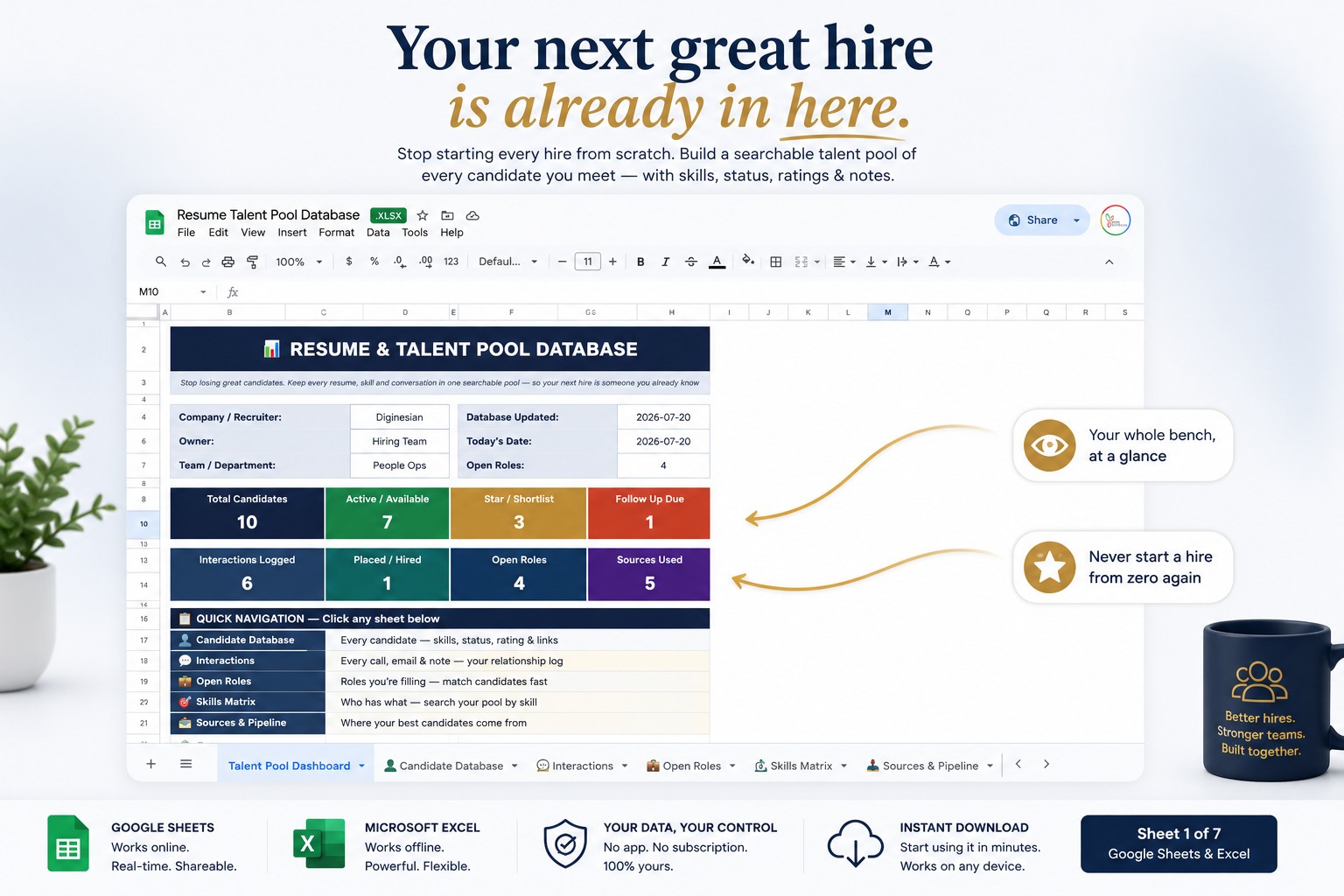
I built a searchable skills matrix and source analytics into my resume and talent pool database in Google Sheets — mark who has which skills and filter to a shortlist in seconds, and see which sources bring your stars and placements, with a built-in privacy and GDPR guidance section:
👉 Resume & Talent Pool Database for Google Sheets & Excel
Whether you use mine or build your own, stop re-reading resumes to find the skills you need, and stop guessing which sources are worth your effort. Structure your candidate data so you can filter it, track where your best people come from, and turn your pool into a system that gets sharper with every candidate you add. The right person is in there — a skills matrix is how you find them in seconds instead of an afternoon.
This reflects my own perspective and is an organising tool — not legal, HR, recruitment or compliance advice, and it guarantees no result; you’re responsible for candidate data and any privacy laws that apply to you. Recruiters: which source consistently brings you your best candidates? Tell me in the comments.