

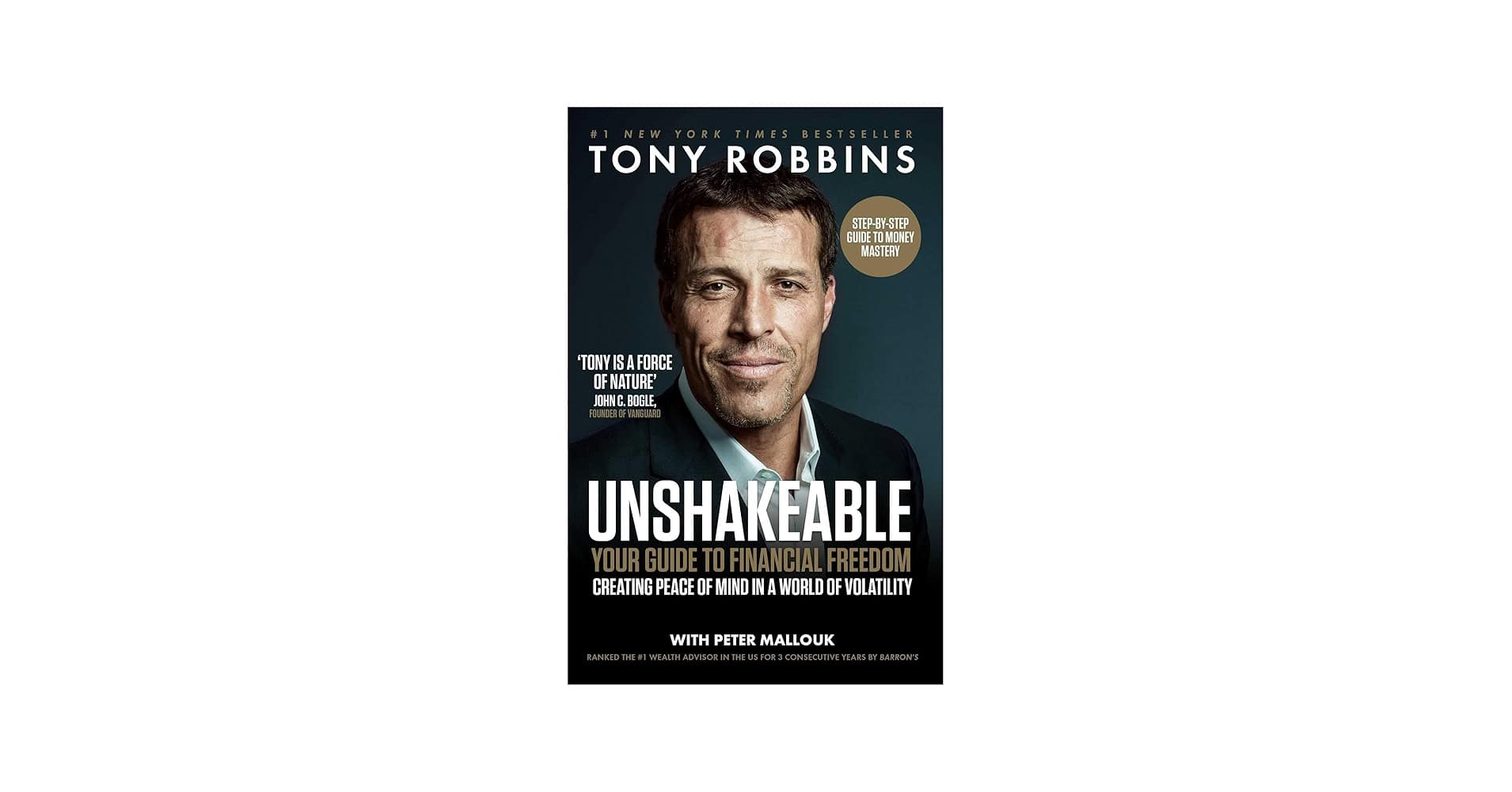
1. THE SNAPSHOT
One-Sentence Verdict: The essential “lite” version of Money Master the Game, specifically engineered to neutralize investor fear and provide a psychological shield against market volatility.
- Star Rating: 4.5/5
- Best For: Nervous Investors, Beginners, and habitual Panic-Sellers.
- Difficulty: Very Easy (Quick read).
- Strategic Value: While Robbins’ larger works provide technical depth, Unshakeable is vital for its focus on minimizing cognitive load. In times of market stress, the human brain often enters a “fight-or-flight” state; this distilled format provides the clarity needed to make rational decisions when emotional volatility is at its peak.
Financial freedom is rarely a product of luck; it is a product of strategy. However, even the most sophisticated strategies fail when an investor succumbs to the internal pressure of market drawdowns. To thrive, one must transition from a passive victim of market cycles to an unshakeable master of them.
——————————————————————————–
2. INTRODUCTION: The Hook of Fear vs. The Power of Knowledge
For the average investor, the word “recession” triggers a visceral trauma associated with the 2008 financial crisis—a period where 401(k)s were decimated and “safe” institutions collapsed. This lingering anxiety creates a “costly long-term mistake” of passivity, keeping millions on the sidelines while the greatest wealth-building machine in history—the U.S. economy—moves forward without them.
Tony Robbins’ mission in Unshakeable is to provide “regular people” with the same tactical advantages as the financial elite. By interviewing over 50 titans of industry, including Ray Dalio, Jack Bogle, and Warren Buffett, Robbins uncovered universal truths that govern market cycles. He defines being “Unshakeable“ as a psychological state: a steadfast commitment to the truth and a calm presence amidst the storm. It is the ability to be the chess player rather than the chess piece. The first step toward this mastery is replacing emotional reactions with historical “Freedom Facts.”
——————————————————————————–
3. THE “FREEDOM FACTS” ABOUT MARKET CRASHES
The primary antidote to fear is pattern recognition. When an investor lacks a map of historical market behavior, a routine correction feels like a terminal disaster. Robbins uses the Buddhist analogy of a monk mistaking a “harmless rope” for a “poisonous snake” in the dark. These seven facts provide the light necessary to reveal the reality of the market.
- Fact 1: Corrections are routine. Since 1900, market corrections (a 10% drop) have occurred once a year on average. They are a seasonal part of the financial cycle, and the average correction lasts only 54 days.
- Fact 2: Few corrections become bear markets. Historically, less than 20% of corrections escalate into a bear market. Panic-selling during a correction is mathematically likely to result in exiting just before a recovery.
- Fact 3: Nobody can consistently time the market. Robbins cites Jack Bogle and Warren Buffett to emphasize that market timing is a fool’s errand. As Buffett famously noted, stock forecasters only exist to “make fortune-tellers look good.”
- Fact 4: The market has a bullish bias. Despite an average intra-year drop of 14.2%, the S&P 500 has achieved a positive return in 27 of the last 36 years. In his 2015 annual report, Buffett reiterated that “America’s economic magic remains alive and well.”
- Fact 5: Bear markets are inevitable but seasonal. They occur every 3 to 5 years and involve an average drawdown of 33%.
- Fact 6: Bear markets turn into bull markets. Every bear market in U.S. history has been followed by a bull market. Following the 2009 low, the S&P 500 surged 69.5% in just 12 months.
- Fact 7: The greatest danger is being out of the market. Missing just the 10 best trading days over 20 years can cut your returns from 8.2% to 4.5%. Missing the top 30 days reduces returns to zero.
If these “Freedom Facts” represent the map of the terrain, the following principles represent the vehicle required to navigate it safely.
Read also: How Risk Perception Shapes Financial Outcomes
——————————————————————————–
4. THE CORE 4 PRINCIPLES: YOUR INVESTMENT PLAYBOOK
To protect and grow capital, Robbins distills the wisdom of the masters into four governing rules of “Asymmetric” investing—limiting downside while maintaining unlimited upside.
- Rule 1: Don’t Lose Money. This is the obsession of the elite. Because a 50% loss requires a 100% gain just to break even, downside protection is the most critical component of long-term compounding.
- Rule 2: Asymmetric Risk/Reward. The goal is to risk as little as possible to make a lot. Robbins highlights the “1 to 5” ratio: if you risk $1 to make $5, you can be wrong 80% of the time and still break even. This mathematical cushion is the secret to surviving high-volatility environments.
- Rule 3: Tax Efficiency. Real wealth is measured by what you keep. Taxes can slash profits by 30% or more. Strategies like utilizing Roth IRAs/401(k)s and tax-loss harvesting are essential to prevent the “silent killer” of wealth.
- Rule 4: Diversification. This remains the “only free lunch” in investing. True diversification involves spreading assets across different classes (equities, bonds, real estate) to ensure the failure of one does not sink the entire ship.
——————————————————————————–
5. THE SILENT KILLER: THE DEVASTATING MATH OF FEES
The financial industry is often a “skimming operation.” The cumulative effect of fees is not merely a small deduction; it is a “vampire effect” that can confiscate up to two-thirds of your lifetime returns.
- The Skimming Operation: 71% of Americans believe their 401(k) plans are free, while 92% have no idea what they actually pay.
- The 96% Failure: A landmark study by Robert Arnott, which looked at 203 actively managed mutual funds over a 15-year period, found that 96% failed to beat the market. Investors are essentially paying “Ferrari prices” for “tractor performance.”
- The 1% Rule: A difference of just 1% in annual fees can represent 10 years of lost retirement income.
The Real Cost of Ownership (Annual Fees)
| Account Type | Total Estimated Annual Fees |
| Nontaxable Accounts (401k/IRA) | 3.17% |
| Taxable Accounts | 4.17% |
| Source: Forbes “Real Cost” Analysis (Includes expense ratios, transaction costs, cash drag, and tax costs). |
——————————————————————————–
6. REAL WEALTH: PSYCHOLOGY AND THE ART OF FULFILLMENT
Robbins concludes with the vital distinction between the “Science of Achievement” (how to get money) and the “Art of Fulfillment” (how to enjoy life). He argues that “success without fulfillment is the ultimate failure.”
Drawing on the stoicism of Marcus Aurelius (“Waste no more time arguing about what a good man should be. Be one.”) and the philosophy of Ayn Rand, Robbins positions money as a tool that should never replace the individual as the “driver.” True wealth is the ability to remain grateful and present, regardless of the “financial season” the market is currently experiencing.
Read also: Principles by Ray Dalio Summary: The Ultimate Algorithm for Life and Work
——————————————————————————–
7. CRITICAL ANALYSIS: UNSHAKEABLE VS. MONEY MASTER THE GAME
| Feature | Unshakeable | Money Master the Game |
| Primary Focus | Psychology, Fee Transparency, Mindset | Technical Specs, Asset Allocation, In-depth Interviews |
| Length | ~200 Pages (Concise) | 670 Pages (Encyclopedic) |
| Audience | Beginners, Nervous Investors | Sophisticated Investors, Data-junkies |
| Core Value | Removing friction and fear | Providing a detailed technical “how-to” |
——————————————————————————–
8. PROS AND CONS
| PROS | CONS |
| High-Density Strategy: Distills complex market history into actionable “Freedom Facts.” | Promotional Conflict: Frequent promotion of Creative Planning creates a tension between educational content and marketing for Robbins’ firm. |
| Fee Exposure: Empowers investors to “buy back a decade of life” by exposing hidden 401(k) costs. | Repetition: Readers of his previous financial work will find a significant amount of recycled data. |
| Accessibility: Effectively translates “jargon” into simple, empowering concepts for beginners. | Simplified Nuance: In pursuit of brevity, some complex tax and equity risk premium details are glossed over. |
——————————————————————————–
9. CONCLUSION: ACTING DESPITE THE FEAR
The central thesis of Unshakeable is that “Winter is coming,” but winter is a season to be utilized, not feared. Being unshakeable is a choice to focus on what you can control: your fees, your taxes, your diversification, and your emotional state. As Robbins notes, decisions equal destiny. By choosing to stay the course, you ensure that “America’s economic magic” works for you even while you sleep.
——————————————————————————–
10. CALL TO ACTION: PROTECT YOUR HARVEST
“Winter is coming. Get your coat.”
The path to freedom is paved with facts, not fear. Take these immediate, actionable steps:
- Acquire the Strategy: Unshakeable on Amazon
- Audit Your Fees: Use a digital fee analyzer to identify exactly how much your 401(k) is siphoning from your retirement.
- Get a Second Opinion: If you have assets over $100,000, seek a conflict-free review of your financial plan.

