Have you ever wondered why financial markets, supposedly driven by rational analysis, seem so chaotic? The conventional view holds that markets are efficient systems that gravitate toward a stable, predictable equilibrium. But what if that entire premise is wrong?
In his seminal work, The Alchemy of Finance, legendary investor George Soros offers a radical alternative. Soros’s theory of reflexivity doesn’t just challenge economic orthodoxy; it dismantles it. He argues that the market is not a scientific system to be observed but a dynamic, messy, and deeply human arena where our perceptions don’t just interpret reality—they actively create it.
This post distills the most impactful takeaways from Soros’s theory in a single, cascading argument. We’ll explore how our own beliefs can build—and destroy—financial realities, starting with the comforting illusion that must be shattered first.
Economic “Equilibrium” Is a Dangerous Illusion
Traditional economic theories are built on the concept of equilibrium—the idea that supply and demand will eventually meet at a stable price. Soros argues this is a fiction. Such equilibria are rarely, if ever, observed in real-world markets, where prices are in a constant state of fluctuation. This illusion stems from classical theories, like perfect competition, which falsely assume participants have “perfect knowledge.”
In reality, market participants are not converging on a static point. Instead, they are constantly responding to a “moving target” of ever-changing prices and flawed expectations. The reason equilibrium is an illusion is precisely because of a force classical economics fails to account for: reflexivity. The constant feedback loop of human perception prevents the market from ever settling.
What this really means is that conventional risk models, which assume a return to a stable mean, are fundamentally broken. They are measuring deviations from a center that doesn’t exist. If constant change is the norm, not a temporary deviation, then the foundation of modern finance is built on sand. This begs the question: what is the true mechanism driving the market?
Your Beliefs Don’t Just Predict the Market—They Create It
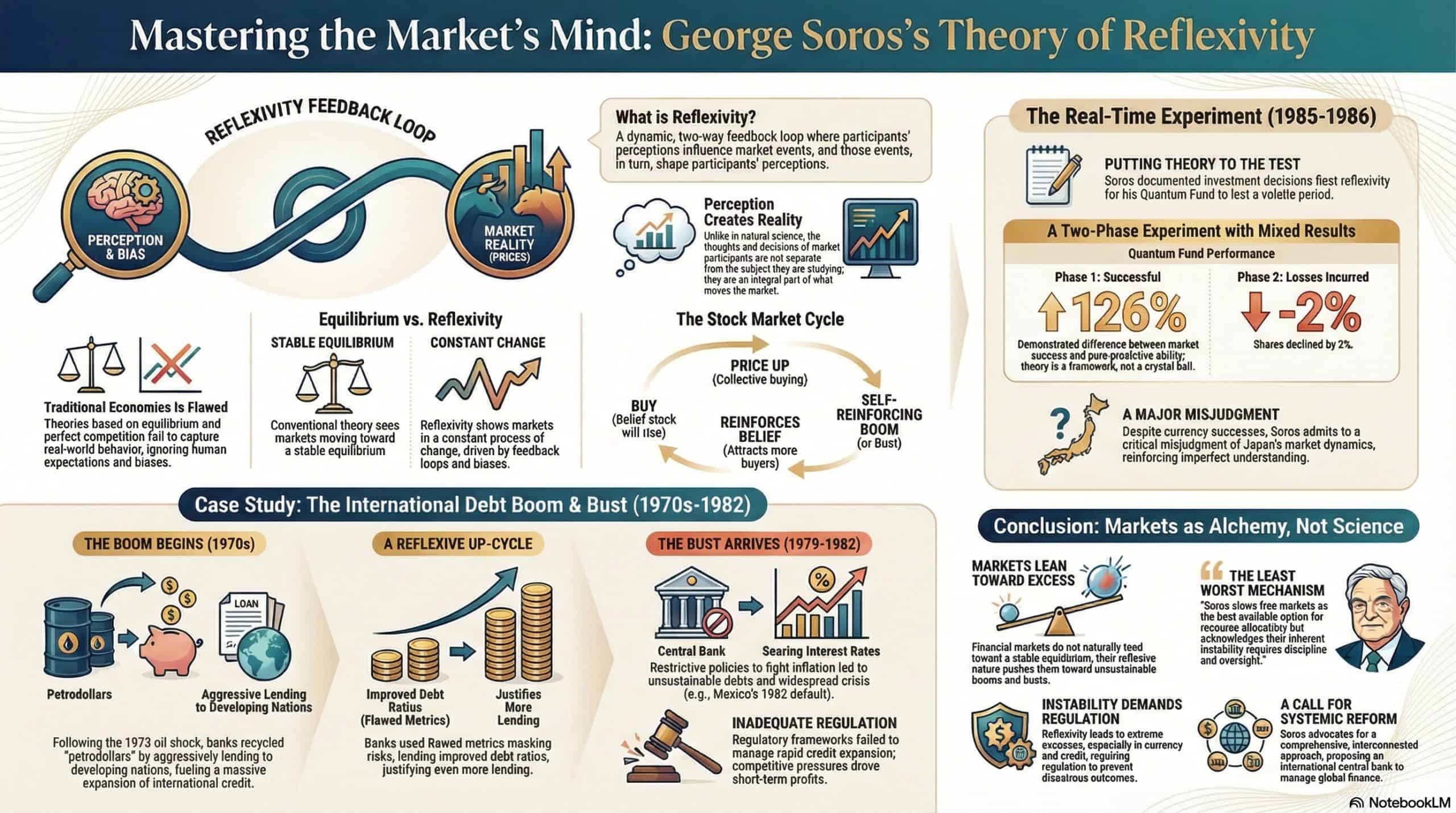
At the heart of Soros’s philosophy is his theory of “reflexivity.” He defines it as a two-way feedback loop: participants’ biased beliefs impact market prices, and those new prices, in turn, alter participants’ beliefs. This creates a continuous, unfolding process of change, not a stable outcome.
Soros uses a “shoelace” theory analogy to describe how historical processes are shaped by misconceptions that propagate through these feedback loops, altering both our perceptions and the actual situation.
A simple stock market example illustrates this perfectly. Imagine you believe a stock’s price will rise, so you buy it. As more people share this belief, their collective buying causes the price to actually rise. This rising price reinforces the initial belief that the stock is a good investment, encouraging even more people to buy. In this cycle, belief doesn’t just predict reality; it forges it. The inescapable conclusion is that we are not passive observers of the economy, but active, biased participants whose collective actions create the very reality we are trying to understand. This isn’t just a theory; it has played out on a global scale with devastating consequences.
History Shows How Feedback Loops Can Build—and Destroy—Fortunes
To see how powerful reflexive cycles can be, we need only look at the international lending boom and bust of the 1970s and 1980s. This period is a terrifying case study of reflexivity in action.
The cycle unfolded in distinct phases:
1. The Initial Boom: After the 1973 oil shock, banks were flooded with “petrodollars” and began aggressively lending to developing nations. This lending was based on flawed metrics; specifically, banks’ evaluation methods relied on “debt ratios” that “no longer accurately reflected willingness to pay.”
2. The Reflexive Feedback Loop: This aggressive lending created the appearance of economic health in borrowing nations. This apparent prosperity, in turn, justified even more lending. A self-reinforcing loop was born, leading to unsustainable debt burdens built on a foundation of misallocated capital.
3. The Bust: In 1979, mounting inflation concerns led to restrictive monetary policies and soaring interest rates. This broke the cycle. Heavily indebted countries could no longer service their debts, triggering the 1982 Mexican debt crisis and a widespread international emergency.
This historical example makes Soros’s abstract theory terrifyingly real. It demonstrates how a reflexive feedback loop, fueled by flawed perceptions and reinforced by market actions, can escalate into a massive, system-wide failure. If markets are this unstable and participant-driven, then navigating them requires a completely different mental model than science.
Investing Is More Like Alchemy Than Science
Soros argues that the methods of natural science cannot be applied to finance. A scientist studying gravity doesn’t change it by observing it. But in markets, the thoughts and biases of participants are an integral part of the reality being studied. An investor cannot study a stock without their actions—and the actions of others—influencing its price.
Because of this, Soros describes successful investing as a form of “alchemy.” In alchemy, success is judged by its operational effectiveness (turning lead into gold, or in this case, making a profit) rather than its factual correctness (forming a perfectly accurate prediction). The alchemist, or investor, isn’t just observing the elements; their actions are part of the chemical reaction.
The implication is profound. A successful investor may not have a “truer” picture of reality. Instead, they simply have a better understanding of how the prevailing market biases and reflexive feedback loops are currently operating. They are not predicting an objective future; they are navigating a subjective, ever-changing present that they are simultaneously helping to create.
Conclusion: What Do We Do in a World We Create?
Ultimately, The Alchemy of Finance is not a book about investment tactics; it’s a philosophical treatise on the nature of social reality. Soros’s central message is that in any system involving thinking participants, from markets to politics, there is no objective reality separate from what we believe it to be. Our perceptions, expectations, and flawed judgments are not just noise; they are the engine of history.
If our collective beliefs truly have the power to shape economic reality, what new responsibilities does that place on us as investors, consumers, and citizens?