The Delay That Stops Your Site in November Was Bookable in September
Trades and materials don’t fail on the day you need them. They fail weeks earlier, when nobody worked backwards. Here’s the arithmetic that prevents most small-site delays.
Most delays on small construction jobs aren’t caused by anything going wrong on site. They’re caused by something not being ordered or booked early enough — and the moment that decision needed to be made was weeks before anybody was thinking about it. The glazier who needs eight weeks’ notice for an installation on the 18th of November had to be called in September. Nobody called in September, because in September the windows felt a long way off. So the site stops in November with the frame up and nothing to put in it. Managing construction lead times properly is mostly a matter of doing one piece of arithmetic backwards, and it prevents a large share of the delays that small jobs suffer.
Work backwards, not forwards
The instinct is to plan forwards: here’s the sequence, here’s roughly when we’ll need each thing. That works right up until something has a long notice period, at which point forward planning fails silently — because “we’ll need the windows in November” contains no prompt to act in September.
The fix is to calculate the last safe day. Take the date the trade or material is needed, subtract the notice period or lead time, and you have a book-by or order-by date that sits in your programme as its own deadline. Now the decision has a date attached, and it appears on your schedule at the point where it becomes urgent — not at the point where it becomes impossible.
Two things make this dramatically more useful in practice:
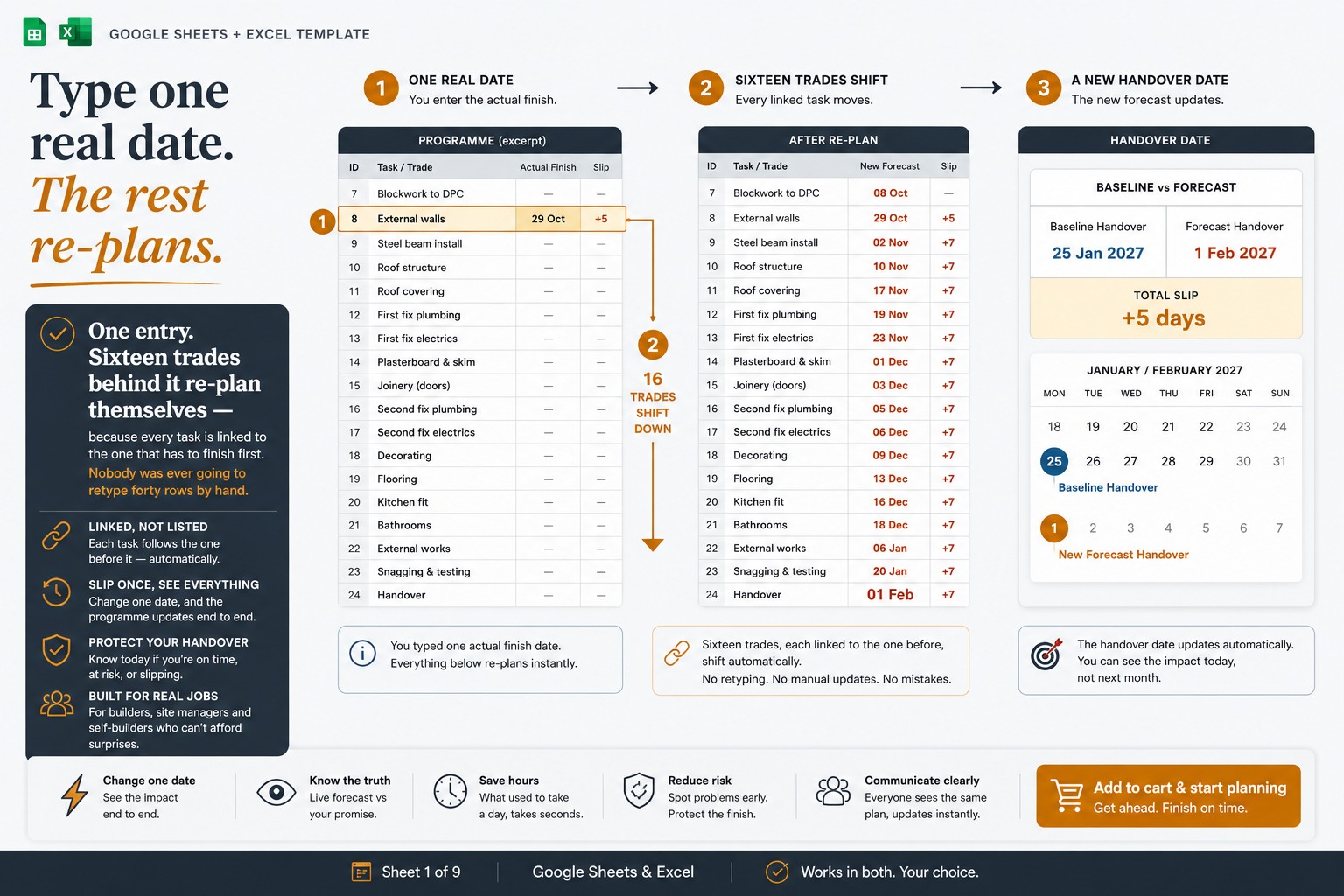
It should recalculate when the job moves. If the programme slips a week, every book-by date behind it should move too. A static list of order dates goes out of date the first time anything changes, which is usually within the first fortnight.
An overdue order needs to shout. A date that has already passed should flag itself clearly — something like an ORDER NOW alert — because the whole failure mode here is not noticing. A quiet list of dates you have to remember to check is barely better than no list.
The categories that catch people are consistent: anything made to order, anything imported, specialist trades in demand, structural steel, bespoke joinery, glazing, and anything requiring a manufacturer’s survey before production. Those are the items worth identifying at the start of a job rather than discovering mid-way.
Protect the hold points
The second category of avoidable delay is inspections — and this one is expensive in a different way.
Certain stages of work typically can’t be covered up until they’ve been inspected. Miss that, and you’re not just delayed: you may have to open up finished work to expose what’s underneath. That is, in my view, the most expensive avoidable mistake available on a small job, and it happens for an entirely ordinary reason — the trade was ready, the weather was good, and covering up was the obvious next step.
Two things prevent it. First, identify the hold points at the start of the job and put them in the programme as tasks, not as things you’ll remember. Second, respect the notice period — inspections usually need booking in advance, so the deadline isn’t the inspection, it’s the call that arranges it. That’s another backwards calculation, and it belongs on the schedule for exactly the same reason.
What’s required, who inspects, and when varies enormously by country and region — that’s yours to establish from your own drawings, your permits and the relevant authority, not from any template. But whatever your requirements are, the pattern is the same: the hold point should be a scheduled task with a booking deadline in front of it.
Log delays on the day they happen
The third habit is the one that pays off in a way you hope never to need.
When something delays the job, write it down the same day: the date, the cause, how many days were lost, whose risk it was under your contract, and what you did to recover. Weather days specifically — because “it rained a lot in October” is a memory, while a dated log of five non-working days is a record.
The value is twofold. Immediately, it’s how you have an honest conversation with a client: not “we’re running behind,” but “here are the five days lost to weather in week 12, here’s the two days waiting on the inspection, here’s what we’ve recovered.” That’s a completely different conversation, and it’s the one that preserves the relationship.
Later, if a job ever goes into dispute, a contemporaneous dated log is worth more than anything else in your file. Records made at the time — before anybody knew there’d be an argument — carry weight that reconstructed accounts simply don’t. You can’t fake having logged it as it happened.
I’d add the obvious caveat, though: who actually bears the cost of a delay depends entirely on your contract and the law where you are. A log records what happened; it doesn’t determine liability. That’s a question for your contract and, where it matters, professional advice.
And close it out properly
The last stage nobody enjoys is the punch list — snagging, if you’re in the UK. Defects raised, by trade, and then closed.
It matters more than it feels like it should, because this is the stage where the client’s final impression is formed, and it’s the stage where jobs drift. A defect list that lives in someone’s head or on a scrap of paper takes weeks to close because nobody can say what’s outstanding. Sorted by trade, with a raised date and a closed date, it becomes a short set of visits rather than an open-ended tail — and you get paid sooner.
An important note
To be clear: this is a general perspective on scheduling and record-keeping. It is not construction, engineering, architectural, health and safety, contractual, insurance, or legal advice, and it guarantees no outcome. Any lead times, notice periods, durations or inspection examples mentioned are illustrative — not recommendations, industry standards, or applicable to your project. Building regulations, permits, required inspections, certification schemes and health and safety duties differ enormously by country and region and are your responsibility to establish and comply with. Who bears the cost of a delay depends entirely on your contract and applicable law. Always work from your own drawings, contract and professional advice, and consult qualified professionals for structural, regulatory and safety matters.
If you want the backwards maths done for you
I built lead-time handling into my construction schedule in Google Sheets — subcontractor book-by dates calculated from your own notice periods, material order-by dates from your own lead times with an ORDER NOW alert once a date has passed, inspection hold points with their notice periods, a dated delay log with cause categories and whose risk, and a punch list sorted by trade:
👉 Construction Schedule & Programme for Google Sheets & Excel
Whether you use mine or a wall planner, do the backwards arithmetic at the start of the job. Work out the last safe day to book each trade and order each long-lead item, put the inspection hold points in as real tasks, and log every delay on the day it happens. Almost every delay that stops a small site was preventable weeks earlier — by someone doing one subtraction. 🏗️
This reflects my own perspective and describes a planning tool — NOT construction, engineering, health and safety, contractual or legal advice, and it guarantees no outcome; lead times and inspection examples are illustrative only. Regulations and delay liability differ by region and contract. What’s the long-lead item that’s caught you out? Tell me in the comments.