Deals Die of Silence — and the Silence Is Usually Yours
Very few deals end in a clear “no”. Most just stop, quietly, in a pipeline that looks perfectly healthy. Here’s how to find the ones dying right now.
Ask someone why they lost a deal and you’ll usually get a story: the budget went, a competitor won it, the timing was wrong. Those losses are real, and they’re also the minority. The much more common ending is that nothing happened at all. A conversation went quiet, both sides got busy, and a deal that was genuinely alive three weeks ago became one that will never close — without anyone deciding anything. The uncomfortable part is that the silence is usually yours. Finding stale deals before they expire is one of the highest-return habits in small-business sales, and it requires no talent, no technique and about five minutes a week. Here’s how.
Why a healthy-looking pipeline hides dying deals
The reason silent death is so hard to spot is that a stale deal looks identical to a live one in any list. It has a name, a value, a stage, an expected close date. Nothing about it announces that nobody has spoken to this person in three weeks.
So when you look at your pipeline, you see a total that includes deals that are, in practice, already gone. The number is comforting and partly fictional — and it stays comforting right up until the end of the quarter, when the deals you were counting on turn out to have quietly expired.
There’s also a psychological pull at work. The deals we neglect are rarely random: they’re often the ones that feel slightly awkward, where the last message went unanswered, or where we suspect the answer might be no. Chasing them means risking a rejection, so they drift to the bottom of the list. Which means the deals most likely to be dying are exactly the ones we’re least inclined to look at.
Track “last touched”, and let it flag itself
The fix is one column and one rule.
Record the date of your last meaningful contact with each open deal. Then set a threshold — how long is too long for your sales cycle — and let anything past it flag itself as stale.
The threshold depends on how you sell. A transactional business might treat a week as too long; one with a six-month enterprise cycle might use a month. The number matters less than having one, because the point is to convert a vague feeling (“I should probably chase a few people”) into a specific list you can work through in twenty minutes.
What people find when they first do this is consistently sobering: a meaningful chunk of pipeline value sitting untouched, in deals they’d have described as active. That’s not a failure of effort — it’s what happens when active work (the deals moving, the meetings booked) crowds out the quiet ones. Nothing was ever decided; the neglected deals just never made it to the top of a list.
Two other columns are worth having alongside it. Days open tells you which deals have been in the pipeline far longer than your typical sales cycle — a sign they may be going nowhere, however friendly the conversations. And an expected close date that’s already in the past is a strong hint that a deal needs either a real update or an honest reclassification.
Chasing is not the same as pestering
A note on tone, because this is where people hesitate. Following up on a deal that’s gone quiet is a normal, professional act. Most silence isn’t rejection; it’s a busy person, a delayed internal approval, a holiday, an email that got buried.
The most useful follow-ups add something rather than just asking for a status: a relevant piece of information, an answer to a question they raised, a genuine offer to make a decision easier. And if the answer is no, getting it is a win — a clear no removes a deal from your forecast, frees your attention, and gives you a loss reason you can learn from. An unanswered maybe does none of that while still inflating your numbers.
Then ask where wins actually come from
The second diagnostic worth running is win rate by source. Not overall — by where the deal came from.
When people do this for the first time, one finding recurs with striking regularity: referrals and warm introductions convert several times better than cold outbound. Sometimes dramatically so. And yet the time allocation almost never reflects it — the cold channel gets the hours because it’s the one that feels like doing sales, while asking happy customers for introductions feels like an imposition and never gets scheduled.
Seeing the numbers side by side is what changes behaviour. If one source closes at several times the rate of another, that’s a strong argument for rebalancing your week — not abandoning the low-converting channel necessarily, but being honest about what each hour is worth.
The same applies to average deal size and average sales cycle by source. A channel with a lower win rate but much larger deals may still be worth it; one with a decent win rate but a cycle twice as long ties up your attention for longer than it looks. Calculating these from your own closed deals — rather than assuming — usually reorders someone’s priorities within an afternoon.
Record why you lost, while you remember
The last habit is the one everyone skips: writing down why a deal was lost, at the moment it happens.
A week later you’ll remember “they went elsewhere.” At the time you knew it was because your proposal took four days too long, or because you never got to the actual decision-maker, or because the price landed badly for a reason you could address next time.
Logged consistently, loss reasons become the most useful diagnostic you own. A cluster of losses to price might mean a positioning problem or a targeting problem — very different fixes. A cluster of “went quiet” losses points straight back at follow-up. A cluster of “wrong fit” means you’re qualifying too late and wasting time earlier in the funnel than you thought.
None of that is visible from a win rate alone. And unlike almost everything else in sales, it costs nothing to collect — just a habit of writing one line while the disappointment is fresh.
An important note
To be clear: this is a general perspective on organising your own sales figures. It is not sales, financial, accounting, legal, or professional advice; it is not a substitute for CRM software; and it guarantees no result. Any figures mentioned are illustrative, not benchmarks — win rates, cycle lengths and thresholds vary enormously by market, deal size and sales motion, so use your own. And if you keep contact details for the people you’re selling to, you’re responsible for handling that information lawfully under the data protection rules that apply to you.
If you want the flags built in
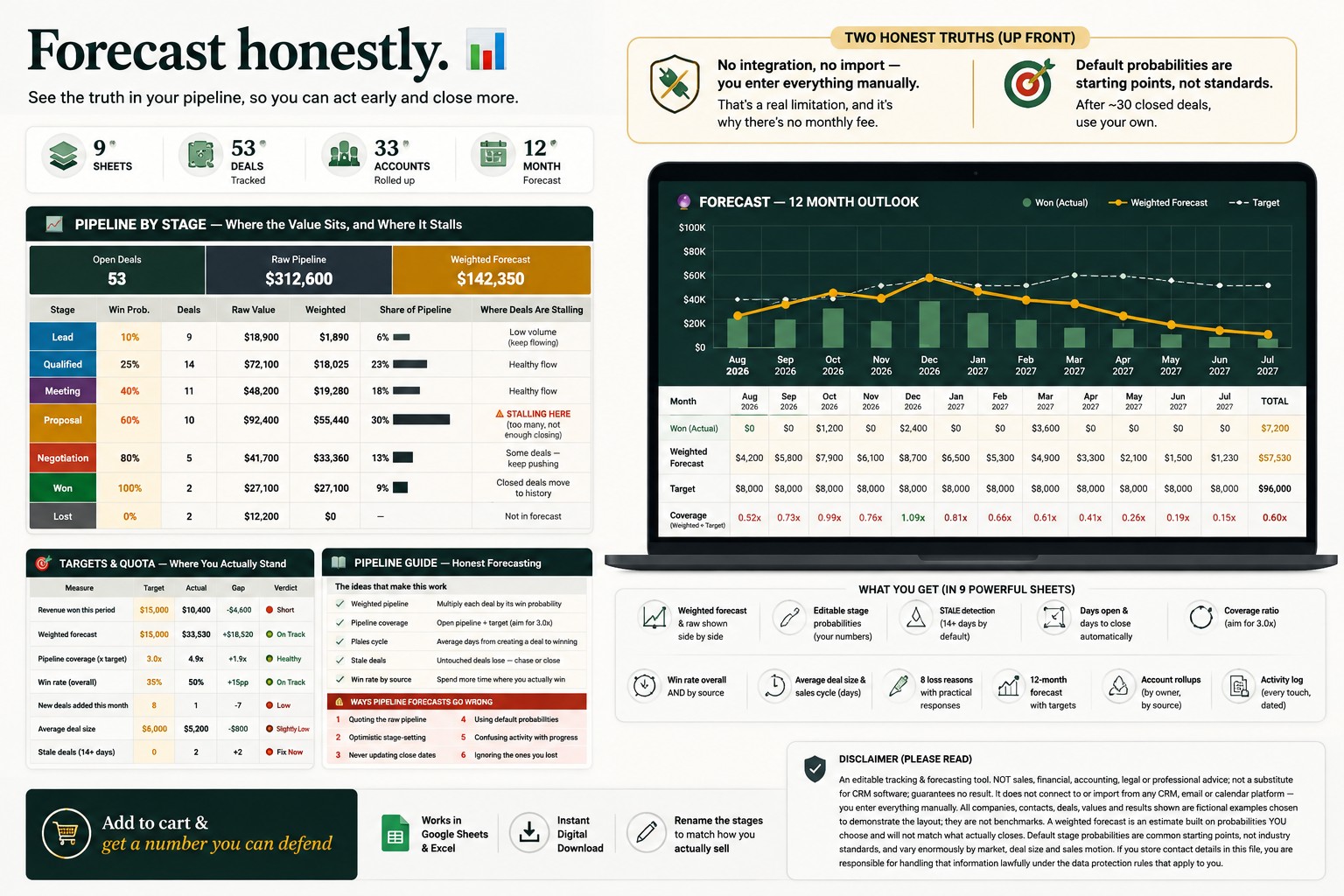
I built stale-deal detection into my sales pipeline CRM in Google Sheets — any deal untouched past a threshold you set flags itself automatically, alongside days open and days to close per deal, win rate calculated overall and by lead source from your own closed deals, average deal size and sales cycle, and eight loss reasons each with a practical response:
👉 Sales Pipeline CRM for Google Sheets & Excel
Whether you use mine or a column in a spreadsheet, start recording when you last touched each deal. Then work the stale list once a week. Most of what you lose isn’t lost to competitors or to price — it’s lost to a silence nobody broke, in a pipeline that looked completely fine. Break the silence, and find out where your deals actually go. 📊
This reflects my own perspective and describes a tracking tool — NOT sales or financial advice, not a substitute for CRM software, and it guarantees no result; figures are illustrative, not benchmarks. You’re responsible for handling any contact data lawfully. What’s your stale threshold — a week, a month? Tell me in the comments.