

Sent Is Not Paid
Someone asks how the month went and you genuinely don’t know. The invoices are in a folder, the payments are somewhere in a bank feed, and one client definitely hasn’t paid — you think. That’s not a discipline problem.
Every freelancer knows this specific fog. Work went out. Invoices went out. Money came in, some of it. But if someone asked you right now exactly how much you’re owed, by whom, and how overdue it is, you’d need ten minutes and a bank feed to find out — and you’d probably still be guessing about one of them. Meanwhile there’s a client you’re fairly sure hasn’t paid, but chasing feels awkward, so you’ll leave it another week. And another. Freelance late payments don’t usually happen because clients are villains. They happen because nobody’s watching, and because chasing feels harder than it is. Here’s how to fix both.
It’s a visibility problem, not a character one
The instinct is to blame yourself — you should be more on top of this, more organised, more businesslike. That framing is both unpleasant and wrong.
The actual problem is structural. Your invoices live in one place (a folder, an app, an email trail). Your payments arrive somewhere else entirely (a bank feed, mixed in with everything else). Nothing connects the two. So answering “has this been paid?” means cross-referencing two systems that don’t know about each other, every single time.
Nobody does that voluntarily for six invoices. So you don’t check, the picture goes fuzzy, and the fuzziness is where the money goes missing. An invoice that quietly aged past its due date generates no event, no alert, no moment where you notice. It just sits there.
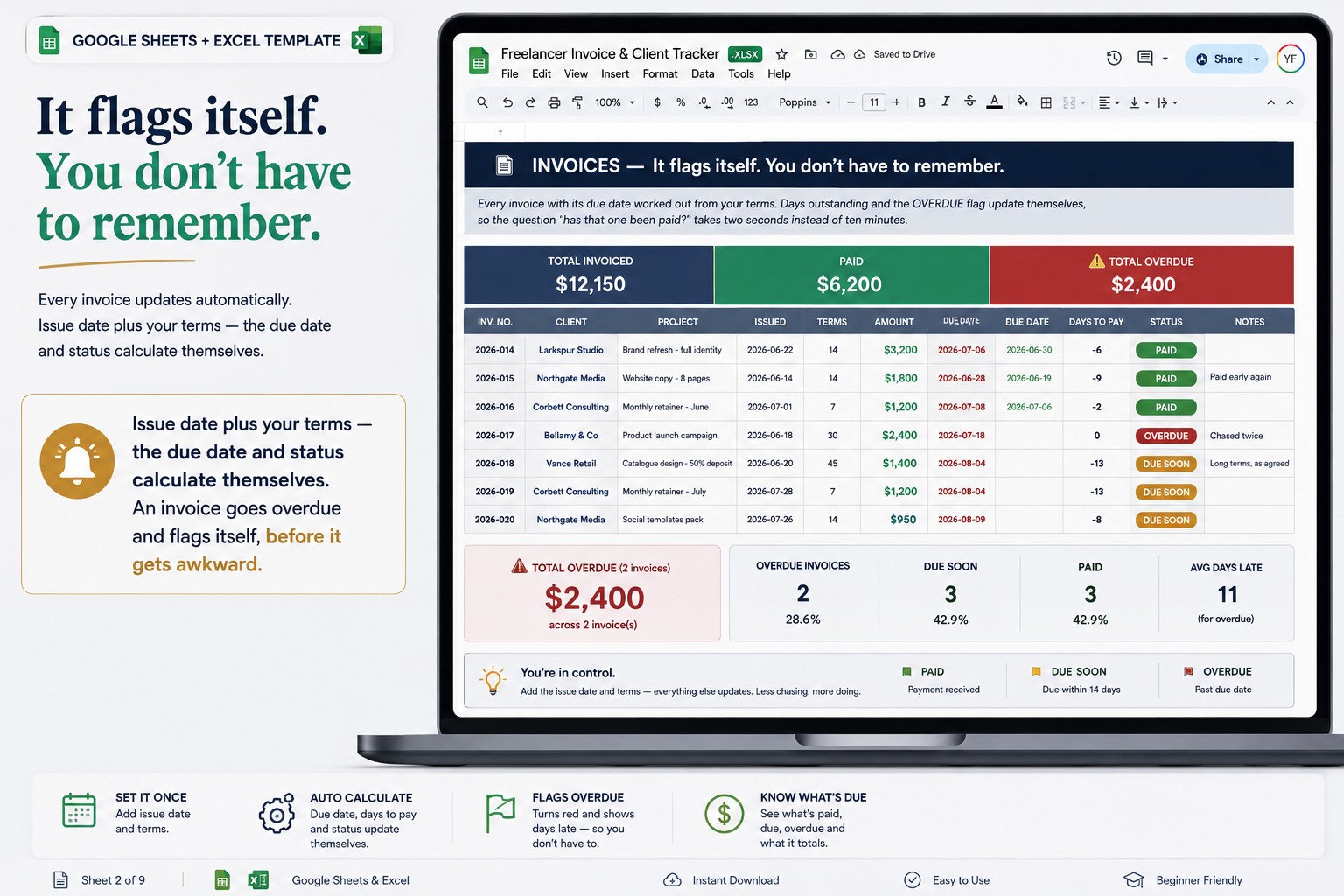
The fix isn’t discipline; it’s putting the two halves in one place. Record what you issued and when it’s due, then mark it paid when the money lands. That single joined-up view answers “what am I owed?” in two seconds instead of ten minutes, and — more importantly — makes an overdue invoice visible on the day it goes overdue, rather than whenever you happen to think about it.
The number you need before you chase
There’s one figure worth having in front of you at all times: total overdue. Not invoices outstanding — invoices past their due date, added up.
It matters for a practical reason and a psychological one. Practically, it tells you how much of the money you’ve already earned is sitting outside your account. Psychologically, it’s usually the thing that makes people finally act. “A couple of invoices are late” is easy to defer. Seeing that a meaningful sum you’ve already worked for is overdue is not.
Underneath it, you want the same view per invoice: how many days late each one is, so you can chase the worst first. Chasing in order of age is both more effective and less draining than trying to chase everything at once — and old invoices genuinely do get harder to collect, so priority matters.
Chasing is not rude
Here’s the belief that costs freelancers the most money: that asking to be paid is somehow impolite.
It isn’t. You delivered work under agreed terms. The money is due. Asking for it is a normal, professional part of running a business, and the vast majority of late payments aren’t malice at all — they’re an invoice sitting in an approval queue, a finance person on holiday, an email that got buried. Most chase messages are answered with “sorry, sorting it now,” because nothing was wrong except that nobody was reminded.
The reason chasing feels so heavy isn’t the ethics of it. It’s the decision — what tone to use, what to say, whether it’s too soon, whether you’ll sound aggressive. That deliberation is genuinely hard, so it gets postponed, and postponement is what turns a slightly late invoice into a very late one.
The fix is to decide the sequence once, in advance, when you’re calm and not owed anything. Something like: a friendly heads-up a few days before the due date; a short “just checking this reached the right person” a few days after; a firmer note referencing the terms; escalating politely up to a formal written notice. Each stage with wording you’ve already written.
Then chasing stops being a decision and becomes a task. You look at what’s overdue, see which stage it’s at, and send the message that’s already drafted. No agonising, no rewriting, no putting it off until Friday.
One note on tone: escalate politely, but don’t apologise for asking. “Sorry to bother you about this” undercuts a completely legitimate request. “Following up on invoice #123, due on the 14th” is professional, neutral, and much harder to ignore.
Prevention beats chasing
Better than chasing well is not needing to. A few things reduce late payment before it starts: agreeing payment terms clearly in writing before work begins, invoicing promptly (invoices sent late get paid late), making sure the invoice goes to whoever actually processes payments rather than your day-to-day contact, and — for larger projects — asking for a deposit upfront. None of these is complicated; they’re just easy to skip when you’re busy doing the actual work.
And once you’re tracking, a quieter benefit appears: how long each client takes to pay you, on average. That number turns a feeling into a fact. The client you suspect is slow either is or isn’t, and knowing lets you act — tighter terms, a deposit, invoicing them earlier, or in persistent cases deciding whether the work is worth the wait. It also protects you from unfairly resenting a client who’s actually fine.
Know what you were paid, not what you invoiced
A last point that affects how you understand your own income: invoiced and paid are different months.
If you think of your income by when you sent invoices, your picture will be consistently wrong — optimistic in months where you billed a lot and collected little, and confusing later. What you can actually spend, plan around, and set aside tax from is what has landed. Tracking income by payment date rather than invoice date gives you a truthful picture of your business, which matters a great deal when income is irregular.
Related, and worth doing from the first payment: set aside a share of every payment as it arrives, into a separate account, for tax. How much depends entirely on where you live and your circumstances — that’s a question for an accountant, not a spreadsheet. But the habit of separating it at the moment money arrives, rather than hoping there’s enough later, is what prevents the classic freelancer January.
An important note
To be clear: this is a general perspective on organising your own freelance admin. It is not accounting, tax, legal, or professional advice, and it guarantees no outcome. Any figures mentioned are illustrative. Tax obligations — income tax, social contributions, VAT/GST, allowable expenses and filing rules — differ enormously by country and by your circumstances, so any set-aside percentage should come from a qualified accountant rather than a rule of thumb. Rules on payment terms, late-payment interest and debt recovery also vary by jurisdiction and by what your contract says; take proper advice on significant unpaid invoices.
If you want it in one place
I built a freelance invoice tracker in Google Sheets around exactly this — due dates calculated from your terms, automatic Due/OVERDUE status, total overdue on the dashboard, average days-to-pay per client, and a six-step chase sequence with wording already written for each stage:
👉 Freelance Invoice Tracker for Google Sheets & Excel
(It doesn’t create invoices to send — it tracks the ones you raise wherever you already do.)
Whether you use mine or a notebook, get your invoices and your payments into one view, and write your chase sequence before you need it. Sending an invoice isn’t getting paid, and the gap between them is where a lot of freelance income quietly disappears. Track what’s owed, chase without dread, and stop wondering how the month went. 💼
This reflects my own perspective and describes an organising tool — NOT accounting, tax or legal advice, and it guarantees no outcome; tax rules and payment/debt-recovery rules vary by country and contract, so consult a qualified accountant and take proper advice on significant unpaid invoices. Freelancers: what’s your first-line chase message? Share it in the comments — someone’s putting one off right now.

