A Savings Plan That Doesn’t Fit Your Income Isn’t a Plan
It’s a wish list with dates on it. Here’s why every savings plan needs an affordability test — and why the emergency fund has to stay in its own pot.
Here’s how a savings plan usually dies. You sit down full of resolve, list everything you want to save for, give each one a target and a date, and work out the monthly amount for each. It looks wonderful. You feel organised. Then, somewhere around the second or third month, the transfers start not happening — not through some dramatic failure, but because the total was quietly more than your income could sustain, and something had to give. You conclude you’re bad at saving. In fact, the plan was never affordable, and nobody checked. Almost every savings plan template will happily let you commit to more than you earn, because adding up the total and testing it against your income is the one step they leave out. It’s also the step that decides whether the plan survives.
The step everyone skips
The reason this happens is subtle. When you plan savings goal by goal, each individual amount seems reasonable. A modest amount a month for the car fund. A modest amount for Christmas. A modest amount for the holiday. None of them feels like much on its own, and each is considered in isolation.
But you don’t pay them in isolation — you pay all of them, every month, out of one income that’s also covering rent, food, and everything else. The total is what matters, and the total is the number nobody computes, because the planning happened one goal at a time.
So people arrive at a monthly commitment that’s substantially larger than they can actually manage, without ever having made that decision. The plan doesn’t fail because of weak willpower; it fails because it was arithmetically impossible from the start, and its impossibility was invisible.
Test the total against a limit you choose
The fix is straightforward: add up every fund’s monthly amount, and compare it to a percentage of your income that you’ve decided in advance is realistic.
Choosing the percentage yourself matters. There’s no universal correct figure — it depends entirely on your income, your fixed costs, your debts, and your life. What matters is that you pick a number you can genuinely sustain alongside everything else, and then hold your plan to it.
Then the test is simple: does the total fit inside your limit? If yes, you have a plan that’s likely to survive. If not, you now know before you fail, rather than after — and that’s the entire value.
Which brings me to the uncomfortable but genuinely useful bit: a good tool should be willing to tell you no. A savings tracker that cheerfully agrees with everything you type isn’t giving you any information. If it can look at your plan and say “this needs more of your income than you said you could spare,” it has just saved you three months of quiet failure and the self-criticism that follows.
What to do when it doesn’t fit
If your plan is over your limit, there are only three honest levers, and none of them involves trying harder:
Push a date back. The same target spread over more months costs less per month. Often the date was somewhat arbitrary anyway — a holiday next summer instead of this spring, and the fund becomes comfortable.
Lower a target. A smaller Christmas, a cheaper holiday, a more modest replacement. Deciding this in advance, calmly, is far better than discovering it in December.
Drop or defer a fund entirely. Not everything has to be funded simultaneously. Some things can wait a year.
What you should not do is pretend an expense isn’t coming. Removing the car insurance fund because it makes the numbers work doesn’t stop the car insurance arriving — it just moves the problem back to where it started. The bills you can’t avoid should be funded first, and the flexible things adjusted around them.
This is also where prioritisation earns its keep. Fund the unavoidable, penalty-carrying things first — insurance, taxes, essential car and home costs. Let the discretionary things flex. It’s not about denying yourself pleasures; it’s about making sure the things that turn into debt when missed are covered first.
Keep the emergency fund separate
There’s one more structural point that people get wrong constantly: your emergency fund and your sinking funds are doing different jobs, and mixing them causes a specific, predictable failure.
Sinking funds are for what you know is coming — dated, predictable, plannable. An emergency fund is for what you don’t know is coming: a job loss, an illness, a boiler that dies, a car that needs something far beyond a service.
If they live in one pot, two bad things happen. You raid the emergency money to cover a planned expense, because it’s all just “savings” — and then when a real emergency arrives, the buffer isn’t there. Or you feel falsely secure, seeing a healthy total that’s actually almost entirely spoken for by expenses due in the next few months.
Keeping them separate — separate accounts, or at minimum separately tracked — means you always know what’s genuinely available for a crisis versus what’s already committed. It’s a small piece of structure that prevents being caught out twice.
An emergency fund is also usefully measured differently: not as a target amount but as months of cover — how long your essential outgoings could be met if income stopped. That framing tells you what the fund is actually for, which is time to sort things out.
An important note
To be clear: this is a general explanation and a way of organising your own figures. It is not financial, investment, tax, debt, or professional advice, and it guarantees no outcome. Figures and percentages mentioned are illustrative — there’s no universal right answer for how much to save or how many months of cover to hold, and the right approach depends on your circumstances. Simple arithmetic here doesn’t model interest, inflation, investment returns or tax. If you’re struggling with debt, or unsure whether to prioritise saving over repaying, please speak to a qualified financial adviser or a free, reputable debt advice service in your country before making decisions.
If you want the check built in
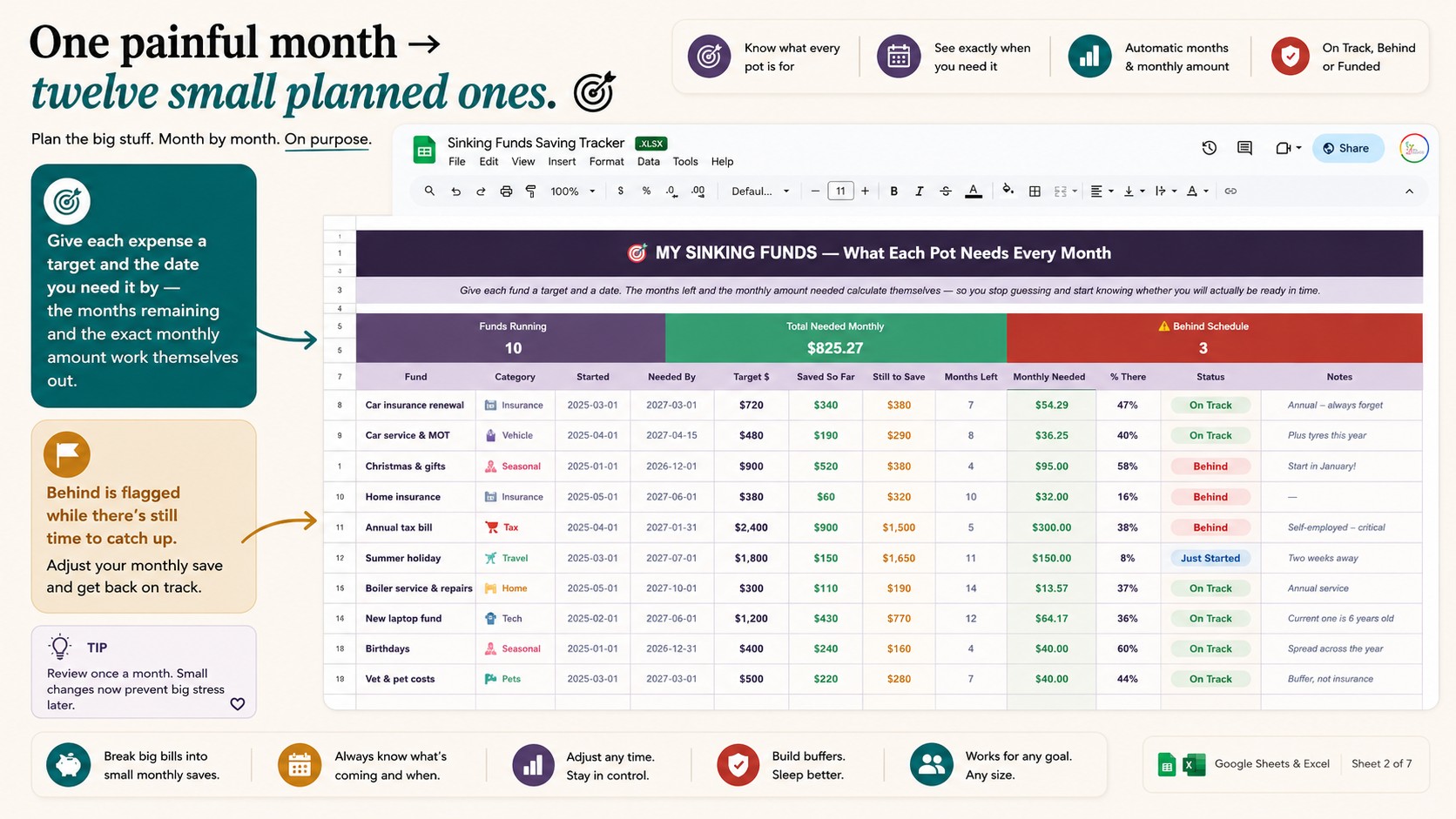
I built an affordability check into my sinking funds tracker in Google Sheets — it totals every fund’s monthly amount, tests it against a percentage of your pay that you set, and gives a plain-English verdict when the plan is over your limit, with the emergency fund tracked separately in months of cover with its own progress bar:
👉 Sinking Funds Tracker for Google Sheets & Excel
Whether you use mine or a calculator, add your savings plan up and test the total before you commit to it. A plan you abandon in March is worth nothing — and the reason people abandon plans is almost never weakness. It’s that nobody checked whether the plan was possible in the first place. Build one that fits, keep the emergency money separate, and it’ll still be running next year. 🏦
This reflects my own perspective and describes a budgeting tool — NOT financial, tax or debt advice, and it guarantees no outcome; figures are illustrative. If you’re struggling with debt, please speak to a free, reputable debt advice service. Have you ever built a savings plan you couldn’t actually sustain? Tell me in the comments — you’re in good company.