By February, It’s All Gone
Which variety cropped beautifully. Which bed the blight was in. When you actually sowed the carrots. You knew all of it in August — and by seed-catalogue season it has quietly evaporated. Here’s why a garden journal is the highest-return thing a grower can keep.
A garden rewards memory more than almost any other hobby. Which tomato was the good one. Which bed had the problem. Whether the courgettes were worth four square metres of your best sunny bed, or whether you spent August apologetically handing them to neighbours. All of that is genuinely valuable information, and all of it is completely obvious to you in August. Then the season ends, winter happens, the seed catalogues arrive — and it’s gone. So you order roughly the same things and make roughly the same mistakes, and the year of hard-won knowledge you accumulated simply doesn’t carry forward. A garden journal solves this, and the strange thing is how few gardeners keep one, given that gardening is the hobby where memory pays the biggest dividends.
Why gardening memory fails so completely
It isn’t carelessness. Gardening has a specific structure that defeats recall:
The feedback loop is a whole year long. You make a decision in March and learn whether it was right in August. Then you don’t act on that lesson until the following March — twelve months after you learned it, and six months after you last thought about it.
The details are small and numerous. Variety names, sowing dates, which bed, how much you picked, what the pest was, what you sprayed or netted. Individually trivial, collectively far too many to hold.
Nothing forces you to record it. In August you’re busy actually gardening, and everything feels vividly memorable because you’re living it. The moment when writing it down would be easiest is exactly the moment it feels least necessary.
Seasons blur together. Was the blight last year or the year before? Was it the bed by the fence or the middle one? After two or three seasons, they genuinely merge.
So the knowledge is real, and it evaporates — reliably, every year, for almost everyone.
The four things actually worth recording
You don’t need a beautiful hand-illustrated journal (though if that’s your pleasure, wonderful). Four categories carry almost all the value:
Varieties. Not just “tomatoes” — which tomato. This is the single most valuable thing to record, because the difference between varieties in your particular garden can be enormous, and it’s the detail you’re most certain to forget by ordering season. Noting how each one actually performed for you turns next year’s seed order from a hopeful guess into an informed choice.
Which bed had what. This is your crop-rotation memory. Rotation is one of those practices every gardener knows about and many quietly fail at, not through disagreement but because they simply can’t remember what was where. A single “last year’s crop” note per bed solves it, and it takes seconds.
Dates you actually did things. Not when you meant to sow — when you did. Because next year, comparing your intentions to what really happened (and how it turned out) is what makes your timing better. Most gardeners sow later than they think they do.
Problems and what you tried. Pests, diseases, failures, and crucially whether the response worked. This page is nearly worthless in year one and genuinely valuable by year three, when you can look back and see that a particular approach worked and another didn’t, in your specific garden with its specific conditions.
Records beat advice, because your garden is specific
Here’s the deeper argument for keeping your own records: general gardening advice can only ever be general. Your soil, your aspect, your microclimate, your rainfall, your pests are yours. A book or a website can tell you what usually works in a broad region; only your own records can tell you what worked here, in this bed, in your conditions.
After three seasons of notes, you have something no book can give you: a personalised guide to your own plot. That’s why the value compounds. Year one is data collection with little payoff. Year three is when you start reading your own journal and making genuinely better decisions than you could have made any other way.
Which is also the case for starting now, in whatever season you’re in, rather than waiting for a tidy beginning. The sooner the records start, the sooner year three arrives.
A note on planting dates and climate
One thing worth being blunt about, because it matters and a lot of gardening content gets it wrong: planting dates are local. They differ enormously by hemisphere, climate zone, altitude and microclimate. A calendar written for a temperate northern garden is actively misleading in the southern hemisphere, the tropics, a desert or a very cold zone — and a planting chart from the wrong climate is worse than no chart at all, because it looks authoritative while being wrong.
So whatever template, book or app you use, treat its dates as an example to be overwritten with your frost dates and your local knowledge. Your local extension service, gardening society, or experienced neighbours are far better sources for timing than anything generic. The parts of a record system that work identically everywhere are the ones that run on the dates you enter — your beds, your sowings, your harvests, your problems.
An important note
To be clear: this is about record-keeping — it is not horticultural, agricultural, plant-health, food-safety, or professional advice, and it guarantees no result. Verify planting times and growing information for your own area and conditions. Two safety points that matter in a food garden: never eat any plant you can’t positively identify as safe and edible, and always read and follow the label on any product you use, checking it’s approved for edible crops where you live.
If you want it structured for you
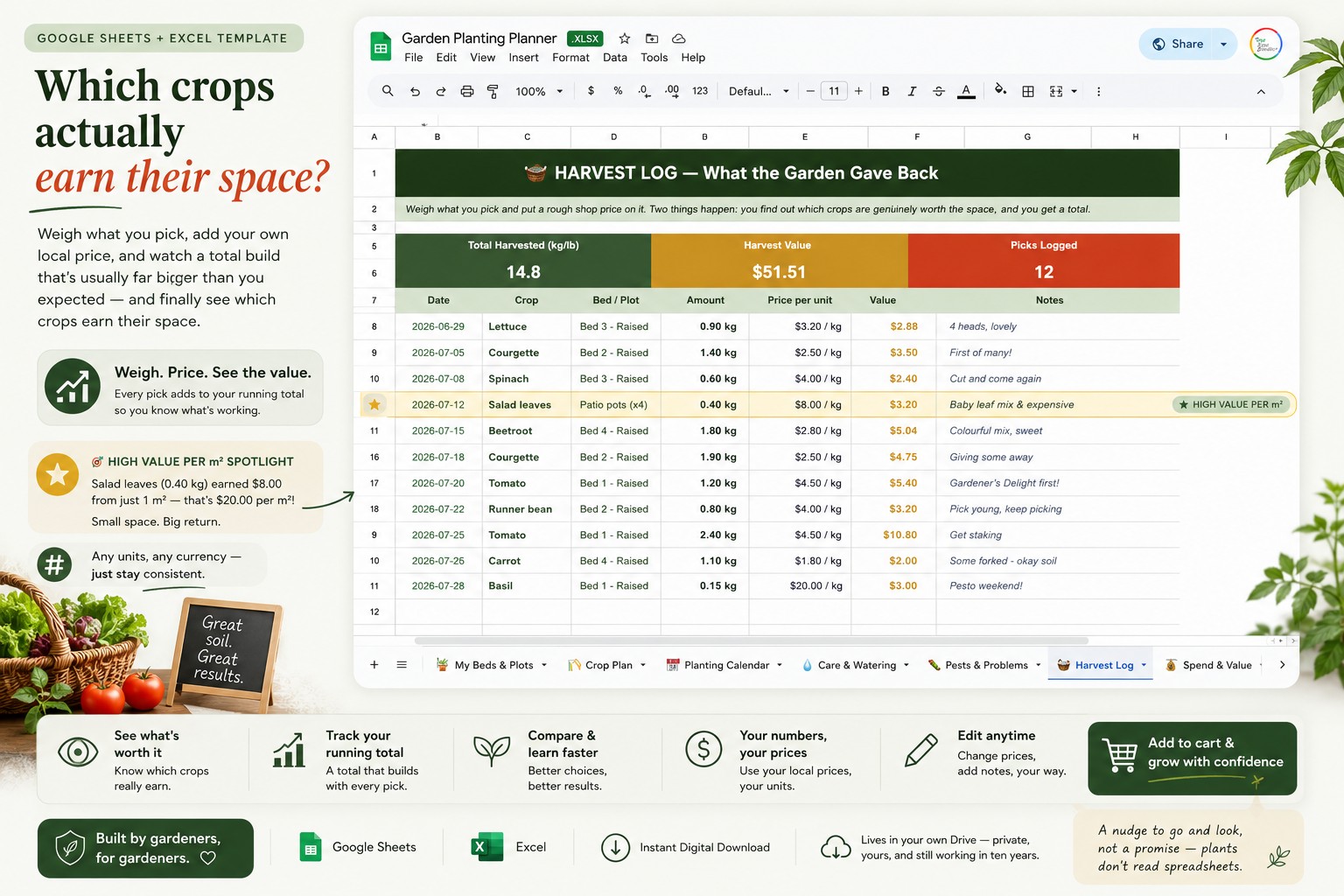
I built a garden planner in Google Sheets around exactly these records — beds with a “last year’s crop” column for rotation, crops with varieties and automatic harvest countdowns from your own sowing dates, a care log, a pest-and-problem log with what you tried and whether it worked, and a harvest log, all fully editable for your own climate and hemisphere:
👉 Garden Planner for Google Sheets & Excel
Whether you use mine or a notebook in the shed, start writing it down this season. Not everything — just the varieties, the beds, the real dates, and what went wrong. It takes a minute here and there through the summer, and it turns the annual February amnesia into a proper record of your own garden. Next spring, you’ll actually remember. 🌱
This reflects my own perspective and is a record-keeping tool — not horticultural, plant-health or food-safety advice, and it guarantees no result; planting times vary enormously by climate and hemisphere, so verify for your own area. Never eat a plant you can’t positively identify as safe. What’s the thing you always forget by February? Tell me in the comments.