A Book Abandoned Is Not a Failure
Forcing yourself through a book you’re not enjoying is costing you the three you’d have loved. Here’s why DNF deserves to be a proper status — and why your reading pace has probably been lying to you since March.
Two things quietly ruin people’s reading years, and they’re related. The first is the book you’re not enjoying but won’t put down, which sits on your bedside table radiating obligation until you stop reading altogether rather than face it. The second is a reading goal you set in January and never actually measured, which means you spent nine months vaguely assuming you were on track and then discovered in December that you weren’t. Both come from the same place: reading is a pleasure that we somehow manage to turn into a performance. Treating DNF book decisions as legitimate, and measuring your pace honestly, fixes more of your reading year than any productivity trick.
The real cost of finishing a book you don’t like
Let’s be clear about the arithmetic. If a book you’re not enjoying takes you five weeks to grind through, you didn’t just have five unenjoyable weeks. You lost the two or three books you’d have loved in that time. That’s the actual cost, and it’s much larger than it feels in the moment.
And it usually goes further than that, because a book you’re avoiding doesn’t just slow you down — it stops you. You don’t want to pick it up, but you feel you can’t start something else until you’ve finished it, so you read nothing at all. The bedside table becomes a source of low-grade guilt, and a reading slump that gets blamed on being busy is very often just one unwanted book blocking the road.
Life is short and the to-read pile is long. Putting a book down is not a judgement on the book, the author, or you — it’s a recognition that this book and this reader, at this moment, aren’t a match. Sometimes it’s a book you’ll love in five years. Sometimes it isn’t for you at all. Neither is a failure.
Track your DNFs — they’re useful data
Here’s the slightly counterintuitive part: abandoned books are worth recording, not erasing.
If you log the ones you put down, and roughly why, a pattern usually emerges. You might notice you consistently abandon a particular genre you keep optimistically buying. Or that you don’t finish very long books in busy periods, but do on holiday. Or that a certain kind of opening loses you every time.
That’s genuinely useful self-knowledge. It makes your future choices better — you stop buying the thing you reliably don’t finish, and you match books to the season of life you’re actually in. Treating DNFs as data rather than as shameful gaps in your record turns a slightly guilty feeling into something that improves your reading.
It also, practically, stops you starting the same unsuitable book again in two years having forgotten you’d already tried it.
Your goal has been lying to you since March
Now the second problem. Most reading goals are set as a number for the year and then never measured until the year ends. That structure practically guarantees a December surprise, because “read 40 books this year” gives you no signal at any point about whether you’re on course.
What actually helps is comparing against today. How many books should you have finished by this date to be on target — and how many have you actually finished? That single comparison converts a vague feeling into a fact, and it does so while you can still respond.
Discovering in June that you’re a few books behind is genuinely actionable: read something shorter, pick up an audiobook for the commute, spend a weekend on it, or — perfectly reasonably — adjust the goal downwards because your year turned out busier than you planned. Discovering the same thing on December 20th gives you nothing but a slightly sour feeling about a hobby you love.
A progress bar helps more than it should, too. Visible progress is motivating in a way that a number in your head isn’t, and watching it fill is one of the small pleasures of tracking.
Adjusting the goal is allowed
One important permission, because reading goals produce a surprising amount of guilt: if you’re behind, changing the target is a completely legitimate response. A reading goal isn’t a contract. It’s a tool for encouraging a habit you enjoy, and if it’s producing stress instead of encouragement, it’s failing at its only job.
The worst outcome of a reading goal is that it pushes you toward short books you don’t want in order to hit a number, or makes you feel bad about a year in which you had other things going on. If the number is doing that, lower it. The point was never the number.
Days-to-read: the honest signal
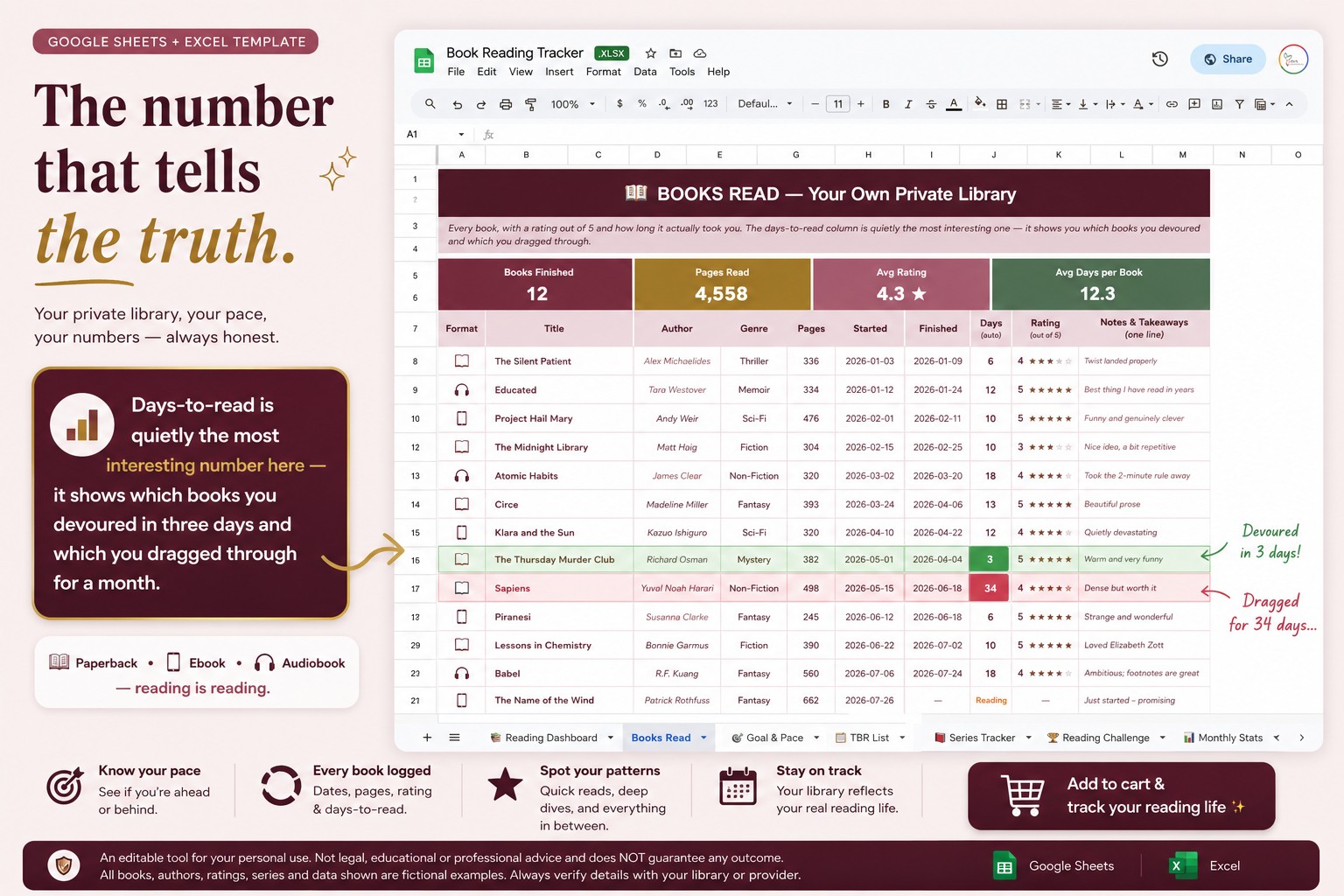
One more small feature that tells you a lot: logging when you started and finished each book, and letting the gap speak. A book you finished in three days was gripping you, whatever rating you gave it afterwards. A book that took six weeks probably wasn’t — even if you eventually decided it was “good.”
Over a year, that pattern is more honest about your taste than your star ratings, which tend to be influenced by what you think you should admire. Days-to-read doesn’t care about that. It quietly records what actually held your attention, which is useful information when you’re choosing what to read next.
And it’s a gentle prompt: a book you started six weeks ago and are 40 pages into is telling you something. Perhaps it’s time to give yourself permission.
An honest note
To be clear: this is a personal logging perspective, not advice of any kind. Example titles, ratings and figures in any template are illustrative, not endorsements or recommendations. Not affiliated with any author, publisher, bookseller, library service, or reading platform.
If you want the tracking done for you
I built a reading tracker in Google Sheets where DNF is a proper status rather than a gap, days-to-read calculates itself from your start and finish dates, and a pace sheet tells you plainly whether you’re ahead or behind by today’s date, with a progress bar and the books-per-month you’d need from here:
👉 Reading Tracker for Google Sheets & Excel
Whether you use mine or a notebook, give yourself two permissions this year: put down the book that isn’t working, and check your pace while you can still do something about it. Reading is one of the great pleasures — it shouldn’t come with homework guilt attached. A book abandoned is not a failure. Life is short and the to-read pile is long. 🤍
This reflects my own perspective and describes a personal logging tool — example titles and figures are illustrative, not recommendations. Not affiliated with any author, publisher, bookseller or reading platform. What’s the book you’re glad you finally put down? Tell me in the comments — permission is contagious.