The Lead You Forgot Is a Commission Someone Else Earned
Real estate rewards the organised agent and quietly punishes the scattered one. Here’s why real estate lead follow up fails — and why it’s a systems problem, not a character one.
There’s an uncomfortable arithmetic in real estate. Every lead that goes quiet and never gets chased is, quite possibly, a transaction that happened anyway — just with a different agent’s name on it. Not because that agent was better, more charming, or more knowledgeable, but because they followed up and you didn’t. This is the part of the business nobody puts on a business card: the agents who consistently do well are rarely the best natural salespeople. They’re the ones who never let anything fall through the cracks. Getting real estate lead follow up right is less about sales talent than about having a system that doesn’t rely on your memory. Here’s why that distinction matters.
Why leads go cold without anyone deciding
Leads rarely die from rejection. They die from silence — and the silence is usually mutual and accidental. A prospective buyer gets busy. Their timeline shifts. They meant to reply and forgot. You meant to check in and forgot, because you were mid-transaction on something urgent. Weeks pass, and a warm relationship quietly cools into nothing.
The structural reason this happens so reliably in real estate is that the business runs on two competing clocks. Live transactions are urgent and loud — they have deadlines, other parties, and consequences if you drop them. Lead nurturing is important but never urgent; nothing bad happens today if you don’t call someone. So the urgent work eats all the attention, and the important work quietly doesn’t happen.
That’s not a discipline failure. It’s what happens to any non-urgent task competing against urgent ones, in a job with an unpredictable workload. Which means the fix isn’t “try harder to remember” — it’s to make the non-urgent work visible so it stops losing by default.
Make time-since-contact the thing you watch
The simplest and most effective mechanism is to track when you last spoke to each lead, and let anything that’s gone quiet past a threshold surface itself.
This works because it converts an invisible problem into a visible list. Without it, “who haven’t I contacted in a while?” is a question you can’t answer — it would require holding dozens of relationships and dates in your head. With it, you open your list, sort by days since contact, and there they are: the people drifting away, in order of how long they’ve been drifting.
Suddenly follow-up stops being a vague intention you feel guilty about and becomes a concrete daily task: work the top of that list. That’s a task an ordinary busy person can actually do, most days, in twenty minutes. And a lead contacted at week two rather than week twelve is a completely different conversation — still warm, still remembering you, still in the same phase of their thinking.
Stages tell you where to spend your energy
Not every lead deserves equal attention, and pretending otherwise is its own kind of failure. Someone actively touring homes this month needs a different cadence from someone who might sell “sometime next year.”
Tagging each lead by stage — hot, active, warm, cold — lets you allocate deliberately instead of by whoever happened to email most recently. The hot ones get frequent, responsive contact. The warm ones get periodic, low-pressure check-ins so you stay in mind when their timeline arrives. The cold ones stay on the list without consuming your energy.
This matters because agent time is genuinely finite, and the most common failure isn’t laziness — it’s spreading attention evenly across leads of wildly different value and urgency, so the hot ones don’t get enough and the cold ones get more than they warrant.
Track where leads come from, then act on it
There’s a second, slower-burning insight available once you’re tracking leads properly: source. Every lead came from somewhere — a referral, a portal, an open house, social media, your sphere of influence. Record it, and after a few months you can see something most agents only guess at: which channels actually produce closings, not just enquiries.
Those are very different things. A source can generate a flood of leads that never transact, while another produces a trickle that closes reliably. Judged on volume, the first looks like the winner. Judged on closings, it may be a waste of your time and marketing budget.
Knowing this lets you concentrate your effort and spend where it actually returns — one of the highest-leverage decisions an agent makes, and one that’s impossible without a few months of recorded data. It’s worth starting the tracking now precisely because the answer only appears later.
Follow up like a professional, not a pest
One important balance: consistent follow-up is not pestering. The goal is respectful persistence — spaced, useful contact that adds something (a relevant listing, a market update, a genuine check-in) rather than repeated “just circling back” messages. And when someone asks you to stop, or clearly isn’t interested, respect that immediately and completely.
There’s also a compliance dimension worth taking seriously. As an agent you’re handling people’s personal information and operating in a heavily regulated field — follow your brokerage’s policies, the contact and marketing rules that apply where you work, and fair-housing requirements in every interaction. Good systems should make compliant, professional behaviour easier, never encourage shortcuts.
An important note
To be clear: this is about organising your own business — it is not legal, financial, tax, accounting, or brokerage advice, and it guarantees no result. Any figures are examples. Follow your brokerage agreement and local real estate regulations, comply with the licensing, disclosure, fair-housing, and contract requirements that apply in your area, and consult your broker or a qualified professional where appropriate.
If you want the flags built in
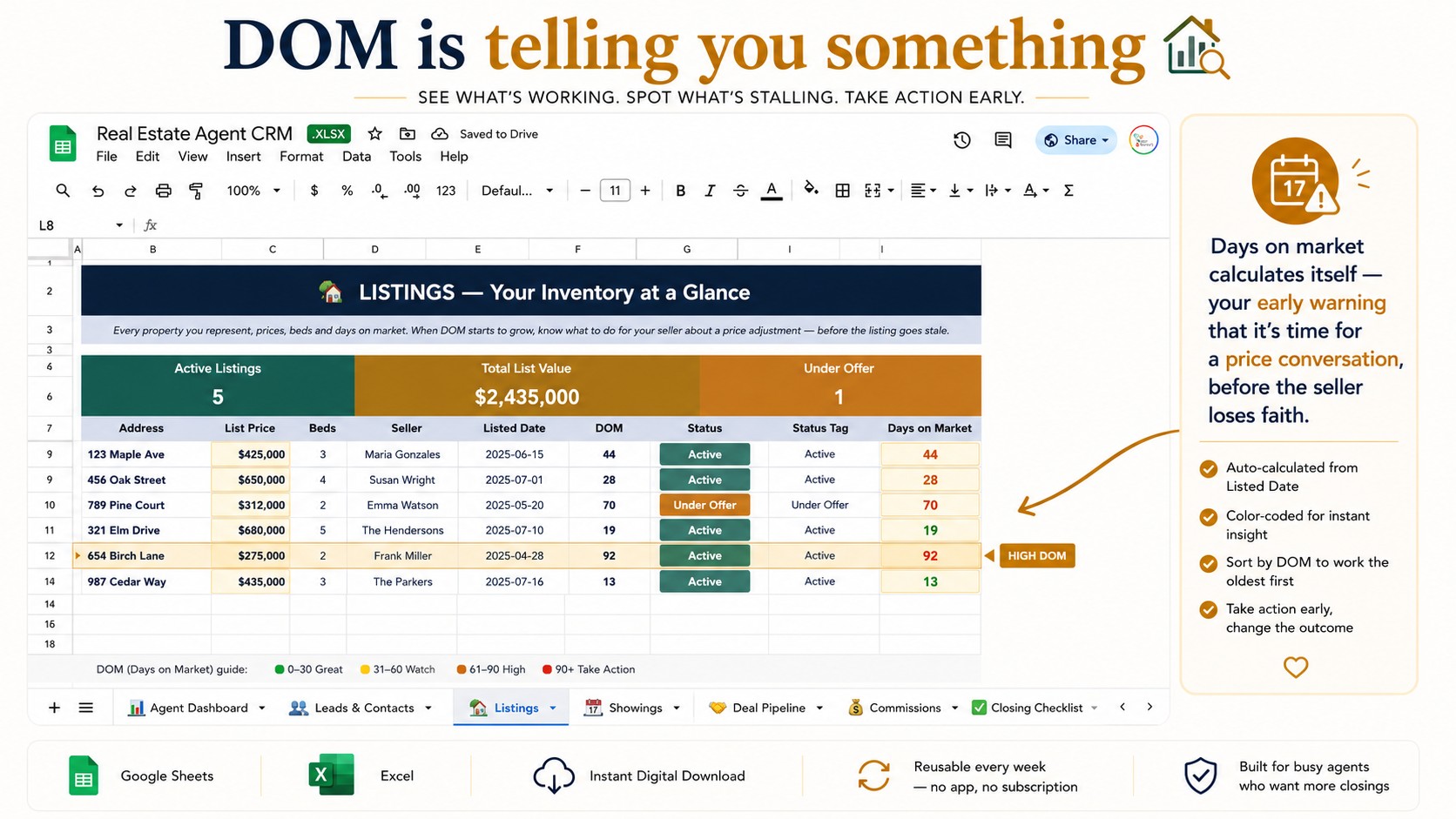
I built automatic follow-up alerts into my real estate agent CRM in Google Sheets — every lead carries a last-contact date, anything gone quiet past a week flags itself “Follow Up,” and a days-since-contact count lets you work the most neglected warm leads first, alongside lead stages and source tracking:
👉 Real Estate Agent CRM for Google Sheets & Excel
Whether you use mine or build your own, stop relying on memory to run the most valuable part of your business. Make time-since-contact visible, work the top of the list, and let the system carry what your busy weeks can’t. You don’t have to be the best salesperson in your market — you just have to be the one who didn’t forget. 🏡
This reflects my own perspective and is an organising tool — not legal, financial or brokerage advice, and it guarantees no result; follow your brokerage agreement, local regulations and fair-housing requirements. Agents: what’s your follow-up cadence for a warm lead? Tell me in the comments.